Results by title
60 books match the query 'Physical' and 8 start with p
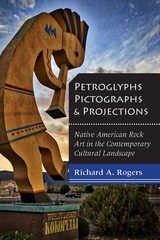
Petroglyphs, Pictographs, and Projections
Native American Rock Art in the Contemporary Cultural LandscapeRichard A. Rogers
University of Utah Press, 2018
Recent decades have seen an upsurge in visitation to rock art sites as well as an increase in commercial reproduction of rock art and attempts to understand the meaning and function of that art within the indigenous cultures that produced it. What motivates this growing interest and what do these interpretations and appropriations of Native American petroglyphs and pictographs reveal about contemporary cultural dynamics? Focusing on the southwestern U.S., this book critically examines the contemporary implications of the interpretation, appropriation, commodification, and management of indigenous rock art.
Neither archaeological interpretations nor commercial reproductions of rock art operate in a cultural vacuum. Both the motivation to seek out rock art and the specific meanings attached to it are deeply embedded in narratives about Native Americans already created by anthropologists, archaeologists, photographers, novelists, film and television producers, the tourism industry, and New Age discourse. For those interested in rock art as a window into indigenous cultures of the past, our contemporary projections of meanings are of great concern. Applying the tools of critical/cultural studies to both academic and popular discourse, Rogers explores the implications of such projections for rock art studies, contemporary gender dynamics, and the neocolonial relationship between Euro-Americans and Native Americans.
Neither archaeological interpretations nor commercial reproductions of rock art operate in a cultural vacuum. Both the motivation to seek out rock art and the specific meanings attached to it are deeply embedded in narratives about Native Americans already created by anthropologists, archaeologists, photographers, novelists, film and television producers, the tourism industry, and New Age discourse. For those interested in rock art as a window into indigenous cultures of the past, our contemporary projections of meanings are of great concern. Applying the tools of critical/cultural studies to both academic and popular discourse, Rogers explores the implications of such projections for rock art studies, contemporary gender dynamics, and the neocolonial relationship between Euro-Americans and Native Americans.
[more]

Physical and Biophysical Foundations of Pharmacy Practice
Issues in Drug DeliveryGordon L. Flynn, Michael S. Roberts
Michigan Publishing Services, 2015
Focused on the physical and biological barriers and opportunities for drug delivery, this book, published in cooperation with the University of Michigan College of Pharmacy, is a peer-reviewed introductory physical pharmacy and biopharmaceutics text that comprehensively addresses the major issues in the field of Pharmacy Practice. It is a must for students wishing to understand the background and mechanics of dosage form technology.
[more]
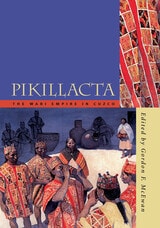
Pikillacta
The Wari Empire in CuzcoMcEwan, Gordon F.
University of Iowa Press, 2005
The origin of the first Andean imperial state has been the subject of lively debate for decades. Archaeological sites dating to the Peruvian Middle Horizon time period, A.D. 540 to 900, appear to give evidence for the emergence of an expansive empire that set the stage for the development of the later Inca state. This archaeological investigation of Pikillacta, the largest provincial site of Peru’s pre-Inca Wari empire, provides essential background for interpreting the empire’s political and cultural organization.
With engineering skills rivaling those of the builders of Cuzco itself, the Wari at Pikillacta erected more than seven hundred buildings covering nearly two square kilometers, with a fresh water supply and an elaborate underground sewage system but, enigmatically, only seven short streets and a near total lack of windows. In this long-awaited volume, Gordon McEwan and his colleagues report on the labor costs of construction (nearly 6 million man-days), the typology of Pikillacta's enigmatic architecture, and the site’s spectacular hydraulic system as well as its ceramics and chronology, human remains, and metal artifacts.
In the final section, building on his years of research and excavation, McEwan develops a hypothetical model of Wari provincial administration in the Cuzco region, arguing that the Wari were innovators of techniques of statecraft that explain the function of and the labor investment in the Pikillacta complex. His book not only substantively contributes to our understanding of when and exactly how and why Pikillacta was built and what it was used for, it also illuminates the political and cultural antecedents of the Inca state.
[more]
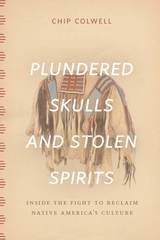
Plundered Skulls and Stolen Spirits
Inside the Fight to Reclaim Native America's CultureChip Colwell
University of Chicago Press, 2017
Who owns the past and the objects that physically connect us to history? And who has the right to decide this ownership, particularly when the objects are sacred or, in the case of skeletal remains, human? Is it the museums that care for the objects or the communities whose ancestors made them? These questions are at the heart of Plundered Skulls and Stolen Spirits, an unflinching insider account by a leading curator who has spent years learning how to balance these controversial considerations.
Five decades ago, Native American leaders launched a crusade to force museums to return their sacred objects and allow them to rebury their kin. Today, hundreds of tribes use the Native American Graves Protection and Repatriation Act to help them recover their looted heritage from museums across the country. As senior curator of anthropology at the Denver Museum of Nature & Science, Chip Colwell has navigated firsthand the questions of how to weigh the religious freedom of Native Americans against the academic freedom of scientists and whether the emptying of museum shelves elevates human rights or destroys a common heritage. This book offers his personal account of the process of repatriation, following the trail of four objects as they were created, collected, and ultimately returned to their sources: a sculpture that is a living god, the scalp of a massacre victim, a ceremonial blanket, and a skeleton from a tribe considered by some to be extinct. These specific stories reveal a dramatic process that involves not merely obeying the law, but negotiating the blurry lines between identity and morality, spirituality and politics.
Things, like people, have biographies. Repatriation, Colwell argues, is a difficult but vitally important way for museums and tribes to acknowledge that fact—and heal the wounds of the past while creating a respectful approach to caring for these rich artifacts of history.
[more]
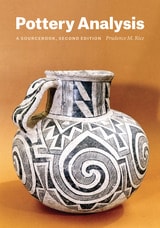
Pottery Analysis, Second Edition
A SourcebookPrudence M. Rice
University of Chicago Press, 2015
Just as a single pot starts with a lump of clay, the study of a piece’s history must start with an understanding of its raw materials. This principle is the foundation of Pottery Analysis, the acclaimed sourcebook that has become the indispensable guide for archaeologists and anthropologists worldwide. By grounding current research in the larger history of pottery and drawing together diverse approaches to the study of pottery, it offers a rich, comprehensive view of ceramic inquiry.
This new edition fully incorporates more than two decades of growth and diversification in the fields of archaeological and ethnographic study of pottery. It begins with a summary of the origins and history of pottery in different parts of the world, then examines the raw materials of pottery and their physical and chemical properties. It addresses ethnographic and ethnoarchaeological perspectives on pottery production; reviews the methods of studying pottery’s physical, mechanical, thermal, mineralogical, and chemical properties; and discusses how proper analysis of artifacts can reveal insights into their culture of origin. Intended for use in the classroom, the lab, and out in the field, this essential text offers an unparalleled basis for pottery research.
This new edition fully incorporates more than two decades of growth and diversification in the fields of archaeological and ethnographic study of pottery. It begins with a summary of the origins and history of pottery in different parts of the world, then examines the raw materials of pottery and their physical and chemical properties. It addresses ethnographic and ethnoarchaeological perspectives on pottery production; reviews the methods of studying pottery’s physical, mechanical, thermal, mineralogical, and chemical properties; and discusses how proper analysis of artifacts can reveal insights into their culture of origin. Intended for use in the classroom, the lab, and out in the field, this essential text offers an unparalleled basis for pottery research.
[more]

Primate Encounters
Models of Science, Gender, and SocietyEdited by Shirley C. Strum and Linda Marie Fedigan
University of Chicago Press, 2000
A provocative collective reflection on primatology and its relations to broader cultural, historical, and social issues, Primate Encounters brings together both scientists and those who study them to investigate precisely what kind of science primatology is.
"[A] fascinating study . . . on how and why ideas about primate society have changed. The volume consists of dialogues among scientists from different disciplines, national traditions, scientific culture, generations, standpoints, and genders. . . . A wonderful reflection on the discipline of primatology and on science in general."—Science Books and Films
"Primate Encounters should be required reading for anyone about to embark on a career in the field. But it equally valuable for its miscellany of opinions, recollections and off-the-cuff remarks, as well as for its thoughtful observations, 'outrageous ravings' and humour (from the elders in the field). It gives us a glimpse of how scientists work together to understand their place in the world."—Deborah L. Mazolillo, Times Literary Supplement
[more]
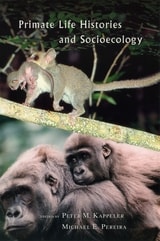
Primate Life Histories and Socioecology
Edited by Peter M. Kappeler and Michael E. Pereira
University of Chicago Press, 2003
We know a great deal about roles the environment plays in shaping survival, reproductive success, and even social systems among primates. But how do primate life histories affect social systems and vice versa? Do baboons' patterns of growth, for example, help to structure their societies? Does fission-fusion sociality interact with predator pressure to influence the timing of maturation in chimpanzees?
Exploring these issues and many others, the contributors to Primate Life Histories and Socioecology provide the first systematic attempt to understand relationships among primate life histories, ecology, and social behavior conjointly. Topics covered include how primate life histories interact with rates of evolution, predator pressure, and diverse social structures; how the slow maturation of primates affects the behavior of both young and adult caregivers; and reciprocal relationships between large brains and increased social and behavioral complexity. The first collection of its kind, this book will interest a wide range of researchers, from anthropologists and evolutionary biologists to psychologists and ecologists.
Contributors:
Paul-Michael Agapow, Susan C. Alberts, Jeanne Altmann, Robert A. Barton, Nicholas G. Blurton Jones, Robert O. Deaner, Robin I. M. Dunbar, Jörg U. Ganzhorn, Laurie R. Godfrey, Kristen Hawkes, Nick J. B. Isaac, Charles H. Janson, Kate E. Jones, William L. Jungers, Peter M. Kappeler, Susanne Klaus, Phyllis C. Lee, Steven R. Leigh, Robert D. Martin, James F. O'Connell, Sylvia Ortmann, Michael E. Pereira, Andy Purvis, Caroline Ross, Karen E. Samonds, Jutta Schmid, Stephen C. Stearns, Michael R. Sutherland, Carel P. van Schaik, and Andrea J. Webster.
[more]
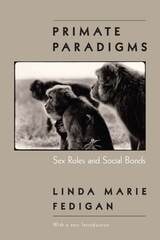
Primate Paradigms
Sex Roles and Social BondsLinda Marie Fedigan
University of Chicago Press, 1992
This critical review of behavior patterns in nonhuman primates is an excellent study of the importance of female roles in different social groups and their significance in the evolution of human social life.
"A book that properly illuminates in rich detail not only developmental and socioecological aspects of primate behavior but also how and why certain questions are asked. In addition, the book frequently focuses on insufficiently answered questions, especially those concerned with the evolution of primate sex differences. Fedigan's book is unique . . . because it places primate adaptations and our explanation of those patterns in a larger intellectual framework that is easily and appropriately connected to many lines of research in different fields (sociology, psychology, anthropology, neurobiology, endocrinology, and biology)—and not in inconsequential ways, either."—James McKenna, American Journal of Primatology
"This is the feminist critique of theories of primate and human evolution."—John H. Cook, Nature
[more]