Results by title
56 books match the query 'Pictorials' and 6 start with p
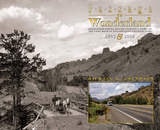
Passage to Wonderland
Rephotographing Joseph Stimson's Views of the Cody Road to Yellowstone National Park, 1903 and 2008Michael A. Amundson
University Press of Colorado, 2012
Amundson examines the physical changes along "the most scenic fifty miles in America" and explores the cultural and natural history behind them. This careful analysis of the paired images make Passage to Wonderland more than a "then and now" photography book--it is a unique exploration of the interconnectedness between the Old West and the New West. It will be a wonderful companion for those touring the Cody Road as well as those armchair tourists who can follow the road on Google Earth using the provided GPS coordinates.
The University Press of Colorado gratefully acknowledges the generous support of the Charles Redd Center for Western Studies at Brigham Young University toward the publication of this book.

Perimeter
A Contemporary Portrait of Lake MichiganKevin J. Miyazaki
Wisconsin Historical Society Press, 2014
Miyazaki also photographed the water as he went, creating waterscapes of the ever-changing lake affected by weather and time. Perimeter gathers these images together, creating a diverse portrait of both people and a place, encapsulating Lake Michigan’s significance to those who are drawn to it.
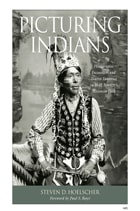
Picturing Indians
Photographic Encounters and Tourist Fantasies in H. H. Bennett's Wisconsin DellsSteven D. Hoelscher
University of Wisconsin Press, 2008
Winner, Book Award of Merit, Wisconsin Historical Society, Best Books for General Audiences, selected by the American Association of School Librarians, and Best Books for Regional Interests, selected by the Public Library Association

Picturing Utopia
Bertha Shambaugh and the Amana PhotographersAbigail Foerstner
University of Iowa Press, 2005
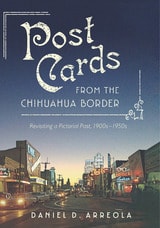
Postcards from the Chihuahua Border
Revisiting a Pictorial Past, 1900s–1950sDaniel D. Arreola
University of Arizona Press, 2019
In Postcards from the Chihuahua Border Daniel D. Arreola captures the exhilaration of places in time, taking us back to Mexico’s northern border towns of Cuidad Juárez, Ojinaga, and Palomas in the early twentieth century. Drawing on more than three decades of archival work, Arreola uses postcards and maps to unveil the history of these towns along west Texas’s and New Mexico’s southern borders.
Postcards offer a special kind of visual evidence. Arreola’s collection of imagery and commentary about them shows us singular places, enriching our understandings of history and the history of change in Chihuahua. No one postcard tells the entire story. But image after image offers a collected view and insight into changing perceptions. Arreola’s geography of place looks both inward and outward. We see what tourists see, while at the same time gaining insight about what postcard photographers and postcard publishers wanted to be seen and perceived about these border communities.
Postcards from the Chihuahua Border is a colorful and dynamic visual history. It invites the reader to time travel, to revisit another era—the first half of the last century—when these border towns were framed and made popular through picture postcards.
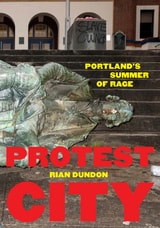
Protest City
Portland's Summer of RageRian Dundon
Oregon State University Press, 2023
In the months leading up to the 2020 presidential election, Portland made national news with nightly social justice protests, often met with violent response by counter protestors and law enforcement. Though frequently regarded as a progressive hub, Portland has a long history of racial inequality and oppression, and the city’s entrenched divisions gained new attention during the Trump years. The photos in Protest City present a visceral visual record of this significant moment in Portland’s history.
Rian Dundon, who has been photographing the rise of extreme politics on the West Coast since 2016, lived only a short walk from the protests that erupted after the murder of George Floyd. For one hundred days, Dundon enmeshed himself in the demonstrations with an unobtrusive point-and-shoot camera. The result is a graphic portrayal of how social movements become politicized, how spectacle serves as a subtext to change in the digital age, and how modern protests blur distinctions among performance, ritual, and surveillance. As he follows the progress of Portland’s conflicts, Dundon draws connections to Oregon’s legacy as a stronghold of white supremacist extremism and interrogates the role of whiteness in racial justice movements.
Most of the photographs in the book were taken between May and October 2020, but the collection also includes photos from protests in late 2020 and 2021 around various related issues, including the Red House eviction blockade, rightwing demonstrations on January 6 and 17, and the one-year anniversary of George Floyd’s murder. Dundon’s striking photos recreate the immediacy and impact of the protests, while essays by historian Carmen Thompson and journalist Donnell Alexander contextualize the uprising’s sociopolitical background. A chronology and author’s note are also featured.
The publisher and author would like to thank the Magnum Foundation, Documentary Arts, and the Economic Hardship Reporting Project for their generous support of this publication. Additional funding has been provided by Furthermore: a program of the J. M. Kaplan Fund.