93 books match the query 'Political violence' and 5 start with p

cover of Paramilitarism and Neoliberalism: Violent Systems of Capital Accumulation in Colombia and Beyond

Paramilitarism and Neoliberalism

Violent Systems of Capital Accumulation in Colombia and Beyond

Jasmin Hristov

Pluto Press, 2016

The people of Colombia have, for the last fifty years, been subject to a specific form of violence: paramilitarism. An embodiment of the underbelly of global capitalist accumulation, this form of pervasive violence expresses the exacerbation of social inequalities and class formation under capitalism. In Paramilitarism and Neoliberalism, Jasmin Hristov theorises this extreme expression in light of forced displacement, labour repression, subjugation of social movements, decentralisation of violence, drug trafficking and the emergence of a variety of para-institutional armed actors across Latin America.

The activities of paramilitary groups in the post­demobilisation era, their involvement in human rights violations, and their multi­level support networks inside major state institutions are documented, with a particular emphasis on violent dispossession and illegal land appropriation that has benefited agroindustries and mining enterprises. Hristov engages in a Marxist political economy approach, combined with a global sociological perspective, allowing for an expansive and deep-reaching understanding of paramilitarism as a phenomenon with many faces, ultimately illustrating how it is increasingly becoming the coercive counterpart of global capital.
[more]
cover of Political Life in the Wake of the Plantation: Sovereignty, Witnessing, Repair

Political Life in the Wake of the Plantation

Sovereignty, Witnessing, Repair

Deborah A. Thomas

Duke University Press, 2019
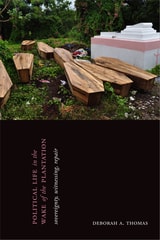
In 2010, Jamaican police and military forces entered the West Kingston community of Tivoli Gardens to apprehend Christopher “Dudus” Coke, who had been ordered for extradition to the United States on gun and drug-running charges. By the time Coke was detained, somewhere between seventy-five and two hundred civilians had been killed. In Political Life in the Wake of the Plantation, Deborah A. Thomas uses the incursion as a point of departure for theorizing the roots of contemporary state violence in Jamaica and in post-plantation societies in general. Drawing on visual, oral historical, and colonial archives, Thomas traces the long-term legacies of the plantation system and how its governing logics continue to shape and replicate forms of violence. She places affect at the center of sovereignty to destabilize disembodied narratives of liberalism and progress and to raise questions about recognition, repair, and accountability. In tying theories of politics, colonialism, race, and affect together with Jamaica's history, Thomas presents a robust framework for understanding what it means to be human in the plantation's wake.
[more]
cover of Politics after Violence: Legacies of the Shining Path Conflict in Peru

Politics after Violence

Legacies of the Shining Path Conflict in Peru

Edited by Hillel David Soifer and Alberto Vergara

University of Texas Press, 2019

Between 1980 and 1994, Peru endured a bloody internal armed conflict, with some 69,000 people killed in clashes involving two insurgent movements, state forces, and local armed groups. In 2003, a government-sponsored “Truth and Reconciliation Committee” reported that the conflict lasted longer, affected broader swaths of the national territory, and inflicted higher costs in both human and economic terms than any other conflict in Peru’s history. Of those killed, 75 percent were speakers of an indigenous language, and almost 40 percent were among the poorest and most rural members of Peruvian society. These unequal impacts of the violence on the Peruvian people revealed deep and historical disparities within the country.

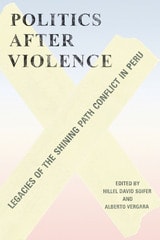
This collection of original essays by leading international experts on Peruvian politics, society, and institutions explores the political and institutional consequences of Peru’s internal armed conflict in the long 1980s. The essays are grouped into sections that cover the conflict itself in historical, comparative, and theoretical perspectives; its consequences for Peru’s political institutions; its effects on political parties across the ideological spectrum; and its impact on public opinion and civil society. This research provides the first systematic and nuanced investigation of the extent to which recent and contemporary Peruvian politics, civil society, and institutions have been shaped by the country’s 1980s violence.
[more]
cover of Promises Beyond Memory: Archives, Art, and the Afterlives of Violence in Latin America

Promises Beyond Memory

Archives, Art, and the Afterlives of Violence in Latin America

Vikki Bell

Duke University Press, 2026

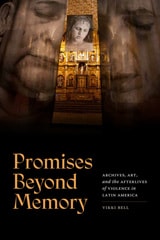
In Promises Beyond Memory, Vikki Bell shows how archives of contemporary political violence in Argentina, Chile, and Colombia challenge the idea that simply sheltering the documentation of violence is sufficient to fulfill the obligations of attending to the past. Beyond mere preservation, these archives, museums, and sites of memory invite exploratory modes of enlivening the past through aesthetic practices like photography, installation, film, and performance. These practices foster the “survivance” of memory where populations still grapple with legacies of violence and often state-sponsored mass disappearance and torture. Rather than produce a definitive account of the past, such survivance facilitates polyvocal articulations that open deeply political and ethical questions around contested histories. They may even create moments for what Bell terms “tender forgetting”—the ability to remember without reawakening trauma. Integrating theory, extensive archival work, and interviews with artists, archivists, museum workers, and survivors of state violence, Bell analyses the creative ways that archives pass on stories of violence as they seek to defend against attempts to rewrite the past.
[more]
cover of Punk and Revolution: Seven More Interpretations of Peruvian Reality

Punk and Revolution

Seven More Interpretations of Peruvian Reality

Shane Greene

Duke University Press, 2016

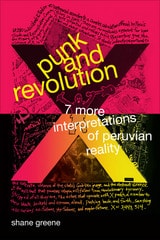
In Punk and Revolution Shane Greene radically uproots punk from its iconic place in First World urban culture, Anglo popular music, and the Euro-American avant-garde, situating it instead as a crucial element in Peru's culture of subversive militancy and political violence. Inspired by José Carlos Mariátegui's Seven Interpretive Essays on Peruvian Reality, Greene explores punk's political aspirations and subcultural possibilities while complicating the dominant narratives of the war between the Shining Path and the Peruvian state. In these seven essays, Greene experiments with style and content, bends the ethnographic genre, and juxtaposes the textual and visual. He theorizes punk in Lima as a mode of aesthetic and material underproduction, rants at canonical cultural studies for its failure to acknowledge punk's potential for generating revolutionary politics, and uncovers the intersections of gender, ethnicity, class, and authenticity in the Lima punk scene. Following the theoretical interventions of Debord, Benjamin, and Bakhtin, Greene fundamentally redefines how we might think about the creative contours of punk subculture and the politics of anarchist praxis.
[more]