57 books match the query 'Portugal' and 3 start with p
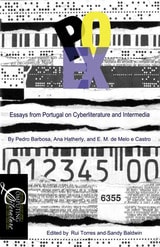
cover of PO.EX: Essays from Portugal on Cyberliterature and Intermedia

PO.EX

Essays from Portugal on Cyberliterature and Intermedia

Rui Torres

West Virginia University Press, 2013

Po.Ex: Essays from Portugal on Cyberliterature and Intermedia is a crucial addition to the bookshelf for scholars and students of new media, digital literature, and experimental writing. Available for the first time outside of Portuguese, these essays are crucial primary texts of experimental literature. Po.Ex shows a long history of procedural composition and expressive intermedial writing, leading directly to the latest computer and network-based artworks. Collecting essays by Pedro Barbosa, Ana Hatherly, and E. M. de Melo e Castro, along with framing essays by the editors and extensive bibliographical materials,this book situates today’s digital and online texts in a rich tradition of European literature. New forms of writing appear in the encounter of literature and digital media, just as old forms are renewed. Po.Ex is an archive of the past, present, and future of cyberliterature and intermedia writing.     
[more]
cover of Portugal and Africa: Ris Af#81

Portugal and Africa

Ris Af#81

David Birmingham

Ohio University Press, 2004

Portugal was the first European nation to assert itself aggressively in African affairs. David Birmingham’s Portugal and Africa, a collection of uniquely accessible historical essays, surveys this colonial encounter from its earliest roots. The Portuguese established sugar plantations on Africa’s offshore islands and built factories on the beaches in the fifteenth century, but Professor Birmingham explains that their focus shifted to regions where medieval African miners had discovered deep seams of gold ore. Later, when even richer mines and more fertile lands were captured from the native peoples of the Americas, Portuguese ships became the great “slave bridge” that spanned the Atlantic and ferried captive black workers to the colonies of the New World. Portugal lost its major mining claims in Africa to the British, but it left a legacy of a new pattern of white settler colonization based on American-style plantations. The blending of European and African cultures and races led to the emergence of elite communities, from the Kongo princes of the seventeenth century to the creolized generals of today. Portugal and Africa focuses extensively on Angola to cast new light on the final years of the colonial experience and its traumatic legacies. After 1950, Portuguese Angola became one of the most dynamic of Africa’s colonies and the largest white colony outside of Algeria or South Africa. Angola’s eventual collapse in a series of wars had devastating results. Birmingham brings the terror and devastation to life in a series of powerful chapters that are a model of disciplined scholarship and informed passion.
[more]
cover of Portugal and Brazil in Transition

Portugal and Brazil in Transition

Raymond S. Sayers, Editor

University of Minnesota Press, 1968

Portugal and Brazil in Transition was first published in 1968. Minnesota Archive Editions uses digital technology to make long-unavailable books once again accessible, and are published unaltered from the original University of Minnesota Press editions.

Through a series of essays on various aspects of Portuguese and Brazilian culture, this book presents an enlightening picture of contemporary civilization in the two countries and a forecast of what the next twenty years or so may bring. The authors discuss subjects in such basic fields as literature, linguistics, history, the social sciences, geography, the fine arts, music, and natural science. Taken as a whole, the contents demonstrate the logic of organizing a volume not around a geographical concept but, rather, around a historical concept, in this case "the world the Portuguese created," as Gilberto Freyre described it.

The essays are based on papers that were given at the Sixth International Colloquium of Luso-Brazilian Studies, held in the United States in 1966. In addition to the essays, the book contains the text of comments and discussion about the papers. There are twenty-seven major essays by as many contributors and comments by a number of discussants.

[more]