Results by title
56 books match the query 'Press' and 4 start with p
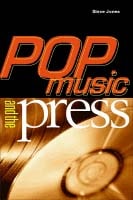
Pop Music And The Press
Steve Jones
Temple University Press, 2002
Since the 1950s, writing about popular music has become a staple of popular culture. Rolling Stone, Vibe, and The Source as well as music columns in major newspapers target consumers who take their music seriously. Rapidly proliferating fanzines, websites, and internet discussion groups enable virtually anyone to engage in popular music criticism. Until now, however, no one has tackled popular music criticism as a genre of journalism with a particular history and evolution.Pop Music and the Press looks at the major publications and journalists who have shaped this criticism, influencing the public's ideas about the music's significance and quality. The contributors to the volume include academics and journalists; several wear both hats, and some are musicians as well. Their essays illuminate the complex relationships of the music industry, print media, critical practice, and rock culture. (And they repeatedly dispel the notion that being a journalist is the next best thing to being a rock star.)
[more]
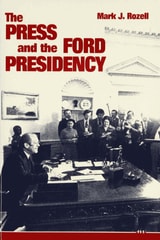
Press and the Ford Presidency
Mark J. Rozell
University of Michigan Press, 1992
Journalists offer a daily dose of commentary sizing up the president's successes and failures, profoundly influencing the public's perceptions of presidential performance. This study shows how leading journalists developed their perceptions of Gerald Ford, the criteria they employed in evaluating his presidency, and the nature and impact of their assessments of his leadership. In The Press and the Ford Presidency, political scientist Mark J. Rozell uses a qualitative content analysis to investigate the national press coverage of the Ford administration. He explores the complicated relationship between what presidents say and do and how their words and deeds are portrayed in the elite press, demonstrating not only how press valuations vary over time, but also how certain impressions of a president take hold and resist change, even in light of conflicting evidence. Rozell shows that a president and presidential image-crafters cannot script their own press coverage and expect journalists dutifully to follow the White House plan. Journalists have identifiable expectations of presidential leadership and performance. Indeed, Gerald Ford consistently fell short of these expectations, leading the media and, consequently, the public to resort to humiliating caricature when describing the president and his programs.The Press and the Ford Presidency will be of special value to schools of the presidency mass media and politics, political communications, and political leadership. In addition, since the author's research included interviews with numerous numbers of Ford's White House staff, the book will appeal to scholars interested in oral history and to historians of the Watergate era and the Ford years.
[more]
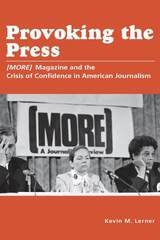
Provoking the Press
(MORE) Magazine and the Crisis of Confidence in American JournalismKevin M. Lerner
University of Missouri Press, 2023
At the beginning of the 1970s, broadcast news and a few newspapers such as The New York Times wielded national influence in shaping public discourse, to a degree never before enjoyed by the news media. At the same time, however, attacks from political conservatives such as Vice President Spiro Agnew began to erode public trust in news institutions, even as a new breed of college-educated reporters were hitting their stride. This new wave of journalists, doing their best to cover the roiling culture wars of the day, grew increasingly frustrated by the limitations of traditional notions of objectivity in news writing and began to push back against convention, turning their eyes on the press itself.
Two of these new journalists, a Pulitzer Prize—winning, Harvard-educated New York Times reporter named J. Anthony Lukas, and a former Newsweek media writer named Richard Pollak, founded a journalism review called (MORE) in 1971, with its pilot issue appearing the same month that the Times began publishing the Pentagon Papers. (MORE) covered the press with a critical attitude that blended seriousness and satire—part New York Review of Books, part underground press. In the eight years that it published, (MORE) brought together nearly every important American journalist of the 1970s, either as a writer, a subject of its critical eye, or as a participant in its series of raucous "A.J. Liebling Counter-Conventions"—meetings named after the outspoken press critic—the first of which convened in 1974. In issue after issue the magazine considered and questioned the mainstream press's coverage of explosive stories of the decade, including the Watergate scandal; the "seven dirty words" obscenity trial; the debate over a reporter's constitutional privilege; the rise of public broadcasting; the struggle for women and minorities to find a voice in mainstream newsrooms; and the U.S. debut of press baron Rupert Murdoch.
In telling the story of (MORE) and its legacy, Kevin Lerner explores the power of criticism to reform and guide the institutions of the press and, in turn, influence public discourse.
[more]
Public Relations and the Press
The Troubled EmbraceKarla Gower
Northwestern University Press, 2007
We are living in what one author describes as “highly promotional times.” Governments and corporations, nonprofits and special interest groups, all have spin doctors trying to turn the news to their advantage. This increasingly incestuous connection between the practitioners of public relations and journalism has resulted in a troubling shift in power. Public Relations and the Press examines how this shift came to be and explores the questions it raises about the role of media in a democratic society and the future of journalism.
A democracy works when individuals have access to reliable information upon which to base decisions—information that in our day comes from the mass media. But what if journalists do not have the wherewithal to question their sources and evaluate the information they provide? This, Karla K. Gower explains, is precisely what happens when economic and competitive pressures shift power from the journalist to the source—and the source, not the journalist, controls the flow of information to the public. Gowers describes a situation in which people, “informed” by practitioners of public relations, do not have sufficient information to make valid decisions. At stake is the core credibility of the press itself, and therefore the essential claim of journalism to a privileged role in a democratic social order.
A democracy works when individuals have access to reliable information upon which to base decisions—information that in our day comes from the mass media. But what if journalists do not have the wherewithal to question their sources and evaluate the information they provide? This, Karla K. Gower explains, is precisely what happens when economic and competitive pressures shift power from the journalist to the source—and the source, not the journalist, controls the flow of information to the public. Gowers describes a situation in which people, “informed” by practitioners of public relations, do not have sufficient information to make valid decisions. At stake is the core credibility of the press itself, and therefore the essential claim of journalism to a privileged role in a democratic social order.
[more]