50 books match the query 'Press and politics' and 7 start with p
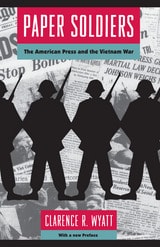
cover of Paper Soldiers: The American Press and the Vietnam War

Paper Soldiers

The American Press and the Vietnam War

Clarence R. Wyatt

University of Chicago Press, 1994

Praised and condemned for its aggressive coverage of the Vietnam War, the American press has been both commended for breaking public support and bringing the war to an end and accused of misrepresenting the nature and progress of the war. While in-depth combat coverage and the instantaneous power of television were used to challenge the war, Clarence R. Wyatt demonstrates that, more often than not, the press reported official information, statements, and views. Examining the relationship between the press and the government, Wyatt looks at how difficult it was to obtain information outside official briefings, what sort of professional constraints the press worked under, and what happened when reporters chose not to "get on the team."

"Wyatt makes the Diem period in Saigon come to life—the primitive communications, the police crackdowns, the quarrels within the news organizations between the pessimists in Saigon and the optimists in Washington and New York."—Peter Braestrup, Washington Times

"An important, readable study of the Vietnam press corps—the most maligned group of journalists in modern American history. Clarence Wyatt's insights and assessments are particularly valuable now that the media is rapidly growing in its influence on domestic and international affairs."—Peter Arnett, CNN foreign correspondent
[more]
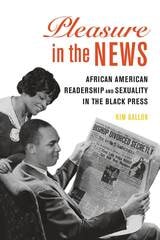
cover of Pleasure in the News: African American Readership and Sexuality in the Black Press

Pleasure in the News

African American Readership and Sexuality in the Black Press

Kim T. Gallon

University of Illinois Press, 2020

Critics often chastised the twentieth-century black press for focusing on sex and scandal rather than African American achievements. In Pleasure in the News, Kim Gallon takes an opposing stance—arguing that African American newspapers fostered black sexual expression, agency, and identity.

Gallon discusses how journalists and editors created black sexual publics that offered everyday African Americans opportunities to discuss sexual topics that exposed class and gender tensions. While black churches and black schools often encouraged sexual restraint, the black press printed stories that complicated notions about respectability. Sensational coverage also expanded African American women’s sexual consciousness and demonstrated the tenuous position of female impersonators, black gay men, and black lesbians in early twentieth African American urban communities.

Informative and empowering, Pleasure in the News redefines the significance of the black press in African American history and advancement while shedding light on the important cultural and social role that sexuality played in the power of the black press.
[more]
cover of Political Literacy in Composition and Rhetoric: Defending Academic Discourse against Postmodern Pluralism

Political Literacy in Composition and Rhetoric

Defending Academic Discourse against Postmodern Pluralism

Donald Lazere

Southern Illinois University Press, 2015
In Political Literacy in Composition and Rhetoric, Donald Lazere calls for revival of NCTE resolutions in the 1970s for teaching the “critical reading, listening, viewing, and thinking skills necessary to enable students to cope with the persuasive techniques in political statements, advertising, entertainment, and news,” and explores the reasons these goals have been eclipsed in composition studies over recent decades.  Obstacles to those goals have included the emphasis in the profession on basic and first year writing at the expense of more advanced study in argumentative rhetoric, and on the privileging of students’ personal writing over critical study of both academic and political discourse.  Lazere further argues that theorists who legitimately champion students’ pluralistic local communities sometimes fail to recognize that liberal education can enable students to grow beyond their home cultures to critical awareness of national and international politics. Finally, he argues that the fixation in recent composition studies on liberally-inclined students and communities “on the margins” has eclipsed attention to the conservative conformity long prevalent in mainstream American society and education. His proposals for curriculum and pedagogy seek to introduce students to a more highly-informed, cogent, and open-ended level of debate between the political left and right.
[more]
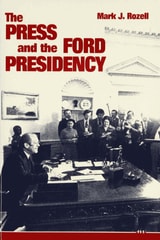
cover of Press and the Ford Presidency

Press and the Ford Presidency

Mark J. Rozell

University of Michigan Press, 1992
Journalists offer a daily dose of commentary sizing up the president's successes and failures, profoundly influencing the public's perceptions of presidential performance. This study shows how leading journalists developed their perceptions of Gerald Ford, the criteria they employed in evaluating his presidency, and the nature and impact of their assessments of his leadership. In The Press and the Ford Presidency, political scientist Mark J. Rozell uses a qualitative content analysis to investigate the national press coverage of the Ford administration. He explores the complicated relationship between what presidents say and do and how their words and deeds are portrayed in the elite press, demonstrating not only how press valuations vary over time, but also how certain impressions of a president take hold and resist change, even in light of conflicting evidence. Rozell shows that a president and presidential image-crafters cannot script their own press coverage and expect journalists dutifully to follow the White House plan. Journalists have identifiable expectations of presidential leadership and performance. Indeed, Gerald Ford consistently fell short of these expectations, leading the media and, consequently, the public to resort to humiliating caricature when describing the president and his programs.The Press and the Ford Presidency will be of special value to schools of the presidency mass media and politics, political communications, and political leadership. In addition, since the author's research included interviews with numerous numbers of Ford's White House staff, the book will appeal to scholars interested in oral history and to historians of the Watergate era and the Ford years.
[more]
cover of Projections of Power: Framing News, Public Opinion, and U.S. Foreign Policy

Projections of Power

Framing News, Public Opinion, and U.S. Foreign Policy

Robert M. Entman

University of Chicago Press, 2003

To succeed in foreign policy, U.S. presidents have to sell their versions or framings of political events to the news media and to the public. But since the end of the Cold War, journalists have increasingly resisted presidential views, even offering their own spin on events. What, then, determines whether the media will accept or reject the White House perspective? And what consequences does this new media environment have for policymaking and public opinion?

To answer these questions, Robert M. Entman develops a powerful new model of how media framing works—a model that allows him to explain why the media cheered American victories over small-time dictators in Grenada and Panama but barely noticed the success of far more difficult missions in Haiti and Kosovo. Discussing the practical implications of his model, Entman also suggests ways to more effectively encourage the exchange of ideas between the government and the media and between the media and the public. His book will be an essential guide for political scientists, students of the media, and anyone interested in the increasingly influential role of the media in foreign policy.
[more]
cover of Propaganda Blitz: How the Corporate Media Distort Reality

Propaganda Blitz

How the Corporate Media Distort Reality

David Edwards and David Cromwell

Pluto Press, 2018

Do you trust the liberal media? While the tabloid and right-wing press - the Sun, The Times, the Mail and the Express - are constantly criticised for dangerous bias, outlets like the BBC and the Guardian are trusted by their readers to report in the interests of the public. However, the reality is that all corporate media is systematically filtered by the powerful interests that own, manage and fund it.

Propaganda Blitz shows that the corporate media does not just 'spin' the news - it fundamentally distorts everything it touches, hiding the real issues from public view, and often completely reversing the truth. This book uncovers a storm of top-down campaigns behind war reporting from Iraq, Syria and Palestine, as well as the destruction of the credibility of figures on the left, including Jeremy Corbyn and Hugo Chavez.

Exposing propagandists at the top levels of the BBC, as well as their reporting on the Scottish independence referendum, the dismantling of the NHS and looming climate chaos, Propaganda Blitz explains the real meaning of 'objective' journalism, exposes the fake news about 'fake news' and outlines a model for anti-business media activism.
[more]
cover of Protest on the Page: Essays on Print and the Culture of Dissent since 1865

Protest on the Page

Essays on Print and the Culture of Dissent since 1865

Edited by James L. Baughman, Jennifer Ratner-Rosenhagen, and James P. Danky

University of Wisconsin Press, 2015

The use of print to challenge prevailing ideas and conventions has a long history in American public life. As dissenters in America sought social change, they used print to document, articulate, and disseminate their ideas to others. Protest always begins on the margins, but print is the medium that allows it to reach a larger audience. In Protest on the Page, scholars in multiple disciplines offer ten original essays that examine protest print culture in America since 1865. They explore the surprising range of dissidents who enlisted print in their causes—from vegetarians and anarchists at the advent of the twentieth century, to midcentury evangelicals and tween comic book readers, to GIs and feminists in the 1970s–80s. Together they demonstrate that print has never been a neutral medium, but rather has been instrumental in shaping the substance of protest and its audiences.
[more]