Results by title
74 books match the query 'Public welfare' and 4 start with p
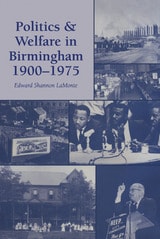
Politics and Welfare in Birmingham, 1900–1975
Edward Shannon LaMonte
University of Alabama Press, 1995
This well-written volume explores the relationships between politics and welfare programs for low-income residents in Birmingham during four periods in the twentieth century:
• 1900-1917, the formative period of city building when welfare was predominantly a responsibility of the private sector;
• 1928-1941, when the Great Depression devastated the local economy and federal intervention became the principal means of meeting human need;
• the mid 1950s, when the lasting impacts of the New Deal could be assessed and when matters of race relations became increasingly significant;
• 1962-1975, when an intense period of local government reform, the Civil Rights movement, federal intervention in the form of the War on Poverty, and increasing demands for citizen participation all reinforced one another.
From the time of its founding in 1871, Birmingham has had a biracial population, so the theme of race relations runs naturally throughout the narrative. LaMonte pays particular attention to those efforts to achieve a more harmonious biracial community, including the failed effort to establish an Urban League in the 1940s, the progressive activities of the Community Chest’s Interracial Division in the 1950s, which were abruptly terminated, and the dramatic events of the Civil Rights Movement in the 1960s, when local events were elevated to international significance.
[more]

Poverty and Society
The Growth of the American Welfare State in International ComparisonLevine, Daniel
Rutgers University Press, 1988
.
[more]
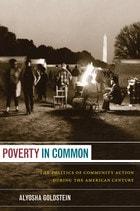
Poverty in Common
The Politics of Community Action during the American CenturyAlyosha Goldstein
Duke University Press, 2012
After the Second World War, the idea that local community action was indispensable for the alleviation of poverty was broadly embraced by US policymakers, social scientists, international development specialists, and grassroots activists. Governmental efforts to mobilize community action in the name of democracy served as a volatile condition of possibility for poor people and dispossessed groups negotiating the tension between calls for self-help and demands for self-determination in the era of the Cold War and global decolonization. In Poverty in Common, Alyosha Goldstein suggests new ways to think about the relationship among liberalism, government, and inequality in the United States. He does so by analyzing historical dynamics including Progressive-era reform as a precursor to community development during the Cold War, the ways that the language of "underdevelopment" articulated ideas about poverty and foreignness, the use of poverty as a crucible of interest group politics, and radical groups' critical reframing of community action in anticolonial terms. During the mid-twentieth century, approaches to poverty in the United States were linked to the racialized and gendered negotiation of boundaries—between the foreign and the domestic, empire and nation, violence and order, and dependency and autonomy.
[more]
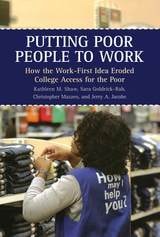
Putting Poor People to Work
How the Work-First Idea Eroded College Access for the PoorKathleen M. Shaw
Russell Sage Foundation, 2006
Today, a college education is increasingly viewed as the gateway to the American Dream—a necessary prerequisite for social mobility. Yet recent policy reforms in the United States effectively steer former welfare recipients away from an education that could further their career prospects, forcing them directly into the workforce where they often find only low-paying jobs with little opportunity for growth. In Putting Poor People to Work, Kathleen Shaw, Sara Goldrick-Rab, Christopher Mazzeo, and Jerry A. Jacobs explore this troubling disconnect between the principles of "work-first" and "college for all." Using comprehensive interviews with government officials and sophisticated data from six states over a four year period, Putting Poor People to Work shows how recent changes in public policy have reduced the quantity and quality of education and training available to adults with low incomes. The authors analyze how two policies encouraging work—the federal welfare reform law of 1996 and the Workforce Investment Act of 1998—have made moving people off of public assistance as soon as possible, with little regard to their long-term career prospects, a government priority. Putting Poor People to Work shows that since the passage of these "work-first" laws, not only are fewer low-income individuals pursuing postsecondary education, but when they do, they are increasingly directed towards the most ineffective, short-term forms of training, rather than higher-quality college-level education. Moreover, the schools most able and ready to serve poor adults—the community colleges—are deterred by these policies from doing so. Having a competitive, agile workforce that can compete with any in the world is a national priority. In a global economy where skills are paramount, that goal requires broad popular access to education and training. Putting Poor People to Work shows how current U.S. policy discourages poor Americans from seeking out a college education, stranding them in jobs with little potential for growth. This important new book makes a powerful argument for a shift in national priorities that would encourage the poor to embrace both work and education, rather than having to choose between the two. Institute for Research on Poverty Affiliated Books on Poverty and Public Policy">An Institute for Research on Poverty Affiliated Book on Poverty and Public Policy
[more]