Results by title
54 books match the query 'Publishers and publishing' and 5 start with p
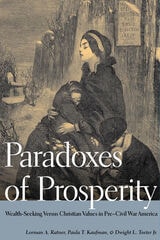
Paradoxes of Prosperity
Wealth Seeking in Pre-Civil War AmericaLorman A. Ratner, Paula T. Kaufman and Dwight L. Teeter Jr.
University of Illinois Press, 2008
At the same time, the United States felt the influence of the rise of popular mass-circulation newspapers and magazines and the surge in American book publishing. Concern over living correctly as well as prosperously was commonly discussed by leading authors and journalists, who were now writing for ever-expanding regional and national audiences. Women became more important as authors and editors, giving advice and building huge markets for women readers, with the magazine Godey's Lady's Book and novels by Susan Warner, Maria Cummins, and Harriet Beecher Stowe expressing women's views about the troubled state of society. Best-selling male writers--including novelist George Lippard, historian George Bancroft, and travel writer Bayard Taylor--were among those adding their voices to concerns about prosperity and morality and about America's place in the world. Writers and publishers discovered that a high moral tone could be exceedingly good for business.
The authors of this book examine how popular writers and widely read newspapers, magazines, and books expressed social tensions between prosperity and morality. This study draws on that nationwide conversation through leading mass media, including circulation-leading newspapers, the New York Herald and the New York Tribune, plus prominent newspapers from the South and West, the Richmond Enquirer and the Cincinnati Enquirer. Best-selling magazines aimed at middle-class tastes, Harper's Magazine and the Southern Literary Messenger, added their voices, as did two leading business magazines.
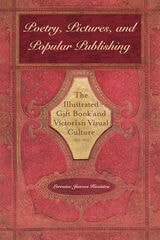
Poetry, Pictures, and Popular Publishing
The Illustrated Gift Book and Victorian Visual Culture, 1855–1875Lorraine Janzen Kooistra
Ohio University Press, 2011
In Poetry, Pictures, and Popular Publishing eminent Rossetti scholar Lorraine Janzen Kooistra demonstrates the cultural centrality of a neglected artifact: the Victorian illustrated gift book. Turning a critical lens on “drawing-room books” as both material objects and historical events, Kooistra reveals how the gift book’s visual/verbal form mediated “high” and popular art as well as book and periodical publication.
A composite text produced by many makers, the poetic gift book was designed for domestic space and a female audience; its mode of publication marks a significant moment in the history of authorship, reading, and publishing. With rigorous attention to the gift book’s aesthetic and ideological features, Kooistra analyzes the contributions of poets, artists, engravers, publishers, and readers and shows how its material form moved poetry into popular culture. Drawing on archival and periodical research, she offers new readings of Eliza Cook, Adelaide Procter, and Jean Ingelow and shows the transatlantic reach of their verses. Boldly resituating Tennyson’s works within the gift-book economy he dominated, Kooistra demonstrates how the conditions of corporate authorship shaped the production and receptionof the laureate’s verses at the peak of his popularity.
Poetry, Pictures, and Popular Publishing changes the map of poetry’s place—in all its senses—in Victorian everyday life and consumer culture.
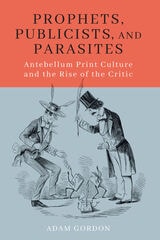
Prophets, Publicists, and Parasites
Antebellum Print Culture and the Rise of the CriticAdam Gordon
University of Massachusetts Press, 2020
Publishing Beyond the Market
Open Access, Care, and the CommonsSamuel A. Moore
University of Michigan Press, 2025
Going forward, Publishing Beyond the Market explores the importance of collectivity and democratic governance within the transition to open access publishing. It suggests that developing a commons-based, scholar-led publishing landscape through a series of presses that are each managed by working academics could offer a productive counterpoint to marketised systems of open access and subscription publishing. In weaving themselves together in order to “scale small” these publishing initiatives would act as a counter-hegemonic project based on mutual reliance and care. By illustrating how these projects build toward a commons-based publishing future, and how they may complement other approaches to publishing within university presses and libraries, the book culminates in an argument for the infrastructures, policies, and forms of governance needed to nurture such a collective vision.
Publishing Women
Salons, the Presses, and the Counter-Reformation in Sixteenth-Century ItalyDiana Robin
University of Chicago Press, 2007
Even the most comprehensive Renaissance histories have neglected the vibrant groups of women writers that emerged in cities across Italy during the mid-1500s—and the thriving network of printers, publishers, and agents that specialized in producing and selling their books. In Publishing Women, Diana Robin finally brings to life this story of women’s cultural and intellectual leadership in early modern Italy, illuminating the factors behind—and the significance of—their sudden dominance.
Focusing on the collective publication process, Robin portrays communities in Naples, Venice, Rome, Siena, and Florence, where women engaged in activities that ranged from establishing literary salons to promoting religious reform. Her innovative cultural history considers the significant roles these women played in tandem with men, rather than separated from them. In doing so, it collapses the borders between women’s history, Renaissance and Reformation studies, and book history to evoke a historical moment that catapulted women’s writings and women-sponsored books into the public sphere for the first time anywhere in Europe.