Results by title
53 books match the query 'Rap & Hip Hop' and 2 start with p
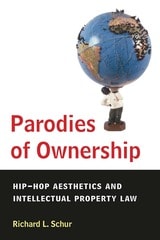
Parodies of Ownership
Hip-Hop Aesthetics and Intellectual Property LawRichard L. Schur
University of Michigan Press, 2009
"Richard Schur offers a provocative view of contemporary African American cultural politics and the relationship between African American cultural production and intellectual property law."
---Mark Anthony Neal, Duke University
"Whites used to own blacks. Now, they accomplish much the same thing by insisting that they 'own' ownership. Blacks shouldn't let them. A culture that makes all artists play by its rules will end up controlling new ideas and stifling change. Richard Schur's fine book explains why."
---Richard Delgado, Seattle University
What is the relationship between hip-hop and African American culture in the post--Civil Rights era? Does hip-hop share a criticism of American culture or stand as an isolated and unique phenomenon? How have African American texts responded to the increasing role intellectual property law plays in regulating images, sounds, words, and logos? Parodies of Ownership examines how contemporary African American writers, artists, and musicians have developed an artistic form that Schur terms "hip-hop aesthetics." This book offers an in-depth examination of a wide range of contemporary African American painters and writers, including Anna Deavere Smith, Toni Morrison, Adrian Piper, Colson Whitehead, Michael Ray Charles, Alice Randall, and Fred Wilson. Their absence from conversations about African American culture has caused a misunderstanding about the nature of contemporary cultural issues and resulted in neglect of their innovative responses to the post--Civil Rights era. By considering their work as a cross-disciplinary and specifically African American cultural movement, Schur shows how a new paradigm for artistic creation has developed.
Parodies of Ownership offers a broad analysis of post--Civil Rights era culture and provides the necessary context for understanding contemporary debates within American studies, African American studies, intellectual property law, African American literature, art history, and hip-hop studies. Weaving together law, literature, art, and music, Schur deftly clarifies the conceptual issues that unify contemporary African American culture, empowering this generation of artists, writers, and musicians to criticize how racism continues to affect our country.
Richard L. Schur is Director, Interdisciplinary Studies Center, and Associate Professor of Interdisciplinary Studies at Drury University. Visit the author's website: http://www2.drury.edu/rschur/index.htm.
Prophets of the Hood
Politics and Poetics in Hip HopImani Perry
Duke University Press, 2004
Perry offers detailed readings of the lyrics of many hip hop artists, including Ice Cube, Public Enemy, De La Soul, krs-One, OutKast, Sean “Puffy” Combs, Tupac Shakur, Lil’ Kim, Biggie Smalls, Nas, Method Man, and Lauryn Hill. She focuses on the cultural foundations of the music and on the form and narrative features of the songs—the call and response, the reliance on the break, the use of metaphor, and the recurring figures of the trickster and the outlaw. Perry also provides complex considerations of hip hop’s association with crime, violence, and misogyny. She shows that while its message may be disconcerting, rap often expresses brilliant insights about existence in a society mired in difficult racial and gender politics. Hip hop, she suggests, airs a much wider, more troubling range of black experience than was projected during the civil rights era. It provides a unique public space where the sacred and the profane impulses within African American culture unite.