Results by title
322 books match the query 'Regional' and 14 start with p
Parsnips in the Snow
Talks with Midwestern GardenersJane Anne Staw
University of Iowa Press, 1990
Through conversations with twelve vastly different gardeners—among them a Trappist monk, a retired mailman, and an advertising copywrite—this enchanting volume captures the spirit of midwestern garderners. Illustrated throughout it is the wholesale dedication of midwesterners to their gardens—despite drought, heat, disabilities, and other challenges. Anyone who delights in gardening, the Midwest, or human triumph will enjoy this book.
Passage to Wonderland
Rephotographing Joseph Stimson's Views of the Cody Road to Yellowstone National Park, 1903 and 2008Michael A. Amundson
University Press of Colorado, 2012
Amundson examines the physical changes along "the most scenic fifty miles in America" and explores the cultural and natural history behind them. This careful analysis of the paired images make Passage to Wonderland more than a "then and now" photography book--it is a unique exploration of the interconnectedness between the Old West and the New West. It will be a wonderful companion for those touring the Cody Road as well as those armchair tourists who can follow the road on Google Earth using the provided GPS coordinates.
The University Press of Colorado gratefully acknowledges the generous support of the Charles Redd Center for Western Studies at Brigham Young University toward the publication of this book.
Paths Along The Hudson
A Guide to Walking and BikingPerls, Jeffrey
Rutgers University Press, 1999
Whether you are an ardent hiker or prefer to enjoy the great outdoors from your living-room armchair, Jeffrey Perls has written the essential guidebook on one of the most majestic natural areas of the eastern United States-the Hudson River.
From the rugged topography of the Hudson Highlands Gorge to the crowded towers of Manhattan, the Hudson has been an inspiration for poets, writers, artists, and countless others who have enjoyed the many wonders of the river. The area surrounding the Hudson abounds in history. It’s played a pivotal part in our country's development, from its strategic role in the American Revolution to its heritage as the nation’s primary entry point for immigrants to this country. The river also supports an incredibly rich diversity of flora and fauna, from the bald eagle to the short-nosed sturgeon.
Perls brings together the culture, history, nature, and recreational activities along the Hudson River in one convenient guide book. He not only maps out walks and bike trails, both urban and rural, but also introduces readers to the landscape, geology, history, and culture of the Hudson Valley region. Perls provides a practical and geographically comprehensive guide to exploring the area on foot and by bike. The trail routes bring readers as close to the river as possible and guides them to rewarding vistas, nature preserves, and historic landmarks. It’s a useful guide for visitors to the Hudson region and local residents as it acquaints them to the natural treasures to be found in their own backyards.

Perimeter
A Contemporary Portrait of Lake MichiganKevin J. Miyazaki
Wisconsin Historical Society Press, 2014
Miyazaki also photographed the water as he went, creating waterscapes of the ever-changing lake affected by weather and time. Perimeter gathers these images together, creating a diverse portrait of both people and a place, encapsulating Lake Michigan’s significance to those who are drawn to it.
Picturing Indians
Photographic Encounters and Tourist Fantasies in H. H. Bennett's Wisconsin DellsSteven D. Hoelscher
University of Wisconsin Press, 2008
Winner, Book Award of Merit, Wisconsin Historical Society, Best Books for General Audiences, selected by the American Association of School Librarians, and Best Books for Regional Interests, selected by the Public Library Association

Picturing Utopia
Bertha Shambaugh and the Amana PhotographersAbigail Foerstner
University of Iowa Press, 2005
Placing John Haines
James Perrin Warren
University of Alaska Press, 2017
John Haines arrived in Alaska, fresh out of the Navy, in 1947, and established a homestead seventy miles southeast of Fairbanks. He stayed there nearly twenty-five years, learning to live off the country: hunting, trapping, fishing, gathering berries, and growing vegetables. Those years formed him as a writer—the interior of Alaska, and especially its boreal forest—marking his poetry and prose and helping him find his unique voice.
Placing John Haines, the first book-length study of his work, tells the story of those years, but also of his later, itinerant life, as his success as a writer led him to hold fellowships and teach at universities across the country. James Perrin Warren draws out the contradictions inherent in that biography—that this poet so indelibly associated with place, and authentic belonging, spent decades in motion—and also sets Haines’s work in the context of contemporaries like Robert Bly, Donald Hall, and his close friend Wendell Berry. The resulting portrait shows us a poet who was regularly reinventing himself, and thereby generating creative tension that fueled his unforgettable work. A major study of a sadly neglected master, Placing John Haines puts his achievement in compelling context.
Plant Communities of New Jersey
A Study in Landscape DiversityCollins, Beryl Robichaud
Rutgers University Press, 1994
From the ridgetops of the north to the Pinelands of the south, New Jersey’s natural areas display an astonishing variety of plant life. This book--a completely revised edition of the classic Vegetation of New Jersey--enables readers to understand why the vegetation of New Jersey is what it is today and what it may become.
The book portrays New Jersey as an ecosystem--its geology, topography and soil, climate, plant-plant and plant-animal relationships, and the human impact on the environment. The authors describe in detail the twelve types of plant habitats distinguished in New Jersey and suggest places to observe good examples of them.
The book is amply illustrated with photographs of plant communities and individual species and maps. The appendixes provide a cross reference between the common and scientific names of native plants of New Jersey, and hints for plant identification.
Scientifically accurate yet written in a lively style, Plant Communities of New Jersey belongs on the bookshelf of every New Jerseyan who cares about the environment.
Plantlore/Dena'ina K'et'una
An Ethnobotany of the Dena'ina People of Southcentral AlaskaPriscilla N. Russell
University of Alaska Press, 2020
This book is the culmination of more than a decade of ethnobotanical study and provides accounts of the traditional lore associated with these plants based on a wealth of interviews with Dena’ina people. This new edition includes new graphical content consolidating practical plant information and traditional uses.
Playing God in the Meadow
How I Learned to Admire My WeedsMartha Leb Molnar
University of Massachusetts Press, 2022
After decades of fantasizing and saving, of working multiple jobs and embracing frugality in the midst of Manhattan, Martha Leb Molnar and her husband had found their parcel of land. Determined to turn an overgrown and unproductive Vermont apple orchard into a thriving and beautiful landscape, they decided to restore this patch of land to a pristine meadow and build a safe haven for their family and nearby wildlife.
Once they cleared the gnarled and dying trees away, Molnar was forced to wage war on the invasive species that had sprung up around the property. Propelled by the heated debates surrounding non-native species and her own complicated family history and migration, she was driven to research the Vermont landscape, turning to scientific literature, experts in botany and environmental science, and locals who have long tended the land in search of answers. At turns funny, thoughtful, and conversational, Playing God in the Meadow follows this big city transplant as she learns to make peace with rural life and an evolving landscape that she cannot entirely control.
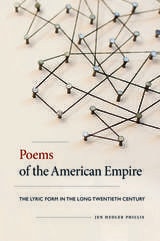
Poems of the American Empire
The Lyric Form in the Long Twentieth CenturyJen Hedler Phillis
University of Iowa Press, 2019
Poems of the American Empire argues that careful attention to a particular strain of twentieth-century lyric poetry yields a counter-history of American global power. The period that Phillis covers—from Ezra Pound’s A Draft of XXX Cantos in 1930 to Cathy Park Hong’s Engine Empire in 2012—roughly matches what some consider the ascent and decline of the American empire. The diverse poems that appear in this book are united by their use of epic forms in the lyric poem, a combination that violates a fundamental framework of both genres’ relationship to time.
This book makes a groundbreaking intervention by insisting that lyric time is key to understanding the genre. These poems demonstrate the lyric form’s ability to represent the totality of history, making American imperial power visible in its fullness. Neither strictly an empty celebration of American exceptionalism nor a catalog of atrocities, Poems of the American Empire allows us to see both.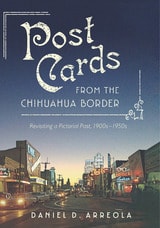
Postcards from the Chihuahua Border
Revisiting a Pictorial Past, 1900s–1950sDaniel D. Arreola
University of Arizona Press, 2019
In Postcards from the Chihuahua Border Daniel D. Arreola captures the exhilaration of places in time, taking us back to Mexico’s northern border towns of Cuidad Juárez, Ojinaga, and Palomas in the early twentieth century. Drawing on more than three decades of archival work, Arreola uses postcards and maps to unveil the history of these towns along west Texas’s and New Mexico’s southern borders.
Postcards offer a special kind of visual evidence. Arreola’s collection of imagery and commentary about them shows us singular places, enriching our understandings of history and the history of change in Chihuahua. No one postcard tells the entire story. But image after image offers a collected view and insight into changing perceptions. Arreola’s geography of place looks both inward and outward. We see what tourists see, while at the same time gaining insight about what postcard photographers and postcard publishers wanted to be seen and perceived about these border communities.
Postcards from the Chihuahua Border is a colorful and dynamic visual history. It invites the reader to time travel, to revisit another era—the first half of the last century—when these border towns were framed and made popular through picture postcards.
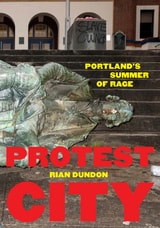
Protest City
Portland's Summer of RageRian Dundon
Oregon State University Press, 2023
In the months leading up to the 2020 presidential election, Portland made national news with nightly social justice protests, often met with violent response by counter protestors and law enforcement. Though frequently regarded as a progressive hub, Portland has a long history of racial inequality and oppression, and the city’s entrenched divisions gained new attention during the Trump years. The photos in Protest City present a visceral visual record of this significant moment in Portland’s history.
Rian Dundon, who has been photographing the rise of extreme politics on the West Coast since 2016, lived only a short walk from the protests that erupted after the murder of George Floyd. For one hundred days, Dundon enmeshed himself in the demonstrations with an unobtrusive point-and-shoot camera. The result is a graphic portrayal of how social movements become politicized, how spectacle serves as a subtext to change in the digital age, and how modern protests blur distinctions among performance, ritual, and surveillance. As he follows the progress of Portland’s conflicts, Dundon draws connections to Oregon’s legacy as a stronghold of white supremacist extremism and interrogates the role of whiteness in racial justice movements.
Most of the photographs in the book were taken between May and October 2020, but the collection also includes photos from protests in late 2020 and 2021 around various related issues, including the Red House eviction blockade, rightwing demonstrations on January 6 and 17, and the one-year anniversary of George Floyd’s murder. Dundon’s striking photos recreate the immediacy and impact of the protests, while essays by historian Carmen Thompson and journalist Donnell Alexander contextualize the uprising’s sociopolitical background. A chronology and author’s note are also featured.
The publisher and author would like to thank the Magnum Foundation, Documentary Arts, and the Economic Hardship Reporting Project for their generous support of this publication. Additional funding has been provided by Furthermore: a program of the J. M. Kaplan Fund.
Putting Down Roots
Gardening Insights from Wisconsin’s Early SettlersMarcia C. Carmichael
Wisconsin Historical Society Press, 2013