Results by title
346 books match the query 'Relations' and 21 start with p
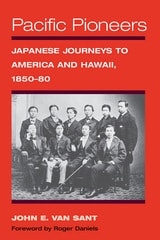
Pacific Pioneers
Japanese Journeys to America and Hawaii, 1850-80John E. Van Sant
University of Illinois Press, 2019
Although Japanese immigrants did not start arriving in substantial numbers in the West until after 1880, in the previous thirty years a handful of key encounters helped shape relations between Japan and the United States. John E. Van Sant explores the motivations and accomplishments of these resourceful, sometimes visionary individuals who made important inroads into a culture quite different from their own and paved the way for the Issei and Nisei.
Pacific Pioneers presents detailed biographical sketches of Japanese such as Joseph Heco, Niijima Jo, and the converts to the Brotherhood of the New Life and introduces the American benefactors, such as William Griffis, David Murray, and Thomas Lake Harris, who built relationships with their foreign visitors. Van Sant also examines the uneasy relations between Japanese laborers and sugar cane plantation magnates in Hawaii during this period and the shortlived Wakamatsu colony of Japanese tea and silk producers in California.
A valuable addition to the literature, Pacific Pioneers brings to life a cast of colorful, long-forgotten characters while forging a critical link between Asian and Asian American studies.

Panamanian Militarism
A Historical InterpretationCarlos Guevara Mann
Ohio University Press, 1996
Focusing on the causes that generated nineteenth-century predatory militarism, including political illegitimacy and US support, Guevara Mann analyzes the so-called professionalization of the armed forces — institutionalized militarism — and the polices developed by the 1968-89 military regime.
The author cautions that although Panamanian Defense Forces were abolished after the US invasion of December 1989, and although the state’s security apparatus has been placed under civilian direction, Panama’s stability remains threatened. Lack of legitimacy — the characteristic which informs military involvement in politics — still persists, and militarism could well reappear if the Panamanian polity fails to achieve legitimacy.
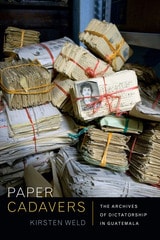
Paper Cadavers
The Archives of Dictatorship in GuatemalaKirsten Weld
Duke University Press, 2014
The unearthing of the archives renewed fierce debates about history, memory, and justice. In Paper Cadavers, Weld explores Guatemala's struggles to manage this avalanche of evidence of past war crimes, providing a firsthand look at how postwar justice activists worked to reconfigure terror archives into implements of social change. Tracing the history of the police files as they were transformed from weapons of counterinsurgency into tools for post-conflict reckoning, Weld sheds light on the country's fraught transition from war to an uneasy peace, reflecting on how societies forget and remember political violence.
Parallax Visions
Making Sense of American-East Asian Relations at the End of the CenturyBruce Cumings
Duke University Press, 1999
Using information based on thirty years of research, Cumings offers a new perspective on a wide range of issues that originated with the cold war—with particular focus on the possibly inappropriate collaboration between universities, foundations, and intelligence agencies. Seeking to explode the presuppositions that Americans usually bring to the understanding of our relations with East Asia, the study ranges over much of the history of the twentieth century in East Asian–American relations—Pearl Harbor, Hiroshima and Nagasaki, the Korean War, and more recent difficulties in U.S. relations with China and Japan. Cumings also rebuts U.S. media coverage of North Korea’s nuclear diplomacy in the 1990s and examines how experiences of colonialism and postcolonialism have had varying effects on economic development in each of these countries. Positing that the central defining experience of twentieth-century East Asia has been its entanglement first with British and Japanese imperialism, and then with the United States, Cumings ends with a discussion of how the situation could change over the next century as the economic and political global clout of the United States declines.
Illuminating the sometimes self-deluded ideology of cold war America, Parallax Visions will engage historians, political scientists, and students and scholars of comparative politics and social theory, as well as readers interested in questions of modernity and the role of the United States in shaping the destinies of modernizing societies in Asia.
Parish behind God's Back
The Changing Culture of Rural BarbadosGeorge Gmelch and Sharon Bohn Gmelch
University of Michigan Press, 1997

Passion of Israel
Jacques Maritain, Catholic Conscience, and the HolocaustRichard Francis Crane
University of Scranton Press, 2010
In his lifetime, French philosopher Jacques Maritain (1882–1973) achieved a reputation as both a leading Catholic intellectual and as an outspoken critic of antisemitism. Here historian Richard Francis Crane traces the development of Maritain’s opposition toward antisemitism and analyzes the Catholic appreciation of Judaism that animated his stance. Crane probes the writings and teachings of Maritain—from before, during, and after the Holocaust—and illuminates how his ideas altered Christian perceptions of Jews and Judaism during his lifetime and continue to do so today.

Paying the Price
Ignacio Ellacuría and the Murdered Jesuits of El SalvadorTeresa Whitfield
Temple University Press, 1994
On November 16, 1989, on the campus of El Salvador's University of Central America, six Jesuits and two women were murdered by members of the Salvadoran army, an army funded and trained by the United States. One of the murdered Jesuits was Ignacio Ellacuría, the university's Rector and a key, although controversial, figure in Salvadoran public life. From an opening account of this terrible crime, Paying the Price asks, Why were they killed and what have their deaths meant? Answers come through Teresa Whitfield's detailed examination of Ellacuría's life and work. His story is told in juxtaposition with the crucial role played by the unraveling investigation of the Jesuits' murders within El Salvador's peace process.
A complex and nuanced book, Paying the Price offers a history of the Church in El Salvador in recent decades, an analysis of Ellacuría's philosophy and theology, an introduction to liberation theology, and an account of the critical importance of the University of Central America. In the end, Whitfield's comprehensive picture of conditions in El Salvador suggest that the Jesuits' murders were almost inevitable. A crime that proved a turning point in El Salvador's civil war, the murders expressed the deep tragedy of the Salvadoran people beyond suffering the heartless cruelty, violence, and deceitfulness of a corrupt military and their patrons in the U.S. government.
Whitfield draws on her extensive research of Jesuit archives and private papers, Ellacuría's diaries, documents declassified by the U.S. government, and 200 interviews conducted with sources ranging from Jesuits to Salvadoran military officers, U.S. officials and congressmen to human rights campaigners.
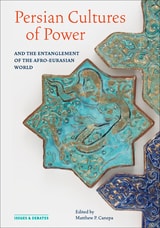
Persian Cultures of Power and the Entanglement of the Afro-Eurasian World
Matthew P. Canepa
J. Paul Getty Trust, The, 2024
With the rise of the Achaemenid Empire (550–330 BCE), Persian institutions of kingship became the model for legitimacy, authority, and prestige across three continents. Despite enormous upheavals, Iranian visual and political cultures connected an ever-wider swath of Afro-Eurasia over the next two millennia, exerting influence at key historical junctures. This book provides the first critical exploration of the role Persian cultures played in articulating the myriad ways power was expressed across Afro-Eurasia between the sixth century BCE and the nineteenth century CE.
Exploring topics such as royal cosmologies, fashion, banqueting, manuscript cultures, sacred landscapes, and inscriptions, the volume’s essays analyze the intellectual and political exchanges of art, architecture, ritual, and luxury material within and beyond the Persian world. They show how Perso-Iranian cultures offered neighbors and competitors raw material with which to formulate their own imperial aspirations. Unique among studies of Persia and Iran, this volume explores issues of change, renovation, and interconnectivity in these cultures over the longue durée.
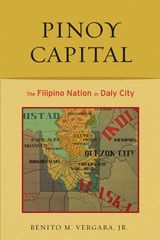
Pinoy Capital
The Filipino Nation in Daly CityBenito M. Vergara, Jr.
Temple University Press, 2009
Home to 33,000 Filipino American residents, Daly City, California, located just outside of San Francisco, has been dubbed “the Pinoy Capital of the United States.” In this fascinating ethnographic study of the lives of Daly City residents, Benito Vergara shows how Daly City has become a magnet for the growing Filipino American community.
Vergara challenges rooted notions of colonialism here, addressing the immigrants’ identities, connections and loyalties. Using the lens of transnationalism, he looks at the “double lives” of both recent and established Filipino Americans. Vergara explores how first-generation Pinoys experience homesickness precisely because Daly City is filled with reminders of their homeland’s culture, like newspapers, shops and festivals. Vergara probes into the complicated, ambivalent feelings these immigrants have—toward the Philippines and the United States—and the conflicting obligations they have presented by belonging to a thriving community and yet possessing nostalgia for the homeland and people they left behind.
Pius XII and the Holocaust
Understanding the ControversyJosé M. Sánchez
Catholic University of America Press, 2002
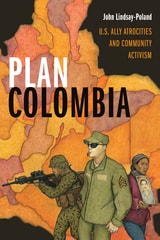
Plan Colombia
U.S. Ally Atrocities and Community ActivismJohn Lindsay-Poland
Duke University Press, 2018
Poetics of Relation
Édouard Glissant
University of Michigan Press, 1997
In Poetics of Relation, Glissant turns the concrete particulars of Caribbean reality into a complex, energetic vision of a world in transformation. He sees the Antilles as enduring suffering imposed by history, yet as a place whose unique interactions will one day produce an emerging global consensus. Arguing that the writer alone can tap the unconscious of a people and apprehend its multiform culture to provide forms of memory capable of transcending "nonhistory," Glissant defines his "poetics of relation"--both aesthetic and political--as a transformative mode of history, capable of enunciating and making concrete a French-Caribbean reality with a self-defined past and future. Glissant's notions of identity as constructed in relation and not in isolation are germane not only to discussions of Caribbean creolization but also to our understanding of U.S. multiculturalism. In Glissant's view, we come to see that relation in all its senses--telling, listening, connecting, and the parallel consciousness of self and surroundings--is the key to transforming mentalities and reshaping societies.
This translation of Glissant's work preserves the resonating quality of his prose and makes the richness and ambiguities of his voice accessible to readers in English.
"The most important theoretician from the Caribbean writing today. . . . He is central not only to the burgeoning field of Caribbean studies, but also to the newly flourishing literary scene in the French West Indies." --Judith Graves Miller, University of Wisconsin, Madison
Édouard Glissant is Distinguished Professor of French at City University of New York, Graduate Center. Betsy Wing's recent translations include Lucie Aubrac's Outwitting the Gestapo (with Konrad Bieber), Didier Eribon's Michel Foucault and Hélêne Cixous's The Book of Promethea.
Positively No Filipinos Allowed
Building Communities and Discourseedited by Antonio T. Tiongson, Jr., Edgardo V. Gutierrez and Ricardo V. Gutierrez, foreword by Lisa Lowe
Temple University Press, 2006

Postcolonial America
Edited by C. Richard King
University of Illinois Press, 2000
Advancing multiple, even conflicted visions of postcolonial America, this important volume interrogates postcolonial theory and traces the emergence and significance of postcolonial practices and precepts in the United States. Contributors discuss how the unique status of the United States as the colony that became a superpower has shaped its sense of itself. They assess the global networks of inequality that have displaced neocolonial systems of conquest, exploitation, and occupation. They also examine how individuals and groups use music, the Internet, and other media to reconfigure, reinvent, and resist postcoloniality in American culture.
Candidly facing the inherent contradictions of "the American experience," this collection demonstrates the patterns, connections, and histories characteristic of postcoloniality in America and initiates important discussions about how these conditions might be changed.
Postcolonial Grief
The Afterlives of the Pacific Wars in the AmericasJinah Kim
Duke University Press, 2019
Poverty of the Imagination
The Cold War and the Social Science of Development in Latin AmericaPatrick Iber
University of Chicago Press, 2026
Explores the history of the “science of development” during the Cold War and how experts across the social sciences tried to create the tools to address the problem of poverty across Latin America.
In the mid-twentieth century, Latin America had the world’s starkest internal inequality. In Brazil in 1960, for example, the top 10 percent took upward of 60 percent of the country’s total income, while its entire bottom half took only 10 percent. As Patrick Iber shows in Poverty of the Imagination, this problem of poverty and social inequality focused the attention of social scientists on the task of articulating a “science of development.” In the context of the Cold War, this project drew the attention of the US government and the Ford Foundation, which hoped that peaceful development would prevent revolutions.
This book examines the five central frameworks that emerged to explain poverty: from dependency theory on the Marxist left; to theories of modernization, the culture of poverty, and marginality in the center; to neoliberalism on the right. Iber shows how each rose (and fell) by connecting them to political projects such as the War on Poverty in the United States and the dictatorship of Augusto Pinochet in Chile. Through vivid portraits of key thinkers, he shows how each was shaped by the environment of the Cold War and the presence of the Ford Foundation. It is a story with surprising turns: What began for Ford as a Cold War project to support university “modernization” changed as dictatorships took control of much of the region. Then, Ford took the side of the dissidents, supporting an antipoverty agenda for the restoration of democracy. A guide to some of the most important ideas in global development and Latin American studies alike, this book also shows how scholars and institutions faced down authoritarian threats—and won.
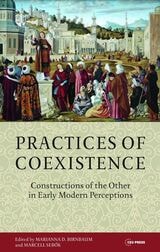
Practices of Coexistence
Constructions of the Other in Early Modern PerceptionsMarianna D. Birnbaum
Central European University Press, 2017
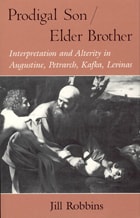
Prodigal Son/Elder Brother
Interpretation and Alterity in Augustine, Petrarch, Kafka, LevinasJill Robbins
University of Chicago Press, 1991
"Through a creative reading of the prodigal son parable, Jill Robbins demonstrates the hermeneutical impasse of the Christian exegete who must and yet cannot incorporate the Old Testament. Having disclosed the aporia at the heart of Christian hermeneutics, she proposes an alternative approach to the Hebrew Bible and new interpretations of Augustine, Petrarch, Kafka, and Levinas. Robbins brilliantly integrates the discourses of biblical texts, literary works, and critical analysis."—Mark C. Taylor, Williams College
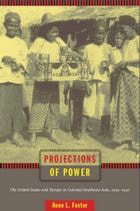
Projections of Power
The United States and Europe in Colonial Southeast Asia, 1919-1941Anne L. Foster
Duke University Press, 2010
Puerto Rican Jam
Rethinking Colonialism and NationalismNegron-Muntaner, Frances
University of Minnesota Press, 1997
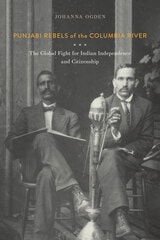
Punjabi Rebels of the Columbia River
The Global Fight for Indian Independence and CitizenshipJohanna Ogden
Oregon State University Press, 2024
Oregon is commonly perceived to have little, let alone notable, South Asian history. Yet in the early 1900s Oregon was at the center of two entwined quests for Indian independence and civic belonging that rocked the world.
Punjabi Rebels of the Columbia River traces the stories of the radical Indian independence organization known as Ghadar and Bhagat Singh Thind’s era-defining US Supreme Court citizenship case. Ghadar sought the overthrow of India’s British colonizers while Thind utilized sanctioned legal channels to do so. Despite widely differing strategies, both the movement and the man were targeted, often in coordination, by the highest levels of the US and British governments. The empires’ united message: India would not be an independent country and Indians could not be citizens. In the decades that followed, it was a verdict Indians refused to abide.
Johanna Ogden’s detailed history of migrants’ experience expands the time frame, geographic boundaries, and knowledge of the conditions and contributions of Indians in North America. It is the story of a people’s awakening amid a rich community of international workers in an age of nationalist uprisings. To understand why one of the smallest western Indian settlements became a resistance center, Punjabi Rebels mines the colonial underpinnings of labor, race, and place-making and their regional and global connections, rendering a history of whiteness and labor as much as of Indian-ness and migration. The first work to rejoin the lived experience of Thind and Ghadar activists, Punjabi Rebels complicates our understanding not just of the global fight for Indian political rights but of multi-racial democracy.