Results by title
79 books match the query 'Religion and science' and 3 start with p
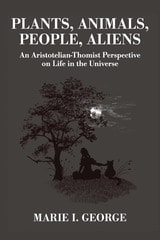
Plants, Animals, People, Aliens
An Aristotelian-Thomist Perspective on Life in the UniverseMarie I. George
Catholic University of America Press, 2026
Aristotle famously maintains in his treatise On the Soul that there are three kinds of living things-- plants, animals, and humans--and he speaks of each kind as having a soul. St. Thomas Aquinas adopts these same views. Nowadays, however, many thinkers reject them on the grounds that they are incompatible with modern science. Molecular biology is seen as affording a superior way of categorizing life forms. Evolutionary biology appears to have established that humans are simply primates with adaptations somewhat different from other primates. Plant physiology, uncovering plants’ directional responses to a wide variety of different stimuli, provides reason to think that plants sense light, pressure, odor, pathogens, etc., in which case plants are simply non-mobile animals, similar to coral. Neuroscience, by showing the dependency of thought, choice, perception, and emotion on the central nervous system, especially on the brain, seems to have eliminated any need to posit a soul.
Plants, Animals, People, Aliens addresses these and a variety of other science-based claims about living things by bringing Aristotelian-Thomistic teachings to bear upon them. While not a systematic work, it both treats some of the most hotly debated philosophical questions concerning living
things, such as what it means to be alive, as well as treating questions less often raised by philosophers, such as whether animals have a theory of mind. Though geared primarily to those conversant with the Aristotelian-Thomistic tradition, many of its key concepts are traced back to experiences that we all share in common, thus rendering these concepts intelligible, if not convincing, to those with scientific and other backgrounds who are curious about this philosophical approach to living things. The author strives to show how Aristotelian-Thomistic philosophy and science complement one another by sketching out the fuller understanding of the living realm that the two together provide.
The book’s final section considers the possibility and the likelihood that embodied rational beings exist elsewhere in our universe. Here, theological arguments drawn from the Christian faith are presented alongside philosophical and scientific arguments. This section closes with a theological discussion of the disputed question of whether extraterrestrials, were they to exist, should be baptized.
[more]
Possibilities for Over One Hundredfold More Spiritual Information
The Humble Approach in Theology and ScienceSir John Templeton
Templeton Press, 2000
Sir John Templeton challenges the reader to apply the same energy that has been devoted to scientific inquiry to the pursuit of spiritual information. The world is at a state of unprecedented technical expertise, but why has our knowledge and faith in our own spirituality stalled and become obsolete in recent times?
Possibilities for Over One Hundredfold More Spiritual Information seeks to address this question. It points out that our spiritual knowledge would also have the capacity to increase dramatically if we were to open our minds to the endless possibilities that await us in terms of our spiritual lives. These include altruistic love for all people, new knowledge of the Divine, and a greater sense of our place in the universe. In order for us as human beings to take advantage of all of the spiritual gifts that we have been given, we need to be open and receptive to our individual spiritual natures, and to open ourselves to the limitless spiritual possibilities available to us.
The book acknowledges the ancient scriptures and thinkers who have guided us for centuries. Vastly expanded research and the use of scientific method would only enhance our understanding of the wisdom contained within these wise teachings. The benefits of extending our spiritual knowledge might, in fact, exceed the benefits we have realized thus far from scientific and medical advances.
Possibilities seeks to reawaken our desire for spiritual knowledge pushed aside so long ago in our quest for scientific knowledge. When these fields work together, the world will reap greater rewards that we can ever imagine.
[more]
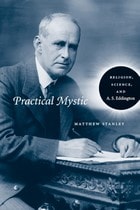
Practical Mystic
Religion, Science, and A. S. EddingtonMatthew Stanley
University of Chicago Press, 2007
Science and religion have long been thought incompatible. But nowhere has this apparent contradiction been more fully resolved than in the figure of A. S. Eddington (1882–1944), a pioneer in astrophysics, relativity, and the popularization of science, and a devout Quaker. Practical Mystic uses the figure of Eddington to shows how religious and scientific values can interact and overlap without compromising the integrity of either.
Eddington was a world-class scientist who not only maintained his religious belief throughout his scientific career but also defended the interrelation of science and religion while drawing inspiration from both for his practices. For instance, at a time when a strict adherence to deductive principles of physics had proved fruitless for understanding the nature of stars, insights from Quaker mysticism led Eddington to argue that an outlook less concerned with certainty and more concerned with further exploration was necessary to overcome the obstacles of incomplete and uncertain knowledge.
By examining this intersection between liberal religion and astrophysics, Practical Mystic questions many common assumptions about the relationship between science and spirituality. Matthew Stanley’s analysis of Eddington’s personal convictions also reveals much about the practice, production, and dissemination of scientific knowledge at the beginning of the twentieth century.
[more]