Results by title
145 books match the query 'Report writing' and 8 start with p
Performing Antiracist Pedagogy in Rhetoric, Writing, and Communication
Frankie Condon
University Press of Colorado, 2017
In Performing Antiracist Pedagogy, Frankie Condon and Vershawn Ashanti Young seek to help create openings to address race and racism not only in course readings and class discussion in writing, rhetoric, and communication courses but also in wider public settings. The contributors to this collection, drawn from a wide range of disciplines, urge readers to renew their commitment to intelligently and publicly deliberate race and to counteract the effects of racism. The book is both theoretically rigorous and practical, providing readers with insightful analyses of race and racism and useful classroom suggestions and examples.
Contributors: Chiara Bacigalupa, Sophia Bell, Susan Leigh Brooks, Frankie Condon, Rasha Diab, John Dean, Thomas Ferrell, Beth Godbee, Dae-Joong Kim, Timothy Lensmire, Calvin M. Logue, Aja Y. Martinez, Rebecca Nathan, Bobbi Olson, Jessica Parker, Charise Pimentel, Octavio Pimentel, Mya Poe, Neil Simpkins, Nathan Snaza, Deatra Sullivan, Vershawn Ashanti Young
Peripheral Visions for Writing Centers
Jackie Grutsch McKinney
Utah State University Press, 2013
McKinney argues that this grand narrative neglects the extent to which writing center work is theoretically and pedagogically complex, with ever-changing work and conditions, and results in a straitjacket for writing center scholars, practitioners, students, and outsiders alike. Peripheral Visions for Writing Centers makes the case for a broader narrative of writing center work that recognizes and theorizes the various spaces of writing center labor, allows for professionalization of administrators, and sees tutoring as just one way to perform writing center work.
McKinney explores possibilities that lie outside the grand narrative, allowing scholars and practitioners to open the field to a fuller, richer, and more realistic representation of their material labor and intellectual work.

Pil 58,Center For Learning
Writing Centers & LibrariesJames Elmborg
Assoc of College & Research Libraries, 2011
Pivotal Strategies
Claiming Writing Studies as DisciplineLynn C. Lewis
Utah State University Press, 2024
Because undergraduate degrees in writing studies are relatively new, claiming the discipline has required reinvention and revision at personal and professional levels far different than any other discipline. Suspicions about the viability of the discipline linger in many departments and universities, as well as outside the academy, leading writing studies scholars to develop innovative strategies to deal with covertly hostile attitudes. Within the collection, contributors name explicit claiming strategies from the discipline’s beginnings to the contemporary moment, locating opportune spaces, negotiating identities and fostering resilience, and developing allegiances by foregrounding their embodiment as underrepresented members of academia through a commitment to social justice and equity.
Responding to current conversations on the worth of education with honest stories about the burdens and joys of becoming and being an academic, Pivotal Strategies features a spectrum of voices across racial, gender, class, and age categories. This collection not only makes the discipline more visible but also helps map the contemporary state of writing studies.
Points of Departure
Rethinking Student Source Use and Writing Studies Research MethodsTricia Serviss
Utah State University Press, 2017
The contributors offer methodologies, techniques, and suggestions for research that move beyond decontextualized guides to grapple with the messiness of research-in-process, as well as design, development, and expansion. Serviss and Jamieson’s model of RAD writing studies research is transcontextual and based on hybridized or mixed methods. Among these methods are citation context analysis, research-aloud protocols, textual and genre analysis, surveys, interviews, and focus groups, with an emphasis on process and knowledge as contingent. Chapters report on research projects at different stages and across institution types—from pilot to multi-site, from community college to research university—focusing on the methods and artifacts employed.
A rich mosaic of research about research, Points of Departure advances knowledge about student writing and serves as a guide for both new and experienced researchers in writing studies.
Contributors: Crystal Benedicks, Katt Blackwell-Starnes, Lee-Ann Kastman Breuch, Kristi Murray Costello, Anne Diekema, Rebecca Moore Howard, Sandra Jamieson, Elizabeth Kleinfeld, Brian N. Larson, Karen J. Lunsford, M. Whitney Olsen, Tricia Serviss, Janice R. Walker
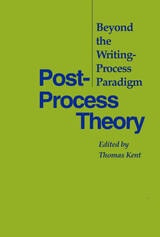
Post-Process Theory
Beyond the Writing-Process ParadigmEdited by Thomas Kent
Southern Illinois University Press, 1999
Breaking with the still-dominant process tradition in composition studies, post-process theory—or at least the different incarnations of post-process theory discussed by the contributors represented in this collection of original essays—endorses the fundamental idea that no codifiable or generalizable writing process exists or could exist. Post-process theorists hold that the practice of writing cannot be captured by a generalized process or a "big" theory.
Most post-process theorists hold three assumptions about the act of writing: writing is public; writing is interpretive; and writing is situated. The first assumption is the commonsensical claim that writing constitutes a public interchange. By "interpretive act," post-process theorists generally mean something as broad as "making sense of" and not exclusively the ability to move from one code to another. To interpret means more than merely to paraphrase; it means to enter into a relationship of understanding with other language users. And finally, because writing is a public act that requires interpretive interaction with others, writers always write from some position or some place. Writers are never nowhere; they are "situated."
Leading theorists and widely published scholars in the field, contributors are Nancy Blyler, John Clifford, Barbara Couture, Nancy C. DeJoy, Sidney I. Dobrin, Elizabeth Ervin, Helen Ewald, David Foster, Debra Journet, Thomas Kent, Gary A. Olson, Joseph Petraglia, George Pullman, David Russell, and John Schilb.
Postprocess Postmortem
M. Kristopher Lotier
University Press of Colorado, 2021
In Postprocess Postmortem, Kristopher M. Lotier surveys the postprocess era-that-never-was, its end, and its after-lives. Employing cutting-edge digital research tools to track the circulation of texts and shifting scales from the global to the local and back again, he offers a revisionist history of a largely unchronicled past. From one perspective, the history of postprocess might seem to be a history of failure: what could have become The Next Big Thing in composition and writing studies during the 1990s and early 2000s never quite ascended. Today, few writing studies scholars apply the term postprocess to their own research or self-identify with a postprocess movement. And yet, as Lotier demonstrates, numerous core postprocess tenets have attained disciplinary centrality. The result: whether they admit to doing so or not, many contemporary scholars employ a postprocess vocabulary, allowing the ideas underlying this important movement/theory/period/attitude to live on.
Process This
Undergraduate Writing in Composition StudiesNancy C. DeJoy
Utah State University Press, 2004
In Process This, Nancy DeJoy argues that even recent revisions to composition studies, cultural studies, service learning, and social process movements--continue to repress the subjects and methodologies that should be central, especially at the level of classroom practice. Designed to move student discourses beyond the classroom, these approaches nonetheless continue to position composition students (and teachers) as mere consumers of the discipline. This means that the subjects, methodologies, and theory/practice relationships that define the field are often absent in composition classrooms.
Arguing that the world inside and outside of the academy cannot be any different if the profession stays the same, DeJoy creates a pedagogy and a plan for faculty development that revisions the prewrite/write/rewrite triad to open spaces for participation and contribution to all members of first-year writing classrooms.