Results by title
231 books match the query 'Revolutionary Period (1775-1800)' and 5 start with p
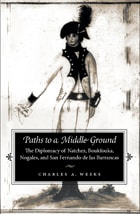
Paths to a Middle Ground
The Diplomacy of Natchez, Boukfouka, Nogales, and San Fernando de las Barrancas, 1791-1795Charles A. Weeks
University of Alabama Press, 2005
Weeks shows how diplomatic relations were established and maintained in the Gulf South between Choctaw, Chickasaw, Creek, and Cherokee chiefs and their Spanish counterparts aided by traders who had become integrated into Indian societies. He explains that despite the absence of a European state system, Indian groups had diplomatic skills that Europeans could understand: full-scale councils or congresses accompanied by elaborate protocol, interpreters, and eloquent metaphorical language.
Paths to a Middle Ground is both a narrative and primary documents. Key documents from Spanish archival sources serve as a basis for the examination of the political culture and imperial rivalry playing out in North America in the waning years of the 18th century.

Pennsylvania
A Military HistoryWilliam A. Pencak
Westholme Publishing, 2016
Westholme State Military History Series
Each state in the United States of America has a unique military history. The volumes in this series seek to provide a portrait of the richness of each state’s military experience, primarily defined by its borders, as well as the important contributions the state has made to the nation’s military history. Written by historians for the general reader, the volumes trace the history of conflict from the original native populations to today. The volumes are well illustrated and include specially commissioned maps, extensive bibliographies, lists of national and state historical sites, and a detailed index.
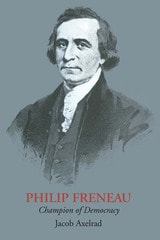
Philip Freneau
Champion of DemocracyBy Jacob Axelrad
University of Texas Press, 1967
Philip Freneau was a poet, editor, and mariner. A graduate of Princeton, he was the roommate of James Madison and a classmate of Hugh Henry Brackenridge and Aaron Burr. When the colonies rebelled against England, he supported his newly born nation as a privateer, spending some time in a British prison as a result. He also served, more effectively, as “the poet of the Revolution.” Later he became the journalistic voice of the democrats.
Ardently devoted to liberty, he believed himself to be a defender of the common man, for whom he fought selflessly and often vitriolicly throughout his life. In newspapers such as The Freeman’s Journal, The New York Daily Advertiser, The National Gazette, The Jersey Chronicle, and The Time-Piece, he published articles, letters, and poems, instructing the citizens of the new Republic about their rights, and attacking those who, he believed, were infringing on those rights. In the midst of the controversy in which he was so often involved, he also found time to write a small body of poetry whose sensitivity and beauty mark him as the poetic equal of his European contemporaries, and, in fact, as a precursor of the new Romantic movement
In Philip Freneau: Champion of Democracy Jacob Axelrad provides a detailed biography of this pensman of the Revolution and early Republic. He gives a sympathetic, imaginative, perceptive, yet objective interpretation of Freneau and his place in history, and at the same time he presents a delightfully readable and clear picture of the period during which the poet lived.
These pages not only re-create the battles between Whig and Tory, federalist and democrat, but they also are alive with the activities and philosophies of the men who made American history. James Madison, Thomas Jefferson, Alexander Hamilton, George Washington, John Adams, James Monroe go about the business of creating and shaping a new country, and as they do, they move into and out of the life of the poet of Monmouth, influencing him in a variety of ways.
Above all, Axelrad brings to life for the reader the man Freneau: simple, direct, often uncritical in his devotion to the cause he believed in; courageous in sustaining his stand against strong opposition; disillusioned and pessimistic about human nature, yet boldly optimistic about the future of humanity and of his country. And always behind the furor the reader is aware of the man struggling to provide a living for himself and his family, and never quite succeeding.

Popular Print and Popular Medicine
Almanacs and Health Advice in Early AmericaThomas A. Horrocks
University of Massachusetts Press, 2008
In this innovative study of the relationship between popular print and popular attitudes toward the body, health, and disease in antebellum America, Thomas A. Horrocks focuses our attention on a publication long neglected by scholars—the almanac.
Approaching his subject as both a historian of the book and a historian of medicine, Horrocks contends that the almanac, the most popular secular publication in America from the late eighteenth century to the first quarter of the nineteenth, both shaped and was shaped by early Americans' beliefs and practices pertaining to health and medicine. Analyzing the astrological, therapeutic, and regimen advice offered in American almanacs over two centuries, and comparing it with similar advice offered in other genres of popular print of the period, Horrocks effectively demonstrates that the almanac was a leading source of health information in America prior to the Civil War. He contends that the almanac was an integral component of a complicated, fragmented, semi-vernacular health literature of the period, and that the genre played a leading role in disseminating astrological health advice as well as shaping contemporary and future perceptions of astrology.
In terms of therapeutic and regimen advice, Horrocks asserts that the almanac performed a complementary role, confirming and reinforcing traditional beliefs and practices. By analyzing the almanac as a cultural artifact that represents a time, a place, and a certain set of assumptions and beliefs, he demonstrates that the genre can provide a lens through which scholars may examine early American attitudes and practices concerning their health in particular and American popular culture in general.
Protocols of Liberty
Communication Innovation and the American RevolutionWilliam B. Warner
University of Chicago Press, 2013