Results by title
70 books match the query 'Rock music' and 5 start with p
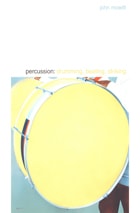
Percussion
Drumming, Beating, StrikingJohn Mowitt
Duke University Press, 2002
Percussion is an attempt—in the author’s words—to make sense of "senseless beating," to grasp how rhythm makes sense in music and society. Both a scholar and a former professional drummer, John Mowitt forges a striking encounter between cultural studies and new musicology that seeks to lay out the "percussive field" through which beating—specifically the backbeat that defines early rock-and-roll—comes to matter for raced, urban subjects.
For Mowitt, percussion is both an experience of embodiment—making contact in and on the skin—and a provocation for critical theory itself. In delimiting the percussive field, he plays drumming off against the musicological account of the beat, the sociological account of shock and the psychoanalytical account of fantasy. In the process he touches on such topics as the separation of slaves and drums in the era of the slave trade, the migration of rural blacks to urban centers of the North, the practice and politics of "rough music," the links between interpellation and possession, the general strike, beating fantasies, and the concept of the "skin ego."
Percussion makes a fresh and provocative contribution to cultural studies, new musicology, the history of the body and critical race theory. It will be of interest to students of cultural studies and critical theory as well as readers with a serious interest in the history of music, rock-and-roll and drumming.
[more]
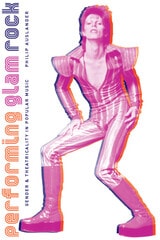
Performing Glam Rock
Gender and Theatricality in Popular MusicPhilip Auslander
University of Michigan Press, 2006
When it first appeared in the early 1970s, glam rock not only caused a stir among audiences and performers, it also stood counterculture and psychedelic rock on their heads. Glam rock was outrageous and overtly theatrical, and its unforgettable characters-adorned with flamboyant costumes and heavy makeup and accompanied by elaborately constructed sets-were personified by performers such as Marc Bolan, David Bowie, Bryan Ferry, and Suzi Quatro. A sea change in rock performance had occurred.
Yet glam was as much about substance as style, and Performing Glam Rock delves into the many ways glam paved the way for new explorations of identity in terms of gender, sexuality, and performance. Philip Auslander positions glam historically and examines it as a set of performance strategies, exploring the ways in which glam rock-while celebrating the showmanship of 1950s rock and roll-began to undermine rock's adherence to the ideology of authenticity in the late 1960s.
In this important study of a too-often-overlooked phenomenon, Auslander takes a fresh look at the genius of the glam movement and introduces glam to a new generation of performance enthusiasts and scholars alike.
Philip Auslander is Professor in the School of Literature, Communication, and Culture at the Georgia Institute of Technology and author of numerous books, including Liveness: Performance in a Mediatized Culture and Presence and Resistance: Postmodernism and Cultural Politics in Contemporary American Performance. He is editor of the major reference work Performance: Critical Concepts and coeditor, with Carrie Sandahl, of Bodies in Commotion: Disability and Performance.
[more]
Pick Up the Pieces
Excursions in Seventies MusicJohn Corbett
University of Chicago Press, 2019
Unless you lived through the 1970s, it seems impossible to understand it at all. Drug delirium, groovy fashion, religious cults, mega corporations, glitzy glam, hard rock, global unrest—from our 2018 perspective, the seventies are often remembered as a bizarre blur of bohemianism and disco. With Pick Up the Pieces, John Corbett transports us back in time to this thrillingly tumultuous era through a playful exploration of its music. Song by song, album by album, he draws our imaginations back into one of the wildest decades in history.
Rock. Disco. Pop. Soul. Jazz. Folk. Funk. The music scene of the 1970s was as varied as it was exhilarating, but the decade’s diversity of sound has never been captured in one book before now. Pick Up the Pieces gives a panoramic view of the era’s music and culture through seventy-eight essays that allow readers to dip in and out of the decade at random or immerse themselves completely in Corbett’s chronological journey.
An inviting mix of skilled music criticism and cultural observation, Pick Up the Pieces is also a coming-of-age story, tracking the author’s absorption in music as he grows from age seven to seventeen. Along with entertaining personal observations and stories, Corbett includes little-known insights into musicians from Pink Floyd, Joni Mitchell, James Brown, and Fleetwood Mac to the Residents, Devo, Gal Costa, and Julius Hemphill.
A master DJ on the page, Corbett takes us through the curated playlist that is Pick Up the Pieces with captivating melody of language and powerful enthusiasm for the era. This funny, energetic book will have readers longing nostalgically for a decade long past.
[more]
Present Tense
Rock & Roll and CultureAnthony DeCurtis, ed.
Duke University Press, 1992
The most compelling art form to emerge from the United States in the second half of the twentieth century, rock & roll stands in an edgy relationship with its own mythology, its own musicological history and the broader culture in which it plays a part. In Present Tense, Anthony DeCurtis brings together writers from a wide variety of fields to explore how rock & roll is made, consumed, and experienced in our time.
In this collection, Greil Marcus creates a collage of words and pictures that evokes and explores Elvis Presley's grisly fate as an American cultural image, while Robert Palmer tells the gripping tale of the origins and meanings of the electric guitar. Rap music, MTV, and the issue of gender identity in the work of Bruce Springsteen all undergo thorough examination; rock & roll's complex relationship with the forces of censorship gets a remarkably fresh reading; and the mainstreaming of rock & roll in the 1980s is detailed and analyzed. And, in an interview with Laurie Anderson and an essay by Atlanta musician Jeff Calder, the artists speak for themselves.
Contributors. Jeff Calder, Anthony DeCurtis, Mark Dery, Paul Evans, Glenn Gass, Trent Hill, Michael Jarrett, Alan Light, Greil Marcus, Robert Palmer, Robert B. Ray, Dan Rubey, David R. Shumway, Martha Nell Smith, Paul Smith
[more]
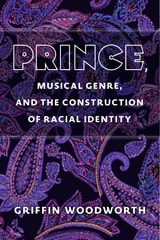
Prince, Musical Genre, and the Construction of Racial Identity
Griffin Woodworth
University of Michigan Press, 2025
Throughout his career, the Minneapolis musician Prince was known for fusing different musical genres as well as moving between different identities—sexual lothario, devout man of God, androgynous sprite—qualities that fit the postmodernism of the 1980s. This volume takes a fresh look at Prince’s work, arguing that his music was deeply informed by the history and techniques of Black culture, and that his multigenre fluency and changeable image were weapons that he deployed in a career-long fight against the racially segregated structures of the American music industry. Using a methodology that mixes musicology with African American literary theory, queer theory, and gender studies, this book analyzes the ways that Prince mixed and manipulated musical genres that are indexed to racial identities—such as “White” rock or new-wave, and “Black” funk, gospel, or R&B—in order to construct pluralistic identities.
Each chapter includes detailed musical analyses and transcriptions of Prince’s songs, focusing on his use of rock guitar, new-wave synthesizers, funk drumming, gospel singing, and R&B horns. By tracking Prince’s transformations of instrumental and vocal idioms derived from specific musical genres, and considering the historical and cultural values embedded within those genres, Griffin Woodworth explores the ways that Prince musically broke down stereotypes of Black masculinity. With its intersectional approach to musical analysis, this book captures the sounds of American racial politics in the 1980s, 90s, and 2000s as heard through the music of one of the era’s most popular artists as he worked to transform and transcend those politics.
Each chapter includes detailed musical analyses and transcriptions of Prince’s songs, focusing on his use of rock guitar, new-wave synthesizers, funk drumming, gospel singing, and R&B horns. By tracking Prince’s transformations of instrumental and vocal idioms derived from specific musical genres, and considering the historical and cultural values embedded within those genres, Griffin Woodworth explores the ways that Prince musically broke down stereotypes of Black masculinity. With its intersectional approach to musical analysis, this book captures the sounds of American racial politics in the 1980s, 90s, and 2000s as heard through the music of one of the era’s most popular artists as he worked to transform and transcend those politics.
[more]