397 books match the query 'Rome' and 20 start with p
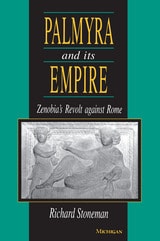
cover of Palmyra and Its Empire: Zenobia's Revolt against Rome

Palmyra and Its Empire

Zenobia's Revolt against Rome

Richard Stoneman

University of Michigan Press, 1995

In the twilight of the third century C.E., the unity of the Western world was threatened by financial crisis, invasion, and plague. The Syrian city Palmyra had long protected Rome against Persian invasion, but under its queen Zenobia, Palmyra broke away from Roman hegemony. The Roman Empire had never been closer to disintegration, nor had it suffered so much before at the hands of a woman.
This volume is the first comprehensive historical treatment in any language of Roman Syria, the revolt of Zenobia, and the city of Palmyra. Drawing on discoveries in archaeology, the history of the Silk Road, numismatics, and Roman and Persian history, Richard Stoneman has assembled a rich collage of knowledge about this intriguing period. As he tells the story of this major revolt and its leader, the author surveys the history of the spice trade in antiquity, the religious ferment of third- century Syria, early modern travelers to Palmyra, and in particular Zenobia's changing image through the ages.
The lucid text and numerous illustrations will attract all who are intrigued by the third- century Roman Empire and its frontiers, by pre-Islamic Arab culture, by Roman Syria and Palmyra itself, and by the fascinating Queen Zenobia.
". . . an excellent synthesis of current knowledge and a sound introduction to the third cen-tury, especially in the East. . . ."--Journal of Military History
". . . Stoneman provides an excellent and readable introduction to what is known about Palmyra, and particularly the astonishing period in the mid-third century A.D. . . . [He] marshalls recent reinterpretations of the politics of the eastern frontier by both historians and archaeologists, as well as the inspiration of his own visits to Syria, to underline Palmyra's unique commercial position and the ability over the centuries of Roman rule of its ethnically and religiously highly heterogeneous ruling class to exploit the caravan trade from East and South Asia to their economic and political advantage."--Greece & Rome
Richard Stoneman has published numerous books on the ancient world and on travel in the Eastern Mediterranean. He is Senior Editor at Routledge.
[more]
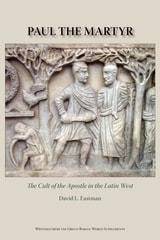
cover of Paul the Martyr: The Cult of the Apostle in the Latin West

Paul the Martyr

The Cult of the Apostle in the Latin West

David L. Eastman

SBL Press, 2011

Ancient iconography of Paul is dominated by one image: Paul as martyr. Whether he is carrying a sword—the traditional instrument of his execution—or receiving a martyr's crown from Christ, the apostle was remembered and honored for his faithfulness to the point of death. As a result, Christians created a cult of Paul, centered on particular holy sites and characterized by practices such as the telling of stories, pilgrimage, and the veneration of relics. This study integrates literary, archaeological, artistic, and liturgical evidence to describe the development of the Pauline cult within the cultural context of the late antique West.
[more]
cover of People, Personal Expression, and Social Relations in Late Antiquity, Volume II: Selected Latin Texts from Gaul and Western Europe

People, Personal Expression, and Social Relations in Late Antiquity, Volume II

Selected Latin Texts from Gaul and Western Europe

Ralph W. Mathisen

University of Michigan Press, 2003

Late Antiquity, which lies between Classical Antiquity and the Middle Ages (ca. A.D. 250-750), heralded the gradual decline of Mediterranean classical civilization, and the initial formation of a strictly western European, Christian society. During this period, three momentous developments threatened the paternalistic Roman social system: the rise of the Christian church, the disintegration of the Roman Empire in the west, and the establishment of the barbarian kingdoms.

The first of its type, this volume presents a collection of Latin source documents illustrating the social upheaval taking place in the Late Roman and early medieval worlds. The texts included in this volume provide the original Latin for the selections that are translated in People, Personal Expression, and Social Relations in Late Antiquity, Volume I. The 140 selected texts gathered from 70 different sources offer the reader firsthand experience with the ways that the Latin language was being used during the transformative period of Late Antiquity.

Ralph W. Mathisen is Professor of Ancient and Byzantine History; Louise Fry Scudder Professor of Humanities; and Director, Biographical Database for Late Antiquity at the University of South Carolina.
[more]
cover of Perspectives of Roman Poetry: A Classics Symposium

Perspectives of Roman Poetry

A Classics Symposium

Edited by G. Karl Galinsky

University of Texas Press, 1974

Written by leading specialists, the essays in Perspectives of Roman Poetry seek to provide a broad range of readers with a good understanding of some essential aspects of major Roman poets and poetic genres. The value of the essays is enhanced, for comparative purposes, by their extensive reference to modern authors. such as Shakespeare and Tolkien. For the modern reader, Latin quotations are accompanied by effective English translations.

The essays and their authors are as follows:

  • "The Woman's Role in Latin Love Poetry," by Georg Luck
  • "Autobiography and Art in Horace," by William S. Anderson
  • "Some Trees in Virgil and Tolkien," by Kenneth J. Reckford
  • "The Business of Roman Comedy," by Erich Segal
  • "Ovid's Metamorphosis of Myth," by G. Karl Galinsky
The preface and concluding panel discussion illumine the situation of literary criticism inthe classics and point out the need for diversity.

Perspectives of Roman Poetry resulted from a symposium held at the University of Texas at Austin in 1972. These essays offer different and, in some cases, heterodox interpretations that will serve as a basis for future discussions.

[more]
cover of Philodemus in Italy: The Books from Herculaneum

Philodemus in Italy

The Books from Herculaneum

Marcello Gigante

University of Michigan Press, 2002
A lively and concise survey of current scholarship on difficult but fascinating texts by this Epicurean poet and philosopher
[more]
cover of Pierio Valeriano on the Ill Fortune of Learned Men: A Renaissance Humanist and His World

Pierio Valeriano on the Ill Fortune of Learned Men

A Renaissance Humanist and His World

Julia Haig Gaisser

University of Michigan Press, 1999
Julia Haig Gaisser provides us with a highly readable translation of and context for the interesting and little known sixteenth-century dialogue, De Litteratorum Infelicitate (On the Ill-Fortune of Learned Men) by Pierio Valeriano. The dialogue between several humanists takes place during Lent, 1529, less than two years after the Sack of Rome and just before the stirrings of the Counter Reformation. These humanists, including Valeriano, are gathered together discussing the lives and unhappy fortunes of humanists from 1470 to 1540. The stories are interesting not only for the direct historical information they provide, but also because they are colored by the knowledge that the glory days of humanism have passed, and the speakers are memorializing a lost era. This first English translation of Valeriano's work contains three sections: an introduction on Valeriano, Roman humanism, and the dialogue; the Latin text and facing English translation with historical notes; and biographies of the humanists involved. Gaisser's delightful book will satisfy all those interested in the world of the Roman humanist, for it elegantly provides a roster of major and minor figures, and the individual stories and characters are shown to be threads of a whole social and intellectual fabric.
[more]
cover of Plautus' Poenulus: A Student Commentary

Plautus' Poenulus

A Student Commentary

Erin K. Moodie

University of Michigan Press, 2015

Erin K. Moodie presents a rigorous yet accessible guide to Plautus’ satirical play Poenulus for use in the contemporary classroom. Likely written and staged in the years following the Second Punic War between Rome and Carthage, Poenulus tells the tale of a young Carthaginian,
the adopted son and heir of the man who purchased him as a slave when he was a child, who is in love with a female Carthaginian slave and prostitute. The comedy, especially Plautus’ portrayal of his main character, compels the reader to consider Rome’s relationship with Carthage, its former enemy; Plautus’ role in choosing and adapting plays for the Roman stage; and the constraints of the palliata genre.

The full Latin text, based primarily on that of Friedrich Leo, is included in this volume. Moodie’s detailed introduction, map, and comprehensive notes approach the text from multiple angles, enabling the advanced undergraduate or graduate student to grapple directly with the issues
Poenulus raises. Her commentary, clearly correlated with specific points in the text by the use of line numbers, provides assistance with early Latin grammar and syntax, Plautine meter, Roman history, and the influences on and performance contexts of Roman comedy. The commentary also introduces students to modern scholarship on the genre, including metatheatrical interpretations and performance criticism.

“A comprehensive, user-friendly tool for students of Plautus and ancient comedy . . . almost everything that a student could ask seems to have been anticipated by the author.”
—Radd Ehrman, Kent State University
 
[more]
cover of Poems from the Greek Anthology: Expanded Edition

Poems from the Greek Anthology

Expanded Edition

Translated, with a Foreword, by Kenneth Rexroth

University of Michigan Press, 1999

"The first translation from the Greek that I ever did was the apple orchard of Sappho in my fifteenth year. It left me so excited with accomplishment that I couldn't sleep well for nights. Since that time, on the freight trains of my youthful years of wandering, in starlit camps on desert and mountain ranges, in snow-covered cabins, on shipboard, in bed, in the bath, in love, in time of loneliness and despair, in jail, while employed as an attendant of the insane, and on many other jobs and in many other places, the Anthology and the lyric poets of Greece have been my constant companions." --Kenneth Rexroth from the Foreword
Friend to the Beats, organizer of the Six Gallery poetry reading in 1955, and iconoclastic poet extraordinare, Kenneth Rexroth here turns his imagination to a selection of verses from the Greek Anthology. In his lively style he successfully captures the spirit of the originals by such poets as Sappho, Anyte, Glykon, Antipatros, Leonidas, Askelpiades, and Ammianos. Students of the classics as well as poets and translators will welcome this collection for the insight and dexterity of its unconventional editor.
Kenneth Rexroth (1905-1982), poet, critic, and translator, is also noted for his translations from the Chinese and Japanese. Widely prolific, he helped usher in the Beat movement in the 1950s and is widely considered to have invented the idea of San Francisco as a center of literary innovation. David Mulroy is Associate Professor in the Department of Foreign Languages and Linguistics, University of Wisconsin, Milwaukee. He is the translator of Early Greek Lyric Poetry and Horace's Odes and Epodes.

[more]
cover of Poetics of the First Punic War

Poetics of the First Punic War

Thomas Biggs

University of Michigan Press, 2020
Poetics of the First Punic War investigates the literary afterlives of Rome’s first conflict with Carthage. From its original role in the Middle Republic as the narrative proving ground for epic’s development out of verse historiography, to its striking cultural reuse during the Augustan and Flavian periods, the First Punic War (264–241 BCE) holds an underappreciated place in the history of Latin literature. Because of the serendipitous meeting of historical content and poetic form in the third century BCE, a textualized First Punic War went on to shape the Latin language and its literary genres, the practices and politics of remembering war, popular visions of Rome as a cultural capital, and numerous influential conceptions of Punic North Africa. Poetics of the First Punic War combines innovative theoretical approaches with advances in the philological analysis of Latin literature to reassess the various “texts” of the First Punic War, including those composed by Vergil, Propertius, Horace, and Silius Italicus. This book also contains sustained treatment of Naevius’ fragmentary Bellum Punicum (Punic War) and Livius Andronicus’ Odusia (Odyssey), some of the earliest works of Latin poetry. As the tradition’s primary Roman topic, the First Punic War is forever bound to these poems, which played a decisive role in transmitting an epic view of history.
[more]
cover of Poetry and the Cult of the Martyrs: The Liber Peristephanon of Prudentius

Poetry and the Cult of the Martyrs

The Liber Peristephanon of Prudentius

Michael Roberts

University of Michigan Press, 1993
Prudentius' Peristephanon is a collection of martyr texts from a vital period for the growth of martyr cult in the West. Building on recent work on the cult of the saints and on the sacralization of the space and time, Roberts demonstrates how the Peristephanon relates to developments in late fourth century spirituality.
The author examines how Prudentius creates an idiom to express devotion to the martyrs, particularly in the structuring of narrative and the use of poetic language. Roberts concludes by demonstrating how Prudentius employs the model of martyr cult to articulate the status of Christian literature, the role of the bishop in the Christian community, and the symbolic status of Rome in the Christian West.
Michael Roberts is Robert Rich Professor of Latin, Wesleyan University.
Jacket art: Gold-glass vase, after A.D. 350. By permission of the Trustees of the British Museum.
[more]
cover of Pompeii's Living Statues: Ancient Roman Lives Stolen from Death

Pompeii's Living Statues

Ancient Roman Lives Stolen from Death

Eugene Dwyer

University of Michigan Press, 2010

In AD 79, Mt. Vesuvius erupted in two stages. While the first stage was incredibly destructive, it was the second stage, a so-called pyroclastic flow, that inundated Pompeii with a combination of superheated gases, pumice, and rocks, killing tens of thousands of people and animals and burying them in ash and mud.

During excavations of the town in 1863, Giuseppe Fiorelli, the director of the dig, poured plaster of paris into a cavity under the soil revealed by a workman's pick. When the plaster set and the mound was uncovered, all were amazed to see the secret that the ground had held for 1,800 years: a detailed cast of an ancient Pompeian such as no one had seen before, frozen in the instant of dying and complete in every respect, including outlines of the clothes he was wearing at the time of the destruction. The bodies, photographed and exhibited in the specially built Pompeii Museum, completely changed the world's ideas of life in ancient Italy.

Pompeii's Living Statues is a narrative account, supported by contemporary documents, of the remarkable discovery of those ancient victims preserved in the volcanic mud of Vesuvius.

Eugene Dwyer examines these casts and related records, the originals of a number of which (along with their museum) were lost in World War II bombing. As he considers the casts as archaeological and cultural pieces, he also discusses Pompeii and its artifacts in the context of Italian unification and party politics, the development of modern excavation methods, and the challenges of maintaining a very large archaeological site. Dwyer's clear organization and writing style, combined with a collection of photographs and engravings, make for a fascinating exploration of Pompeii and its victims.
[more]
cover of Pomponius Mela's Description of the World

Pomponius Mela's Description of the World

F. E. Romer

University of Michigan Press, 1998

The Description of the World (Chorographia), written by Pomponius Mela, was last translated into English over 400 years ago, and is the earliest surviving geographical work in Latin. Although first published at the height of the Roman Empire, in roughly 44 C.E., Pomponius Mela's work circulated during Europe's great Age of Exploration. His description is in the form of a voyage around the three "known" continents--Africa, Asia, and Europe. Mela integrates geographical description with more familiar historical, cultural, and mythological information. F. E. Romer's translation and commentary on this work help the reader to appreciate the intellectual and physical shape of the ancient world as Mela and the Romans perceived it.
Frank Romer's introduction assesses Mela as a literary and geographic writer, while his translation matches Mela's style. Mela knows of the Chinese and reports geographical and cultural information about Sri Lanka and India, as well as Mediterranean and European locales that are less remote to his experience. The outer edges of all the continents, including Europe, however, remained unfamiliar to the Romans, and it is on the inhabited world's outer edges that the creatures of legend and mythology were believed to live. Romer's commentary clarifies specific ideas raised in the text. He identifies and explains issues, and he points the reader to ancient sources and modern studies.
This new study will intrigue students and teachers of ancient history. This edition of Mela's geography will be of interest to map lovers, historians, classicists, and anyone interested in history of travel, geography, and education.

F.E. Romer is Professor and Chair of the Department of Foreign Languages and Literatures, East Carolina University. He is the author of numerous articles and has received awards for both his writing and teaching.
[more]
cover of Populus: Living and Dying in Ancient Rome

Populus

Living and Dying in Ancient Rome

Guy de la Bédoyère

University of Chicago Press, 2024

This revealing look at life in ancient Rome offers a compelling journey through the vivid landscape of politics, domestic life, entertainment, and inequality experienced daily by Romans of all social strata.

Frenzied crowds, talking ravens, the stench of the Tiber River: life in ancient Rome was stimulating, dynamic, and often downright dangerous. The Romans relaxed and gossiped in baths, stole precious water from aqueducts, and partied and dined to excess. Everyone from senators to the enslaved crowded into theaters and circuses to watch their favorite singers, pantomime, and comedies and scream their approval at charioteers. The lucky celebrated their accomplishments with elaborate tombs. Amid pervasive inequality and brutality, beauty also flourished through architecture, poetry, and art.
 
From the smells of fragrant cookshops and religious sacrifices to the cries of public executions and murderous electoral mobs, Guy de la Bédoyère’s Populus draws on a host of historical and literary sources to transport us into the intensity of daily life at the height of ancient Rome.
 
[more]
cover of Portraits of the Vestal Virgins, Priestesses of Ancient Rome

Portraits of the Vestal Virgins, Priestesses of Ancient Rome

Molly M. Lindner

University of Michigan Press, 2015
For more than eleven hundred years, the Vestal Virgins dedicated their lives to the goddess Vesta, protector of the Roman state. Though supervised by a male priest, the Pontifex Maximus, they had privileges beyond those of most women; like Roman men, they dispensed favors and influence on behalf of their clients and relatives. In 1883, Rodolfo Lanciani, Director of Antiquities for Rome, discovered the first Vestal statues. The recovery of the Vestals’ house, and the objects contained therein, was an exciting moment in Roman archaeology. Newspapers were filled with details about the huge numbers of sculptures, inscriptions, jewelry, coins, and terracotta figures.

Molly M. Lindner examines the sculptural presentation of the Vestal Virgins and investigates what images of long-dead women tell us about their lives. She addresses why these portraits were created, and why they only began to appear in the late first or second century CE—much later than portraits of other Roman priestesses and nonimperial women. Lindner sheds light on the distinctions between a Vestal portrait and portraits of other priestesses, and considers why Vestal portraits do not copy each other’s headdresses and hairstyles. In addition to the extensive illustrations that complement the text, a catalog of all known Vestal portraits displays historical clues embedded in the hairstyles and facial features of the Vestals and other women of their day. In Portraits of the Vestal Virgins, Priestesses of Ancient Rome, Lindner has given a voice to the long-silent women of these extraordinary marble portraits.
 
[more]
cover of Poverty and Leadership in the Later Roman Empire

Poverty and Leadership in the Later Roman Empire

Peter Brown

Brandeis University Press, 2001
In three magisterial essays, Peter Brown, one of the world's foremost scholars of the society and culture of late antiquity, explores the emergence in late Roman society of "the poor" as a distinct social class, one for which the Christian church claimed a special responsibility. It is the story of how a society came to see itself as responsible for the care of a particular class of people -- a class that had not previously been cared for -- and of who benefited from that shift in interests. In his characteristically elegant and lucid prose, Brown seeks to recover the pre-Christian status of poor people, the actual nature of the relations between the Christian church and the poor, and the true motivations -- sometimes sincere, sometimes self-serving -- behind Christian rhetoric of love for the poor. He draws not only on the standard Greek and Latin sources for the later Roman Empire, but also on Jewish sources to document the interactions between Middle Eastern provincial societies and classical Roman traditions. Brown gracefully illuminates a crucial transition from classical to Christian culture: the emergence of a new understanding of what society -- and the Church -- owes to the poor that continues to resonate.
[more]
cover of Power & Persuasion Late Antiquity: Towards A Christian Empire

Power & Persuasion Late Antiquity

Towards A Christian Empire

Peter Brown

University of Wisconsin Press, 1992
Peter Brown, perhaps the greatest living authority on Mediterranean civilization in late antiquity, traces the growing power of Christian bishops as they wrested influence from philosophers, who had traditionally advised the rulers of Graeco-Roman society.  In the new “Christian empire,” the ancient bonds of citizen to citizen and of each city to its benefactors were replaced by a common Christianity and common loyalty to a distant, Christian autocrat.  This transformation of the Roman empire from an ancient to a medieval society, he argues, is among the most far-reaching consequences of the rise of Christianity.
[more]
cover of Princes and Political Cultures: The New Tiberian Senatorial Decrees

Princes and Political Cultures

The New Tiberian Senatorial Decrees

Greg Rowe

University of Michigan Press, 2002
An investigation of the transformation of the Roman state from Republic to dynastic monarchy
[more]
cover of Prostitutes and Courtesans in the Ancient World

Prostitutes and Courtesans in the Ancient World

Edited by Christopher A. Faraone and Laura K. McClure

University of Wisconsin Press, 2006

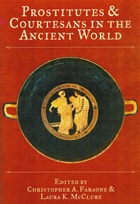
    Prostitutes and Courtesans in the Ancient World explores the implications of sex-for-pay across a broad span of time, from ancient Mesopotamia to the early Christian period. In ancient times, although they were socially marginal, prostitutes connected with almost every aspect of daily life. They sat in brothels and walked the streets; they paid taxes and set up dedications in religious sanctuaries; they appeared as characters—sometimes admirable, sometimes despicable—on the comic stage and in the law courts; they lived lavishly, consorting with famous poets and politicians; and they participated in otherwise all-male banquets and drinking parties, where they aroused jealousy among their anxious lovers.

    The chapters in this volume examine a wide variety of genres and sources, from legal and religious tracts to the genres of lyric poetry, love elegy, and comic drama to the graffiti scrawled on the walls of ancient Pompeii. These essays reflect the variety and vitality of the debates engendered by the last three decades of research by confronting the ambiguous terms for prostitution in ancient languages, the difficulty of distinguishing the prostitute from the woman who is merely promiscuous or adulterous, the question of whether sacred or temple prostitution actually existed in the ancient Near East and Greece, and the political and social implications of literary representations of prostitutes and courtesans.
[more]
cover of Provincial Soldiers and Imperial Instability in the Histories of Tacitus

Provincial Soldiers and Imperial Instability in the Histories of Tacitus

Jonathan Master

University of Michigan Press, 2016

Tacitus’ narrative of 69 CE, the year of the four emperors, is famous for its description of a series of coups that sees one man after another crowned. Many scholars seem to read Tacitus as though he wrote only about the constricted world of imperial Rome and the machinations of emperors, courtiers, and victims of the principate; even recent work on the Histories either passes over or lightly touches upon civil unrest and revolts in the provinces. In Provincial Soldiers and Imperial Instability in the Histories of Tacitus, Jonathan Master looks beyond imperial politics and finds threats to the Empire’s stability among unassimilated foreign subjects who were made to fight in the Roman army.

Master draws on scholarship in political theory, Latin historiography, Roman history, and ethnic identity to demonstrate how Tacitus presented to his contemporary audience in Trajanic Rome the dangerous consequences of the city’s failure to reward and incorporate its provincial subjects. Master argues that Tacitus’ presentation of the Vitellian and Flavian armies, and especially the Batavian auxiliary soldiers, reflects a central lesson of the Histories: the Empire’s exploitation of provincial manpower (increasingly the majority of all soldiers under Roman banners) while offering little in return, set the stage for civil wars and ultimately the separatist Batavian revolt.
[more]
cover of Public Office in Early Rome: Ritual Procedure and Political Practice

Public Office in Early Rome

Ritual Procedure and Political Practice

Roberta Stewart

University of Michigan Press, 2010

". . . [A]n excellent, erudite book."
---Bryn Mawr Classical Review
 
Studies of Roman politics have traditionally emphasized individual personalities or groups of personalities and have explained political behavior in terms of contests for individual power or group power. By contrast, Roberta Stewart focuses on being the religious institution of the "allotment" of duties among elected officials as a primary control on Roman politics. She examines in detail the procedure of allotment, the roles of popular election and allotment in defining public authority and duty, and the relationship between the Roman Senate and elected officials. Allotment is seen to reflect Republican ideology about the divine sanction of Roman leadership, military enterprise, and empire.
 
Allotment is examined in particular historical contexts, and the successive formations of public office in 444, 367, and 242 b.c.e. are analyzed as a series of political solutions in an evolving cultural context. The discussion documents the ritual definition of allotments and the historical development of distinctive features of Republican political office: the equal authority of colleagues (collegiality), the individual authority and accountability for an allotted function (provincia), the procedural alternative to allotment (comparatio), and the hierarchy of offices with imperium (the consuls and praetors).
Public Office in Early Rome will be of great interest for scholars and students of Roman religion, government, and history.
 
Roberta Stewart is Associate Professor of Classics, Dartmouth College.
[more]