Results by title
67 books match the query 'Segregation' and 5 start with p

Palestinians in Israel
Segregation, Discrimination and DemocracyBen White
Pluto Press, 2012
Palestinians in Israel considers a key issue ignored by the official 'peace process' and most mainstream commentators: that of the growing Palestinian minority within Israel itself.
What the Israeli right-wing calls 'the demographic problem' Ben White identifies as 'the democratic problem' which goes to the heart of the conflict. Israel defines itself not as a state of its citizens, but as a Jewish state, despite the substantial and increasing Palestinian population. White demonstrates how the consistent emphasis on privileging one ethno-religious group over another cannot be seen as compatible with democratic values and that, unless addressed, will undermine any attempts to find a lasting peace.
Individual case studies are used to complement this deeply informed study into the great, unspoken contradiction of Israeli democracy. It is a pioneering contribution which will spark debate amongst all those concerned with a resolution to the Israel/Palestine conflict.
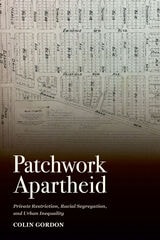
Patchwork Apartheid
Private Restriction, Racial Segregation, and Urban InequalityColin Gordon
Russell Sage Foundation, 2023
Gordon also explores the role of other policies and practices in sustaining segregation. Enforcement of private racial restrictions was held unconstitutional in 1948, and such agreements were prohibited outright in 1968. But their premises and assumptions, and the segregation they had accomplished, were accommodated by local zoning and federal housing policies. Explicit racial restrictions were replaced by the deceptive business practices of real estate agents and developers, who characterized certain neighborhoods as white and desirable and others as black and undesirable, thereby hiding segregation behind the promotion of sound property investments, safe neighborhoods, and good schools. These practices were in turn replaced by local zoning, which systematically protected white neighborhoods while targeting “blighted” black neighborhoods for commercial and industrial redevelopment, and by a tangle of federal policies that reliably deferred to local and private interests with deep investments in local segregation. Private race restriction was thus a key element in the original segregation of American cities and a source of durable inequalities in housing wealth, housing opportunity, and economic mobility.
Patchwork Apartheid exhaustively documents the history of private restriction in urban settings and demonstrates its crucial role in the ideas and assumptions that have sustained racial segregation in the United States into the twenty-first century.

Political Economy of the Urban Ghetto
Daniel R. Fusfeld and Timothy Bates
Southern Illinois University Press, 1984
The income of blacks in most northern industrial states today is lower relative to the income of whites than in 1949.Fusfeld and Bates examine the forces that have led to this state of affairs and find that these economic relationships are the product of a complex pattern of historical development and change in which black-white economic relationships play a major part, along with patterns of industrial, agricultural, and technological change and urban development. They argue that today’s urban racial ghettos are the result of the same forces that created modern America and that one of the by-products of American affluence is a ghettoized racial underclass.
These two themes, they state, are essential for an understanding of the problem and for the formulation of policy. Poverty is not simply the result of poor education, skills, and work habits but one outcome of the structure and functioning of the economy. Solutions require more than policies that seek to change people: they await a recognition that basic economic relationships must be changed.

Primary Lessons
Sarah Bracey White
CavanKerry Press, 2013
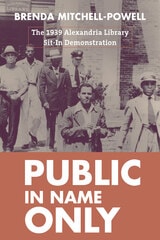
Public in Name Only
The 1939 Alexandria Library Sit-In DemonstrationBrenda Mitchell-Powell
University of Massachusetts Press, 2022
Library History Round Table Reads Selection, March 2024
Alexandria Historical Society Special Merit Award, 2023
When Alexandria, Virginia’s first public library, was constructed just a few blocks from his home, Samuel Wilbert Tucker, a young, Black attorney, was appalled to learn that he could not use the library because of his race. Inspired by the legal successes of the NAACP in discrimination cases, he organized a grassroots protest to desegregate the library that his tax dollars supported.
Public in Name Only tells the important, but largely forgotten, story of Tucker and a group of Black citizens who agitated for change in the terms and conditions of their lives. Employing the combined strategies of direct-action public protest, nonviolent civil disobedience, and municipal litigation, Tucker’s initiative dovetailed with the national priorities and tactics of larger civil rights organizations. While Tucker’s campaign did not end with the desegregation of the Alexandria Library, but instead resulted in the creation of a “separate-and-unequal” Jim Crow Black branch, the sit-in demonstration represents a momentous early struggle for racial equity waged through civil rights activism.