Results by title
94 books match the query 'Services for' and 13 start with p

Parallel Views
Education and Access for Deaf People in France and the United StatesThe French American Foundation
Gallaudet University Press, 1994
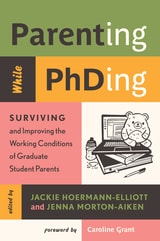
Parenting While PhDing
Surviving and Improving the Working Conditions of Graduate Student ParentsJackie Hoermann-Elliott
Rutgers University Press, 2025
Featuring contributions from more than forty current and former graduate students raising children, Parenting While PhDing offers valuable advice for students and administrators. Parents will get practical recommendations on both child care and self-care, learning how to form supportive personal and professional networks while establishing a healthy work/life balance. The collection also offers thoughtful suggestions on how to make graduate programs less toxic and more inclusive.
Recognizing that not all graduate students have similar backgrounds or needs, Parenting While PhDing features a diverse range of viewpoints, including queer, trans, disabled, BIPOC, immigrant, and first-generation college students. The authors represent a variety of disciplines, from the natural and social sciences to the humanities and health care professions. Together, they share fresh perspectives on the experiences of graduate students with children and offer strategies they can use to navigate the dual pressures of the academy and parenting.
Parents and Their Deaf Children
The Early YearsKathryn P. Meadow-Orlans
Gallaudet University Press, 2003
To correct the paucity of information on deaf or hard of hearing children and their parents’ experiences with early intervention services, researchers explored these relationships as part of the National Parent Project. From this investigation, Parents and Their Deaf Children details the experiences of a group of parents and their deaf children from the first identification of the latter’s hearing loss through their early years in elementary school. Renowned scholars Kathryn Meadow-Orlans, Donna Mertens, and Marilyn Sass-Lehrer reveal here for the first time the goals and expectations of the parents, the children’s achievements and troubles, and the families’ satisfaction and disappointment with health and educational systems.
Parents and their Deaf Children stems from a nationwide survey of parents with six-to-seven-year-old deaf or hard of hearing children, followed up by interviews with 80 parents. The authors not only discuss the parents’ communication choices for their children, but also provide how parents’ experiences differ, especially for those whose children are hard of hearing, have additional conditions, or have cochlear implants. Also, one chapter is devoted to families from minority cultures. The final section of this distinctive study offers solid advice for other parents of deaf children and also the professionals who serve them.
Patients of the State
The Politics of Waiting in ArgentinaJavier Auyero
Duke University Press, 2012
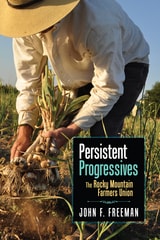
Persistent Progressives
The Rocky Mountain Farmers UnionJohn F. Freeman
University Press of Colorado, 2015
Using data spanning decades, author John Freeman covers the founding of the RMFU in 1907 until the present, demonstrating how members continually sought to control the means of production and marketing by forming cooperatives, providing consumer services, and engaging in politics. Powering this evolution was a group of “practical idealists”—the Farmers Union leaders and titular persistent progressives who shaped the organization’s growth and expansion. Initiated by Jim Patton, who brought the organization out of its oppositional roots and into its cooperative advocacy, the RMFU passed to John Stencel and then David Carter, joining hands with agricultural conservationists and small organic producers along the way to carry the torch for progressive agrarianism in today’s urbanized world. Shaken but undeterred by some notable failures, its leadership remains convinced of the efficacy of cooperatives as a means to achieve justice for all.
Discussing the broader social, economic, political, and environmental issues related to farming, ranching, and urbanization, Persistent Progressives seamlessly blends regional history with ongoing issues of agricultural and economic development.
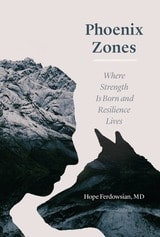
Phoenix Zones
Where Strength Is Born and Resilience LivesHope Ferdowsian, MD
University of Chicago Press, 2018
With Phoenix Zones, Dr. Hope Ferdowsian shows us how. Ferdowsian has spent years traveling the world to work with people and animals who have endured trauma—war, abuse, displacement. Here, she combines compelling stories of survivors with the latest science on resilience to help us understand the link between violence against people and animals and the biological foundations of recovery, peace, and hope. Taking us to the sanctuaries that give the book its title, she reveals how the injured can heal and thrive if we attend to key principles: respect for liberty and sovereignty, a commitment to love and tolerance, the promotion of justice, and a fundamental belief that each individual possesses dignity. Courageous tales show us how: stories of combat veterans and wolves recovering together at a California refuge, Congolese women thriving in one of the most dangerous places on earth, abused chimpanzees finding peace in a Washington sanctuary, and refugees seeking care at Ferdowsian’s own medical clinic.
These are not easy stories. Suffering is real, and recovery is hard. But resilience is real, too, and Phoenix Zones shows how we can foster it. It reveals how both people and animals deserve a chance to live up to their full potential—and how such a view could inspire solutions to some of the greatest challenges of our time.
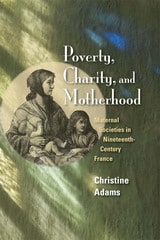
Poverty, Charity, and Motherhood
Maternal Societies in Nineteenth-Century FranceChristine Adams
University of Illinois Press, 2010
Power to the Transfer
Critical Race Theory and a Transfer Receptive CultureDimpal Jain
Michigan State University Press, 2020
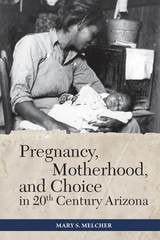
Pregnancy, Motherhood, and Choice in Twentieth-Century Arizona
Mary S. Melcher
University of Arizona Press, 2012
Early twentieth-century Arizona was a life-threatening place for new and expectant mothers. Towns were small and very far apart, and the weather and harsh landscape often delayed midwives. It was not uncommon for a woman to give birth without medical care and with the aid of only family members. By the 1920s, Arizona was at the top of the list for the highest number of infant deaths.
Mary Melcher’s Pregnancy, Motherhood, and Choice in Twentieth-Century Arizona provides a deep and diverse history of the dramatic changes in childbirth, birth control, infant mortality, and abortion over the course of the last century. Using oral histories, memoirs, newspaper accounts, government documents, letters, photos, and biographical collections, this fine-grained study of women’s reproductive health places the voices of real women at the forefront of the narrative, providing a personal view into some of the most intense experiences of their lives.
Tackling difficult issues such as disparities in reproductive health care based on race and class, abortion, and birth control, this book seeks to change the way the world looks at women’s health. An essential read for both historians and public health officials, this book reveals that many of the choices and challenges that women once faced remain even today.
Prescription TV
Therapeutic Discourse in the Hospital and at HomeJoy V. Fuqua
Duke University Press, 2012
Professional Autonomy in Video Relay Service Interpreting
Erica Alley
Gallaudet University Press, 2019
Alley considers the question of how VRS fits into the professional field of interpreting, and discovers that—regardless of the profit-focused mentality of VRS providers—interpreters make decisions with the goal of creating quality customer service experiences for deaf consumers, even if it means “breaking the rules.” Her findings shed light on the decision-making process of interpreters and how their actions are governed by principles of self-care, care for colleagues, and concern for the quality of services provided. Professional Autonomy in Video Relay Service Interpreting is essential reading in interpreter education courses and interpreter training programs.

Programming for Children and Teens with Autism Spectrum Disorder
Barbara Klipper
American Library Association, 2014
Promoting Positive Transition Outcomes
Effective Planning for Deaf and Hard of Hearing Young AdultsPamela Luft
Gallaudet University Press, 2016
Promoting Positive Transition Outcomes is the most comprehensive discussion of transition planning and results for DHH students now available. Luft begins with an overview of the historical and current challenges to DHH students and their academic and vocational potential. She explores the importance of forming an identity and building foundational social and problem-solving skills. She then reviews the history of rehabilitation and workforce legislation, which now mandates that every student with an individualized education plan (IEP) have a transition plan in place by the age of 16. Most schools, however, are not equipped to meet the needs of a population as diverse as DHH students. She examines the services that are currently available in high schools and offers recommendations for strengthening transition team planning by reaching out to external experts. The volume concludes with suggestions for creating a framework to address the challenges of transition planning for deaf and hard of hearing students and offers guidance on building effective plans.