254 books match the query 'Sex' and 10 start with p
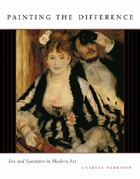
cover of Painting the Difference: Sex and Spectator in Modern Art

Painting the Difference

Sex and Spectator in Modern Art

Charles Harrison

University of Chicago Press, 2005

The picture plane of a painting creates boundaries and perspectives. It governs the relationship of daubs of pigment on a canvas to reality, allowing the viewer to connect with the imagined world of a work of art. Charles Harrison's latest endeavor, Painting the Difference, explores the role of the picture plane in modern painting and the relationships it creates among the artist, the subject, and the spectator. One of the most respected teachers and theorists of modern art, Harrison here offers a bold interpretation of the Modernist canon that uncovers the significance of gender to the functioning of the picture plane.

Arguing that the representation of women in art was crucial to the character of modernity, Harrison traces the history of female subjects as they began to gaze out of the picture to confront and engage their viewers. Combining sweeping conceptual history with telling investigations into the details of particular paintings, Painting the Difference deciphers the implications of sexual difference for the development of nineteenth- and twentieth-century art. Harrison shows how artists, reflecting the underlying anxieties of the time about gender, used female subjects' gazes both to create a sexualized relationship between these subjects and their viewers, and to simultaneously question that relationship. In considering works by artists such as Renoir, Manet, Degas, Cézanne, Picasso, and Matisse, as well as Rothko, Warhol, Cindy Sherman, and many more, Harrison incorporates elements of cultural criticism and social history into his arguments, and generous color illustrations permit the reader to test Harrison's claims against the works on which they are based. Rich with detail and compelling analysis, Painting the Difference offers cutting-edge interpretation grounded in the reality of magnificent works of art.

[more]
cover of Paradoxes of Hawaiian Sovereignty: Land, Sex, and the Colonial Politics of State Nationalism

Paradoxes of Hawaiian Sovereignty

Land, Sex, and the Colonial Politics of State Nationalism

J. Kehaulani Kauanui

Duke University Press, 2018

In Paradoxes of Hawaiian Sovereignty J. Kēhaulani Kauanui examines contradictions of indigeneity and self-determination in U.S. domestic policy and international law. She theorizes paradoxes in the laws themselves and in nationalist assertions of Hawaiian Kingdom restoration and demands for U.S. deoccupation, which echo colonialist models of governance. Kauanui argues that Hawaiian elites' approaches to reforming and regulating land, gender, and sexuality in the early nineteenth century that paved the way for sovereign recognition of the kingdom complicate contemporary nationalist activism today, which too often includes disavowing the indigeneity of the Kanaka Maoli (Indigenous Hawaiian) people. Problematizing the ways the positing of the Hawaiian Kingdom's continued existence has been accompanied by a denial of U.S. settler colonialism, Kauanui considers possibilities for a decolonial approach to Hawaiian sovereignty that would address the privatization and capitalist development of land and the ongoing legacy of the imposition of heteropatriarchal modes of social relations.
[more]
cover of Passionate and Pious: Religious Media and Black Women's Sexuality

Passionate and Pious

Religious Media and Black Women's Sexuality

Monique Moultrie

Duke University Press, 2018

In Passionate and Pious Monique Moultrie explores the impact of faith-based sexual ministries on black women's sexual agency to trace how these women navigate sexuality, religious authority, and their spiritual walk with God. Providing churchwomen a space to candidly discuss these issues, these popular ministries exist largely beyond the traditional church, with dialogues about sex taking place in chat rooms and through text messages, social media, email, and other media. Moultrie foregrounds televangelist Juanita Bynum's construction of the black Christian sexual identity these ministries promote while emphasizing how churchwomen reconcile these prescriptive identities with their individual experiences. What does it mean for senior women to exercise sexual agency when their church standing could be questioned? What does celibacy mean for women who experience same-sex desire while believing that such desire goes against God's will? Advancing a womanist sexual ethics, Moultrie reframes biblical interpretations and conceptions of what constitutes a healthy relationship to provide a basis for sexual decision making that does not privilege monogamy or deny female pleasure, thereby calling on black churchwomen to experience responsible and life-enhancing sex.
[more]
cover of People's Pornography: Sex and Surveillance on the Chinese Internet

People's Pornography

Sex and Surveillance on the Chinese Internet

Katrien Jacobs

Intellect Books, 2012

 Since its establishment in 1949, the People's Republic of China has upheld a nationwide ban on pornography, imposing harsh punishments on those caught purchasing, producing, or distributing materials deemed a violation of public morality. A provocative contribution to Chinese media studies by a well-known international media researcher, People’s Pornography offers a wide-ranging overview of the political controversies surrounding the ban, as well as a fascinating glimpse into the many distinct media subcultures that have gained widespread popularity on the Chinese Internet as a result. Rounding out this exploration of the many new tendencies in digital citizenship, pornography, and activist media cultures in the greater China region are thought-provoking interviews with individuals involved.

A timely contribution to the existing literature on sexuality, Chinese media, and Internet culture, People’s Pornography provides a unique angle on the robust voices involved in the debate over about pornography’s globalization.
[more]
cover of Philosophies of Sex: Critical Essays on The Hermaphrodite

Philosophies of Sex

Critical Essays on The Hermaphrodite

Edited and with an introduction by Renée Bergland and Gary Williams

The Ohio State University Press, 2012
Philosophies of Sex: Critical Essays on The Hermaphrodite is the first collection of critical studies of Julia Ward Howe’s long-secret novel that, since its initial publication in 2004, has caused a seismic shift in how we understand gender awareness and sexuality in antebellum America. Howe figures in the history of the nineteenth-century American literature primarily as a poet, most famous for having written the lyrics to “Battle Hymn of the Republic.” Renée Bergland and Gary Williams have assembled a luminous array of essays by eminent scholars of the nineteenth-century American literature, providing fascinating—and widely differing—contexts in which to understand Howe’s venture into territory altogether foreign to American writers in her day.   An introduction by Bergland and Williams traces the (re)discovery of Howe’s manuscript and the beginnings of commentary as word spread about this remarkable text. Mary Grant, an early reader, invokes the excitement and frontier spirit of women’s history in the 1970s. Marianne Noble and Laura Saltz place the narrative within the frames of European and American Romanticism and of Howe’s other writings. Betsy Klimasmith, Williams, Bethany Schneider, and Joyce Warren explore connections between Howe’s novel and other ground-breaking nineteenth-century works on gender, sexuality, and relationship. Bergland and Suzanne Ashworth explore The Hermaphrodite’s suggestive invocations of two other kinds of “texts”: sculpture and theology.
[more]
cover of Pleasure in the News: African American Readership and Sexuality in the Black Press

Pleasure in the News

African American Readership and Sexuality in the Black Press

Kim T. Gallon

University of Illinois Press, 2020

Critics often chastised the twentieth-century black press for focusing on sex and scandal rather than African American achievements. In Pleasure in the News, Kim Gallon takes an opposing stance—arguing that African American newspapers fostered black sexual expression, agency, and identity.

Gallon discusses how journalists and editors created black sexual publics that offered everyday African Americans opportunities to discuss sexual topics that exposed class and gender tensions. While black churches and black schools often encouraged sexual restraint, the black press printed stories that complicated notions about respectability. Sensational coverage also expanded African American women’s sexual consciousness and demonstrated the tenuous position of female impersonators, black gay men, and black lesbians in early twentieth African American urban communities.

Informative and empowering, Pleasure in the News redefines the significance of the black press in African American history and advancement while shedding light on the important cultural and social role that sexuality played in the power of the black press.

[more]
cover of Pleasures Taken: Performances of Sexuality and Loss in Victorian Photographs

Pleasures Taken

Performances of Sexuality and Loss in Victorian Photographs

Carol Mavor

Duke University Press, 1995

An intimate look into three Victorian photo-settings, Pleasures Taken considers questions of loss and sexuality as they are raised by some of the most compelling and often misrepresented photographs of the era: Lewis Carroll’s photographs of young girls; Julia Margaret Cameron’s photographs of Madonnas; and the photographs of Hannah Cullwick, a "maid of all work," who had herself pictured in a range of masquerades, from a blackened chimney sweep to a bare-chested Magdalene. Reading these settings performatively, Carol Mavor shifts the focus toward the subjectivity of these girls and women, and toward herself as a writer.
Mavor’s original approach to these photographs emphatically sees sexuality where it has been previously rendered invisible. She insists that the sexuality of the girls in Carroll’s pictures is not only present, but deserves recognition, respect, and scrutiny. Similarly, she sees in Cameron’s photographs of sensual Madonnas surprising visions of motherhood that outstrip both Victorian and contemporary understandings of the maternal as untouchable and inviolate, without sexuality. Finally she shows how Hannah Cullwick, posing in various masquerades for her secret paramour, emerges as a subject with desires rather than simply a victim of her upper-class partner. Even when confronting the darker areas of these photographs, Mavor perseveres in her insistence on the pleasures taken—by the viewer, the photographer, and often by the model herself—in the act of imagining these sexualities. Inspired by Roland Barthes, and drawing on other theorists such as Julia Kristeva and Luce Irigaray, Mavor creates a text that is at once interdisciplinary, personal, and profoundly pleasurable.
[more]
cover of Pleasures and Perils: Girls' Sexuality in a Caribbean Consumer Culture

Pleasures and Perils

Girls' Sexuality in a Caribbean Consumer Culture

Curtis, Debra

Rutgers University Press, 2009

Pleasures and Perils follows a group of young girls living on Nevis, an island society in the Eastern Caribbean. In this provocative ethnography, Debra Curtis examines their sexuality in gripping detail: why do Nevisian girls engage in sexual activity at such young ages? Where is the line between coercion and consent? How does a desire for wealth affect a girl's sexual practices?

Curtis shows that girls are often caught between conflicting discourses of Christian teachings about chastity, public health cautions about safe sex, and media enticements about consumer delights. Sexuality's contradictions are exposed: power and powerless¡ness, self-determination and cultural control, violence and pleasure. Pleasures and Perils illuminates the methodological and ethical issues anthropologists face when they conduct research on sex, especially among girls. The sexually explicit narratives conveyed in this book challenge not only the reader's own thoughts on sexuality but also the broader limits and possibilities of ethnography.

 

[more]
cover of Porno Chic and the Sex Wars: American Sexual Representation in the 1970s

Porno Chic and the Sex Wars

American Sexual Representation in the 1970s

Carolyn Bronstein

University of Massachusetts Press, 2016

For many Americans, the emergence of a “porno chic” culture provided an opportunity to embrace the sexual revolution by attending a film like Deep Throat (1972) or leafing through an erotic magazine like Penthouse. By the 1980s, this pornographic moment was beaten back by the rise of Reagan-era political conservatism and feminist anti-pornography sentiment.

This volume places pornography at the heart of the 1970s American experience, exploring lesser-known forms of pornography from the decade, such as a new, vibrant gay porn genre; transsexual/female impersonator magazines; and pornography for new users, including women and conservative Christians. The collection also explores the rise of a culture of porn film auteurs and stars as well as the transition from film to video. As the corpus of adult ephemera of the 1970s disintegrates, much of it never to be professionally restored and archived, these essays seek to document what pornography meant to its producers and consumers at a pivotal moment.

In addition to the volume editors, contributors include Peter Alilunas, Gillian Frank, Elizabeth Fraterrigo, Lucas Hilderbrand, Nancy Semin Lingo, Laura Helen Marks, Nicholas Matte, Jennifer Christine Nash, Joe Rubin, Alex Warner, Leigh Ann Wheeler, and Greg Youmans.
[more]
cover of Pretty Modern: Beauty, Sex, and Plastic Surgery in Brazil

Pretty Modern

Beauty, Sex, and Plastic Surgery in Brazil

Alexander Edmonds

Duke University Press, 2010

Pretty Modern is a riveting account of Brazil’s emergence as a global leader in plastic surgery. Intrigued by a Carnaval parade that mysteriously paid homage to a Rio de Janeiro plastic surgeon, anthropologist Alexander Edmonds conducted research that took him from Ipanema socialite circles to glitzy telenovela studios to the packed waiting rooms of public hospitals offering free cosmetic surgery. The result is provocative exploration of the erotic, commercial, and intimate aspects of beauty in a nation with extremes of wealth and poverty and a reputation for natural sensuality. Drawing on conversations with maids and their elite mistresses, divorced housewives, black celebrities, and favela residents aspiring to be fashion models, Edmonds analyzes what sexual desirability means and does for women in different social positions. He argues that beauty is a distinct realm of modern experience that does not simply reflect other inequalities. It mimics the ambiguous emancipatory potential of capital, challenging traditional hierarchies while luring consumers into a sexual culture that reduces the body to the brute biological criteria of attractiveness. Illustrated with color photographs, Pretty Modern offers a fresh theoretical perspective on the significance of female beauty in consumer capitalism.
[more]