59 books match the query 'Sex customs' and 3 start with p
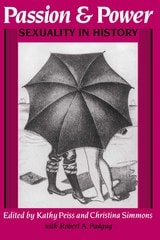
cover of Passion And Power: Sexuality in History

Passion And Power

Sexuality in History

Kathy Peiss

Temple University Press, 1989

"Brings together some of the most recent and innovative writing on the history of sexuality and explores the experiences, ideas and conflicts that have shaped the emergence of modern sexual identities." --Dare Passion and Power brings together some of the most recent and innovative writings on the history of sexuality and explores the experiences, ideas, and conflicts that have shaped the emergence of modern sexual identities. Arguing that sexuality is not an unchanging biological reality or a universal natural force, the essays in this volume discuss sexuality as an integral part of the history of human experience. Articles on sexual assault, homosexuality, birth control, venereal disease, sexual repression, pornography, and the AIDS epidemic examine the ways that sexuality has become a core element of modern social identity in the nineteenth- and twentieth-century United States. It is only in recent years that historians have begun to examine the social construction of sexuality. This is the first anthology that addresses this issue from a radical historical perspective, examining sexuality as a field of contention in itself and as part of other struggles rooted in divisions of gender, class, and race. Contents Part I: Sexuality and Historical Meaning 1. Passion and Power: An Introdtion - Kathy Peiss and Christina Simmons 2. Sexual Matters: On Conceptualizing Sexuality in History - Robert A. Padgug Part II: The Emergence of Modern Sexuality, 1790 to 1930 3. "The Life of a Citizen in the Hands of a Woman": Sexual Assault in New York City, 1790 to 1820 - Marybeth Hamilton Arnold 4. "Charity Girls" and City Pleasurer: Historical Notes on Working Class Sexuality, 1880-1920 - Kathy Peiss 5. Movements of Affirmation: Sexual Meanings and Homosexual Identities - Jeffrey Weeks 6. From Sexual Inversion to Homosexuality: The Changing Medical Conceptualization of Female "Deviance" - George Chauncey, Jr. 7. "We Were a Little Band of Willful Women": The Heterodoxy Club of Greenwich Village - Judith Schwartz, Kathy Peiss, and Christina Simmons 8. The Black Community and the Birth Control Movement - Jessie M. Rodrique Part III: Sexual Conflicts and Cultural Authority, 1920 to 1960 9. Modern Sexuality and the Myrh of Victorian Repression - Christina Simmons 10. Venereal Disease: The Wages of Sin? - Elizabeth Fee 11. "Uncontrolled Desires": The Response to the Sexual Psychopath, 1920-1960 - Estelle B. Freedman 12. The Homosexual Menace: The Politics of Sexuality in Cold War America - John D'Emilio 13. The Reproduction of Butch-Fern Roles: A Social Constructionist Approach - Elizabeth Lapovsky Kennedy and Madeline Davis Part IV: Private Passions and Public Debate, 1960 to the Present 14. Mass Market Romance: Pornography for Women Is Different - Ann Barr Snitow 15. (De)Constructing Pornography: Feminisms in Conflict - Duphne Read 16. Gay Villain, Gay Hero: Homosexuality and the Social Construction of AIDS - Robert A. Padgug About the Author(s) Kathy Peiss is Associate Professor of History and Women's Studies at the University of Massachusetts at Amherst and author of Cheap Amusements: Working Women and Leisure in Turn-of-the-century New York (Temple). Christina Simmons is Assistant Professor of History at the University of Cincinnati-Raymond Walters College.
[more]
cover of Primal Screams: How the Sexual Revolution Created Identity Politics

Primal Screams

How the Sexual Revolution Created Identity Politics

Eberstadt, Mary

Templeton Press, 2021

Who am I? The question today haunts every society in the Western world.  

Legions of people—especially the young—have become unmoored from a firm sense of self. To compensate, they join the ranks of ideological tribes spawned by identity politics and react with frenzy against any perceived threat to their group. 

As identitarians track and expose the ideologically impure, other citizens face the consequences of their rancor: a litany of “isms” run amok across all levels of cultural life, the free marketplace of ideas muted by agendas shouted through megaphones, and a spirit of general goodwill warped into a state of perpetual outrage.  

How did we get here? Why have we divided against one another so bitterly? In Primal Screams, acclaimed cultural critic Mary Eberstadt presents the most provocative and original theory to come along in recent years. The rise of identity politics, she argues, is a direct result of the fallout of the sexual revolution, especially the collapse and shrinkage of the family.  

As Eberstadt illustrates, humans have forged their identities within the kinship structure from time immemorial. The extended family, in a real sense, is the first tribe and teacher. But with its unprecedented decline across various measures, generations of people have been set adrift and can no longer answer the question Who am I? concerning primordial ties. Desperate for solidarity and connection, they claim membership in politicized groups whose displays of frantic irrationalism amount to primal screams for familial and communal loss.

Written in her impeccable style and with empathy rarely encountered in today’s divisive discourse, Eberstadt’s theory holds immense explanatory power that no serious citizen can afford to ignore. The book concludes with three incisive essays by Rod Dreher, Mark Lilla, and Peter Thiel, each sharing their perspective on the author’s formidable argument.  
[more]
cover of Primitive Normativity: Race, Sexuality, and Temporality in Colonial Kenya

Primitive Normativity

Race, Sexuality, and Temporality in Colonial Kenya

Elizabeth W. Williams

Duke University Press, 2024

In Primitive Normativity Elizabeth W. Williams traces the genealogy of a distinct narrative about African sexuality that British colonial authorities in Kenya used to justify their control over indigenous populations. She identifies a discourse of “primitive normativity” that suggested that Africans were too close to nature to develop sexual neuroses and practices such as hysteria, homosexuality, and prostitution which supposedly were common among Europeans. Primitive normativity framed Kenyan African sexuality as less polluted than that of the more deviant populations of their colonizers. Williams shows that colonial officials and settlers used this narrative to further the goals of white supremacy by arguing that Africans’ sexuality was proof that Kenyan Africans must be protected from the forces of urbanization, Western-style education, and political participation, lest they be exposed to forms of civilized sexual deviance. Challenging the more familiar notion that Europeans universally viewed Africans as hypersexualized, Williams demonstrates how narratives of African sexual normativity rather than deviance reinforced ideas about the evolutionary backwardness of African peoples and their inability to govern themselves.
[more]