Results by title
143 books match the query 'Sexuality' and 6 start with p
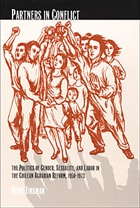
Partners in Conflict
The Politics of Gender, Sexuality, and Labor in the Chilean Agrarian Reform, 1950–1973Heidi Tinsman
Duke University Press, 2002
Partners in Conflict examines the importance of sexuality and gender to rural labor and agrarian politics during the last days of Chile’s latifundia system of traditional landed estates and throughout the governments of Eduardo Frei and Salvador Allende. Heidi Tinsman analyzes differences between men’s and women’s participation in Chile’s Agrarian Reform movement and considers how conflicts over gender and sexuality shape the contours of working-class struggles and national politics.
Tinsman restores women to a scholarly narrative that has been almost exclusively about men, recounting the centrality of women’s labor to the pre-Agrarian Reform world of the hacienda during the 1950s and recovering women’s critical roles in union struggles and land occupations during the Agrarian Reform itself. Providing a theoretical framework for understanding why the Agrarian Reform ultimately empowered men more than women, Tinsman argues that women were marginalized not because the Agrarian Reform ignored women but because, under both the Frei and Allende governments, it promoted the male-headed household as the cornerstone of a new society. Although this emphasis on gender cooperation stressed that men should have more respect for their wives and funneled unprecedented amounts of resources into women’s hands, the reform defined men as its protagonists and affirmed their authority over women.
This is the first monographic social history of Chile’s Agrarian Reform in either English or Spanish, and the first historical work to make sexuality and gender central to the analysis of the reforms.
[more]
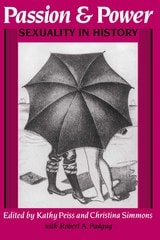
Passion And Power
Sexuality in HistoryKathy Peiss
Temple University Press, 1989
"Brings together some of the most recent and innovative writing on the history of sexuality and explores the experiences, ideas and conflicts that have shaped the emergence of modern sexual identities."
--Dare
Passion and Power brings together some of the most recent and innovative writings on the history of sexuality and explores the experiences, ideas, and conflicts that have shaped the emergence of modern sexual identities. Arguing that sexuality is not an unchanging biological reality or a universal natural force, the essays in this volume discuss sexuality as an integral part of the history of human experience. Articles on sexual assault, homosexuality, birth control, venereal disease, sexual repression, pornography, and the AIDS epidemic examine the ways that sexuality has become a core element of modern social identity in the nineteenth- and twentieth-century United States.
It is only in recent years that historians have begun to examine the social construction of sexuality. This is the first anthology that addresses this issue from a radical historical perspective, examining sexuality as a field of contention in itself and as part of other struggles rooted in divisions of gender, class, and race.
Contents
Part I: Sexuality and Historical Meaning
1. Passion and Power: An Introdtion - Kathy Peiss and Christina Simmons
2. Sexual Matters: On Conceptualizing Sexuality in History - Robert A. Padgug
Part II: The Emergence of Modern Sexuality, 1790 to 1930
3. "The Life of a Citizen in the Hands of a Woman": Sexual Assault in New York City, 1790 to 1820 - Marybeth Hamilton Arnold
4. "Charity Girls" and City Pleasurer: Historical Notes on Working Class Sexuality, 1880-1920 - Kathy Peiss
5. Movements of Affirmation: Sexual Meanings and Homosexual Identities - Jeffrey Weeks
6. From Sexual Inversion to Homosexuality: The Changing Medical Conceptualization of Female "Deviance" - George Chauncey, Jr.
7. "We Were a Little Band of Willful Women": The Heterodoxy Club of Greenwich Village - Judith Schwartz, Kathy Peiss, and Christina Simmons
8. The Black Community and the Birth Control Movement - Jessie M. Rodrique
Part III: Sexual Conflicts and Cultural Authority, 1920 to 1960
9. Modern Sexuality and the Myrh of Victorian Repression - Christina Simmons
10. Venereal Disease: The Wages of Sin? - Elizabeth Fee
11. "Uncontrolled Desires": The Response to the Sexual Psychopath, 1920-1960 - Estelle B. Freedman
12. The Homosexual Menace: The Politics of Sexuality in Cold War America - John D'Emilio
13. The Reproduction of Butch-Fern Roles: A Social Constructionist Approach - Elizabeth Lapovsky Kennedy and Madeline Davis
Part IV: Private Passions and Public Debate, 1960 to the Present
14. Mass Market Romance: Pornography for Women Is Different - Ann Barr Snitow
15. (De)Constructing Pornography: Feminisms in Conflict - Duphne Read
16. Gay Villain, Gay Hero: Homosexuality and the Social Construction of AIDS - Robert A. Padgug
About the Author(s)
Kathy Peiss is Associate Professor of History and Women's Studies at the University of Massachusetts at Amherst and author of Cheap Amusements: Working Women and Leisure in Turn-of-the-century New York (Temple).
Christina Simmons is Assistant Professor of History at the University of Cincinnati-Raymond Walters College.
[more]

Playing Dirty
Sexuality and Waste in Early Modern ComedyWill Stockton
University of Minnesota Press, 2010
Playing Dirty is full of dirty jokes. Arguing that the early modern excremental body is in many ways an erotic body, Will Stockton—with humor and dry wit—reads psychoanalytic theory through early modern comedies, claiming that it is helpful, rather than inimical, to the project of historicizing the body.
Noting that psychoanalysis has traditionally operated in a paranoid framework that relentlessly produces evidence of the same “truths,” Stockton turns to a minority practice in psychoanalysis—associated with Jean Laplanche—to develop a more “playful” analytic for literary studies. This analytic brings together different discourses of sexuality and the body and allows individual writings to reform psychoanalytic wisdom about sexuality, waste, and comedy. Through original explorations of works by William Shakespeare, Ben Jonson, Sir John Harington, Thomas Nashe, and Geoffrey Chaucer, Stockton further encourages the reconciliation of psychoanalysis and queer historicism. He focuses in large part on the less-often-read texts of the early modern English canon, assessing the ways in which these books have been purged from the canon in the name of generic purity.
Playing Dirty builds on recent calls by Renaissance and medieval queer scholars for a method of literary analysis that is less constrained by the boundaries of periodicity and the supposed exigencies of historicism. To take Playing Dirty seriously is to accept its invitation to “play”—to queerly disrupt the modern divide in moving promiscuously between texts past and present.
[more]

Pleasures Taken
Performances of Sexuality and Loss in Victorian PhotographsCarol Mavor
Duke University Press, 1995
An intimate look into three Victorian photo-settings, Pleasures Taken considers questions of loss and sexuality as they are raised by some of the most compelling and often misrepresented photographs of the era: Lewis Carroll’s photographs of young girls; Julia Margaret Cameron’s photographs of Madonnas; and the photographs of Hannah Cullwick, a "maid of all work," who had herself pictured in a range of masquerades, from a blackened chimney sweep to a bare-chested Magdalene. Reading these settings performatively, Carol Mavor shifts the focus toward the subjectivity of these girls and women, and toward herself as a writer.
Mavor’s original approach to these photographs emphatically sees sexuality where it has been previously rendered invisible. She insists that the sexuality of the girls in Carroll’s pictures is not only present, but deserves recognition, respect, and scrutiny. Similarly, she sees in Cameron’s photographs of sensual Madonnas surprising visions of motherhood that outstrip both Victorian and contemporary understandings of the maternal as untouchable and inviolate, without sexuality. Finally she shows how Hannah Cullwick, posing in various masquerades for her secret paramour, emerges as a subject with desires rather than simply a victim of her upper-class partner. Even when confronting the darker areas of these photographs, Mavor perseveres in her insistence on the pleasures taken—by the viewer, the photographer, and often by the model herself—in the act of imagining these sexualities. Inspired by Roland Barthes, and drawing on other theorists such as Julia Kristeva and Luce Irigaray, Mavor creates a text that is at once interdisciplinary, personal, and profoundly pleasurable.
Mavor’s original approach to these photographs emphatically sees sexuality where it has been previously rendered invisible. She insists that the sexuality of the girls in Carroll’s pictures is not only present, but deserves recognition, respect, and scrutiny. Similarly, she sees in Cameron’s photographs of sensual Madonnas surprising visions of motherhood that outstrip both Victorian and contemporary understandings of the maternal as untouchable and inviolate, without sexuality. Finally she shows how Hannah Cullwick, posing in various masquerades for her secret paramour, emerges as a subject with desires rather than simply a victim of her upper-class partner. Even when confronting the darker areas of these photographs, Mavor perseveres in her insistence on the pleasures taken—by the viewer, the photographer, and often by the model herself—in the act of imagining these sexualities. Inspired by Roland Barthes, and drawing on other theorists such as Julia Kristeva and Luce Irigaray, Mavor creates a text that is at once interdisciplinary, personal, and profoundly pleasurable.
[more]
Politics of Rightful Killing
Civil Society, Gender, and Sexuality in WeblogistanSima Shakhsari
Duke University Press, 2020
In the early 2000s, mainstream international news outlets celebrated the growth of Weblogistan—the online and real-life transnational network of Iranian bloggers—and depicted it as a liberatory site that gave voice to Iranians. As Sima Shakhsari argues in Politics of Rightful Killing, the common assumptions of Weblogistan as a site of civil society consensus and resistance to state oppression belie its deep internal conflicts. While Weblogistan was an effective venue for some Iranians to “practice democracy,” it served as a valuable site for the United States to surveil bloggers and express anti-Iranian sentiment and policies. At the same time, bloggers used the network to self-police and enforce gender and sexuality norms based on Western liberal values in ways that unwittingly undermined Weblogistan's claims of democratic participation. In this way, Weblogistan became a site of cybergovernmentality, where biopolitical security regimes disciplined and regulated populations. Analyzing online and off-line ethnography, Shakhsari provides an account of digital citizenship that raises questions about the internet's relationship to political engagement, militarism, and democracy.
[more]
Primitive Normativity
Race, Sexuality, and Temporality in Colonial KenyaElizabeth W. Williams
Duke University Press, 2024
In Primitive Normativity Elizabeth W. Williams traces the genealogy of a distinct narrative about African sexuality that British colonial authorities in Kenya used to justify their control over indigenous populations. She identifies a discourse of “primitive normativity” that suggested that Africans were too close to nature to develop sexual neuroses and practices such as hysteria, homosexuality, and prostitution which supposedly were common among Europeans. Primitive normativity framed Kenyan African sexuality as less polluted than that of the more deviant populations of their colonizers. Williams shows that colonial officials and settlers used this narrative to further the goals of white supremacy by arguing that Africans’ sexuality was proof that Kenyan Africans must be protected from the forces of urbanization, Western-style education, and political participation, lest they be exposed to forms of civilized sexual deviance. Challenging the more familiar notion that Europeans universally viewed Africans as hypersexualized, Williams demonstrates how narratives of African sexual normativity rather than deviance reinforced ideas about the evolutionary backwardness of African peoples and their inability to govern themselves.
[more]