Results by title
177 books match the query 'Shakespeare' and 5 start with p
Pericles
William Shakespeare
Arizona Center for Medieval and Renaissance Studies, 2023
Shakespeare’s romance Pericles follows Pericles, the Prince of Tyre, on a series of adventures across the Mediterranean Sea. Navigating one heroic challenge after another, Pericles strives to be reunited with his wife and child. Ellen McLaughlin’s translation of Pericles illuminates Shakespeare’s text, untangling syntax and bringing forth the poetry of the verse. An encounter between the contemporary and the iconic, this translation brings the play to life as audiences would have experienced it in Shakespeare’s time.
This translation of Pericles was written as part of the Oregon Shakespeare Festival’s Play On! project, which commissioned new translations of thirty-nine Shakespeare plays. These translations present work from “The Bard” in language accessible to modern audiences while never losing the beauty of Shakespeare’s verse. Enlisting the talents of a diverse group of contemporary playwrights, screenwriters, and dramaturges from diverse backgrounds, this project reenvisions Shakespeare for the twenty-first century. These volumes make these works available for the first time in print—a new First Folio for a new era.

Poets and Playwrights
Shakespeare, Jonson, Spenser, MiltonElmer Edgar Stoll
University of Minnesota Press, 1967
Poets and Playwrights was first published in 1967. Minnesota Archive Editions uses digital technology to make long-unavailable books once again accessible, and are published unaltered from the original University of Minnesota Press editions.
Poets and Playwrights is a collection of nine essays by the eminent Shakespearean scholar and critic, the late Elmer Edgar Stoll. In this work, which was first published by the University of Minnesota Press in 1930, Professor Stoll presents his maturest consideration of the art of the poets and playwrights of his subtitle—Shakespeare, Jonson, Spenser, and Milton. The most extensive essay, "Shakespeare and the Moderns," includes, in Mr. Stoll's words, "a review of Shakespeare as I conceive him, in order the better to compare him with those who in some respect or other are his peers."
Political Aesthetics in the Era of Shakespeare
Edited by Christopher Pye
Northwestern University Press, 2020
Taking up this expansive conception of aesthetics, Political Aesthetics in the Era of Shakespeare suggests that the political stakes of the literary work—and Shakespeare’s work in particular—extend from the most intimate dimensions of affective response to the problem of the grounds of political society. The approaches to aesthetic thought included in this volume explore the intersections between the literary work and the full range of concerns animating the field today: political philosophy, affect theory, and ecocritical analysis of environs and habitus.
Poor Tom
Living "King Lear"Simon Palfrey
University of Chicago Press, 2014
In Poor Tom, Simon Palfrey asks us to go beyond any such received understandings—and thus to experience King Lear as never before. He argues that the part of Edgar is Shakespeare’s most radical experiment in characterization, and his most exhaustive model of both human and theatrical possibility. The key to the Edgar character is that he spends most of the play disguised, much of it as “Poor Tom of Bedlam,” and his disguises come to uncanny life. The Edgar role is always more than one person; it animates multitudes, past and present and future, and gives life to states of being beyond the normal reach of the senses—undead, or not-yet, or ghostly, or possible rather than actual. And because the Edgar role both connects and retunes all of the figures and scenes in King Lear, close attention to this particular part can shine stunning new light on how the whole play works.
The ultimate message of Palfrey’s bravura analysis is the same for readers or actors or audiences as it is for the characters in the play: see and listen feelingly; pay attention, especially when it seems as though there is nothing there.
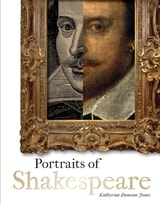
Portraits of Shakespeare
Katherine Duncan-Jones
Bodleian Library Publishing, 2015
With Portraits of Shakespeare, Katherine Duncan-Jones poses a series of questions about the mysterious physical appearance of the brilliant writer of plays, poems, and sonnets: Why is it so difficult to find images of Shakespeare that were made during his lifetime? Which images are most likely to have been made by those close to the writer? And why do newly discovered images emerge with such startling regularity? With an eye toward answering these questions, the book begins with a broad analysis of the tradition of the “author portrait” before, during, and after Shakespeare’s lifetime. Duncan-Jones provides a detailed critique of three of the most widely accepted portraits: the engraving facing the First Folio’s title page; the sculptured stone bust that adorns Shakespeare’s funerary monument at Holy Trinity Church, Stratford-upon-Avon; and the “Chandos portrait,” an early seventeenth-century painting on canvas which is widely recognized as the best image. Through a painstaking historical analysis of the painting’s early history and provenance, Duncan-Jones arrives at a plausible new identification of both the artist and the artist’s personal connections with Shakespeare. Finally, taking the book into the present, she considers the afterlife of all three images in memorials, advertising, and in graphic art—all evidence of a continuing desire to put a face to one of literature’s most famous names.