Results by title
151 books match the query 'Sign Language' and 3 start with p
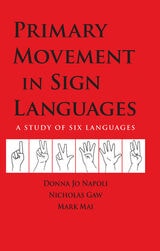
Primary Movement in Sign Languages
A Study of Six LanguagesDonna Jo Napoli
Gallaudet University Press, 2011
Is it possible to identify sign languages by their prosody, that is, the rhythm and stress of sign production, and then determine if they are related to each other or other sign languages? If so, reasoned authors Donna Jo Napoli, Mark Mai, and Nicholas Gaw, perhaps they could offer such identification as a new way to typologize, or categorize sign languages by their structural features. Their new collaboration Primary Movement in Sign Languages: A Study of Six Languages traces the process and findings from this unique investigation.
Resolving on the direction of movement as the prosodic factor to track, they began their research by comparing five sign languages: American Sign Language (ASL), British Sign Language (BSL), Italian Sign Language (LIS), French Sign Language (LSF), and Australian Sign Language (Auslan). They soon discovered that the languages in their study clustered with respect to several characteristics along genetic lines, with BSL and Auslan contrasting with LSF, LIS, and ASL. They learned that sign languages with the same geographic origin evolved differently when relocated, and they isolated differences in each individual sign language. They compared four of these established sign languages with the newly emerging Nicaraguan Sign Language (NSL), with the exception of ASL due to their past close contact, thereby validating their work as the first study to identify sign language relationships without depending on grammar.
Professional Autonomy in Video Relay Service Interpreting
Erica Alley
Gallaudet University Press, 2019
Alley considers the question of how VRS fits into the professional field of interpreting, and discovers that—regardless of the profit-focused mentality of VRS providers—interpreters make decisions with the goal of creating quality customer service experiences for deaf consumers, even if it means “breaking the rules.” Her findings shed light on the decision-making process of interpreters and how their actions are governed by principles of self-care, care for colleagues, and concern for the quality of services provided. Professional Autonomy in Video Relay Service Interpreting is essential reading in interpreter education courses and interpreter training programs.
Prosodic Markers and Utterance Boundaries in American Sign Language Interpretation
Brenda Nicodemus
Gallaudet University Press, 2009
The Fifth Volume in the Studies in Interpretation Series
In interpreting, professionals must be able to convey to their clients the rhythm, stress, and length of phrases used by the communicating parties to indicate their respective emotional states. Such subtleties, which can signal sarcasm and irony or whether a statement is a question or a command, are defined in linguistics as prosody. Brenda Nicodemus’s new volume, the fifth in the Studies in Interpretation series, discusses the prosodic features of spoken and signed languages, and reports the findings of her groundbreaking research on prosodic markers in ASL interpretation.
In her study, Nicodemus videotaped five highly skilled interpreters as they interpreted a spoken English lecture into ASL. Fifty Deaf individuals viewed the videotaped interpretations and indicated perceived boundaries in the interpreted discourse. These identified points were then examined for the presence of prosodic markers that might be responsible for the perception of a boundary. Prosodic Markers and Utterance Boundaries reports on the characteristics of the ASL markers, including their frequency, number, duration, and timing. Among other findings, the results show that interpreters produce an average of seven prosodic markers at each boundary point. The markers are produced both sequentially and simultaneously and under conditions of highly precise timing. Further, the results suggest that the type of prosodic markers used by interpreters are both systematic and stylistic.