279 books match the query 'Slavery' and 6 start with p
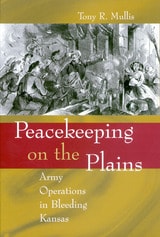
cover of Peacekeeping on the Plains: Army Operations in Bleeding Kansas

Peacekeeping on the Plains

Army Operations in Bleeding Kansas

Tony R. Mullis

University of Missouri Press, 2004
 

Historians have written on “Bleeding Kansas” and on the frontier army as a constabulary force, but little scholarship exists on how the army performed its peacekeeping operations in the 1850s. In Peacekeeping on the Plains, Tony R. Mullis is one of the first scholars to detail the military concerns associated with peace enforcement in Kansas and the trans-Missouri West.


Between 1854 and 1856, the Franklin Pierce administration called upon the U.S. Army to conduct a series of peace operations in the newly formed Kansas and Nebraska territories. The army responded to the president’s call by successfully completing a mission against the Lakota Sioux in 1855 and by aiding civil authorities in the imposition of peace among competing factions in Kansas during 1856.


Although these police duties were not always popular with the soldiers that conducted them, the purpose behind them remained constant—the maintenance of peace, order, and security. Given Americans’ misgivings about a standing army and their limited expectations for it as a domestic peacekeeper, its use in this fashion during the 1850s was a delicate proposition.


By drawing on diverse sources, including official army correspondence, personal papers of key military and political leaders, and local accounts of army activities, Mullis shows how peace operations were conducted by the U.S. Army long before the second half of the twentieth century. He alsopresents a thorough analysis of the professional dilemmas confronted by army officers, as well as the delicate command and control issues associated with the different types of peace operations.


Mullis’s assessment of the army’s peacekeeping efforts in the mid-1850s offers a full understanding of the constraints and frustrations involved. Many of the dilemmas faced by the army in Kansas parallel those encountered in various spots around the globe today. Peacekeeping on the Plains will provide any reader with a better insight into the nuances of peace operations in the 1850s and assist military historians in their understanding of these activities as they relate to the twenty-first century.
[more]
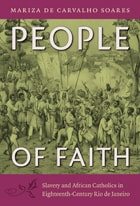
cover of People of Faith: Slavery and African Catholics in Eighteenth-Century Rio de Janeiro

People of Faith

Slavery and African Catholics in Eighteenth-Century Rio de Janeiro

Mariza de Carvalho Soares

Duke University Press, 2011
In People of Faith, Mariza de Carvalho Soares reconstructs the everyday lives of Mina slaves transported in the eighteenth century to Rio de Janeiro from the western coast of Africa, particularly from modern-day Benin. She describes a Catholic lay brotherhood formed by the enslaved Mina congregants of a Rio church, and she situates the brotherhood in a panoramic setting encompassing the historical development of the Atlantic slave trade in West Africa and the ethnic composition of Mina slaves in eighteenth-century Rio. Although Africans from the Mina Coast constituted no more than ten percent of the slave population of Rio, they were a strong presence in urban life at the time. Soares analyzes the role that Catholicism, and particularly lay brotherhoods, played in Africans’ construction of identities under slavery in colonial Brazil. As in the rest of the Portuguese empire, black lay brotherhoods in Rio engaged in expressions of imperial pomp through elaborate festivals, processions, and funerals; the election of kings and queens; and the organization of royal courts. Drawing mainly on ecclesiastical documents, Soares reveals the value of church records for historical research.
[more]
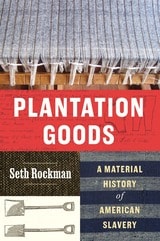
cover of Plantation Goods: A Material History of American Slavery

Plantation Goods

A Material History of American Slavery

Seth Rockman

University of Chicago Press, 2024

A Pulitzer Prize finalist in History, this eye-opening rethinking of nineteenth-century American history reveals the interdependence of the Northern industrial economy and Southern slave labor.

The industrializing North and the agricultural South—that’s how we have been taught to think about the United States in the early nineteenth century. But in doing so, we overlook the economic ties that held the nation together before the Civil War. We miss slavery’s long reach into small New England communities, just as we fail to see the role of Northern manufacturing in shaping the terrain of human bondage in the South. Using plantation goods—the shirts, hats, hoes, shovels, shoes, axes, and whips made in the North for use in the South—historian Seth Rockman locates the biggest stories in American history in the everyday objects that stitched together the lives and livelihoods of Americans—white and Black, male and female, enslaved and free—across an expanding nation.
 
By following the stories of material objects, such as shoes made by Massachusetts farm women that found their way to the feet of a Mississippi slave, Rockman reveals a national economy organized by slavery—a slavery that outsourced the production of its supplies to the North, and a North that outsourced its slavery to the South. Melding business and labor history through powerful storytelling, Plantation Goods brings northern industrialists, southern slaveholders, enslaved field hands, and paid factory laborers into the same picture. In one part of the country, entrepreneurs envisioned fortunes to be made from “planter’s hoes” and rural women spent their days weaving “negro cloth” and assembling “slave brogans.” In another, enslaved people actively consumed textiles and tools imported from the North to contest their bondage. In between, merchants, marketers, storekeepers, and debt collectors laid claim to the profits of a thriving interregional trade.
 
Examining producers and consumers linked in economic and moral relationships across great geographic and political distances, Plantation Goods explores how people in the nineteenth century thought about complicity with slavery while showing how slavery structured life nationwide and established a modern world of entrepreneurship and exploitation. Rockman brings together lines of American history that have for too long been told separately, as slavery and capitalism converge in something as deceptively ordinary as a humble pair of shoes.
[more]
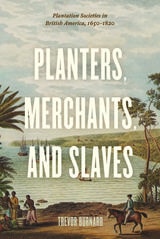
cover of Planters, Merchants, and Slaves: Plantation Societies in British America, 1650-1820

Planters, Merchants, and Slaves

Plantation Societies in British America, 1650-1820

Trevor Burnard

University of Chicago Press, 2015

As with any enterprise involving violence and lots of money, running a plantation in early British America was a serious and brutal enterprise. In the contentious Planters, Merchants, and Slaves, Burnard argues that white men did not choose to develop and maintain the plantation system out of virulent racism or sadism, but rather out of economic logic because—to speak bluntly—it worked. These economically successful and ethically monstrous plantations required racial divisions to exist, but their successes were measured in gold, rather than skin or blood. Sure to be controversial, this book is a major intervention in the scholarship on slavery, economic development, and political power in early British America, mounting a powerful and original argument that boldly challenges historical orthodoxy.
[more]
cover of Policing Black Lives: State Violence in Canada from Slavery to the Present

Policing Black Lives

State Violence in Canada from Slavery to the Present

Robyn Maynard

Duke University Press, 2025
Robyn Maynard’s bestselling Policing Black Lives offers a comprehensive account of the state-sanctioned surveillance, criminalization, and punishment of Black lives in Canada. In this revised and expanded edition, Maynard exposes Canada’s veneer of multiculturalism and tolerance to document how half a century of police reforms have expanded the scope and scale of policing and undermined Black freedom struggles in the wake of global Black uprisings in 2020. She traces the afterlives of slavery across multiple institutions and illuminates the state’s role in perpetuating colonial dispossession, racial profiling, police killings, incarceration, immigration detention, deportation, exploitative migrant labor practices, and the school-to-prison pipeline. At the same time, Maynard foregrounds the ubiquity of Black resistance while offering new insights on how to build liveable futures without policing. Advancing a compelling vision for making policing obsolete and building new forms of safety, Policing Black Lives is an essential text that will guide and inspire activists, students, scholars, and all those working toward Black futures beyond surveillance and confinement.
[more]
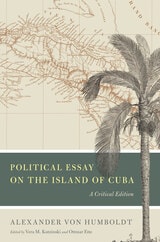
cover of Political Essay on the Island of Cuba: A Critical Edition

Political Essay on the Island of Cuba

A Critical Edition

Alexander von Humboldt

University of Chicago Press, 2011

The research Alexander von Humboldt amassed during his five-year trek through the Americas in the early nineteenth-century proved foundational to the fields of botany, geography, and geology. But his visit to Cuba during this time yielded observations that extended far beyond the natural world. Political Essay on the Island of Cuba is a physical and cultural study of the island nation. In it, Humboldt denounces colonial slavery on both moral and economic grounds and stresses the vital importance of improving intercultural relations throughout the Americas.

Humboldt’s most controversial book, Political Essay on the Island of Cuba was banned, censored, and willfully mistranslated to suppress Humboldt’s strong antislavery sentiments. It reemerges here, newly translated from the original two volume French edition, to introduce a new generation of readers to Humboldt’s astonishing multiplicity of scientific and philosophical perspectives. In their critical introduction, Vera Kutzinski and Ottmar Ette emphasize Humboldt’s rare ability to combine scientific rigor with a cosmopolitan consciousness and a deeply felt philosophical humanism. The result is a work on Cuba of historical import that will attract historians of science as well as cultural historians, political scientists, and literary scholars.

[more]