Results by title
139 books match the query 'Social archaeology' and 8 start with p
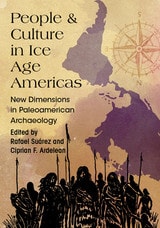
People and Culture in Ice Age Americas
New Dimensions in Paleoamerican ArchaeologyRafael Suarez and Ciprian F. Ardelean
University of Utah Press, 2018
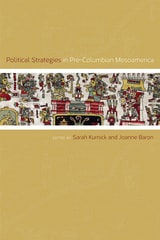
Political Strategies in Pre-Columbian Mesoamerica
Sarah Kurnick
University Press of Colorado, 2020
Political authority contains an inherent contradiction. Rulers must reinforce social inequality and bolster their own unique position at the top of the sociopolitical hierarchy, yet simultaneously emphasize social similarities and the commonalities shared by all. Political Strategies in Pre-Columbian Mesoamerica explores the different and complex ways that those who exercised authority in the region confronted this contradiction.
New data from a variety of well-known scholars in Mesoamerican archaeology reveal the creation, perpetuation, and contestation of politically authoritative relationships between rulers and subjects and between nobles and commoners. The contributions span the geographic breadth and temporal extent of pre-Columbian Mesoamerica—from Preclassic Oaxaca to the Classic Petén region of Guatemala to the Postclassic Michoacán—and the contributors weave together archaeological, epigraphic, and ethnohistoric data.
Grappling with the questions of how those exercising authority convince others to follow and why individuals often choose to recognize and comply with authority, Political Strategies in Pre-Columbian Mesoamerica discusses why the study of political authority is both timely and significant, reviews how scholars have historically understood the operation of political authority, and proposes a new analytical framework to understand how rulers rule.
Contributors include Sarah B. Barber, Joanne Baron, Christopher S. Beekman, Jeffrey Brzezinski, Bryce Davenport, Charles Golden, Takeshi Inomata, Arthur A. Joyce, Sarah Kurnick, Carlo J. Lucido, Simon Martin, Tatsuya Murakami, Helen Perlstein Pollard, and Víctor Salazar Chávez.
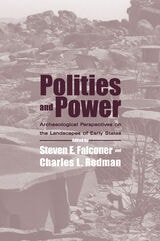
Polities and Power
Archaeological Perspectives on the Landscapes of Early StatesEdited by Steven E. Falconer and Charles L. Redman
University of Arizona Press, 2009
Polities and Power features detailed studies from an intentionally disparate array of regions, including Mesoamerica, Andean South America, southwestern Asia, East Africa, and the Indian subcontinent. Each chapter or pair of chapters is followed by a critical commentary. In concert, these studies strive to infer social, political, and economic meaning from archaeologically discerned landscapes associated with societies that incorporate some expression of state authority. The contributions engage a variety of themes, including the significance of landscapes as they condition and reflect complex polities; the interplay of natural and cultural elements in defining landscapes of state; archaeological landscapes as ever-dynamic entities; and archaeological landscapes as recursive structures, reflected in palimpsests of human activity.
Individually, many of these contributions are provocative, even controversial. Taken together, they reveal the contours of landscape archaeology at this particular evolutionary moment.
Population Circulation and the Transformation of Ancient Zuni Communities
Gregson Schachner
University of Arizona Press, 2012
Because nearly all aspects of culture depend on the movement of bodies, objects, and ideas, mobility has been a primary topic during the past forty years of archaeological research on small-scale societies. Most studies have concentrated either on local moves related to subsistence within geographically bounded communities or on migrations between regions resulting from pan-regional social and environmental changes. Gregson Schachner, however, contends that a critical aspect of mobility is the transfer of people, goods, and information within regions. This type of movement, which geographers term "population circulation," is vitally important in defining how both regional social systems and local communities are constituted, maintained, and—most important—changed.
Schachner analyzes a population shift in the Zuni region of west-central New Mexico during the thirteenth century AD that led to the inception of major demographic changes, the founding of numerous settlements in frontier zones, and the initiation of radical transformations of community organization. Schachner argues that intraregional population circulation played a vital role in shaping social transformation in the region and that many notable changes during this period arose directly out of peoples' attempts to create new social mechanisms for coping with frequent and geographically extensive residential mobility. By examining multiple aspects of population circulation and comparing areas that were newly settled in the thirteenth century to some that had been continuously occupied for hundreds of years, Schachner illustrates the role of population circulation in the formation of social groups and the creation of contexts conducive to social change.
Power and Identity in Archaeological Theory and Practice
Case Studies from Ancient MesoamericaEleanor Harrison-Buck
University of Utah Press, 2012
The contributions to this volume represent a diverse array of Mesoamerican archaeological studies that are all theo-retically rooted to larger, global debates concerning issues of power and identity—two logically paired concepts. While social identity has been the focus of more critical analysis in recent years, the concept of power has received far less attention. Most studies focus on large-scale, institutional forms of power and the ruling body. Here, the focus is on relations of power, addressing broader segments of society outside the dominant group, that often are ignored in traditional reconstructions of past societies.
Harrison-Buck has compiled works that address a common criticism of social theory in the field of anthropological archaeology—the lack of strong case studies and corroborating facts supporting the abstract and often complex social theoretical concepts presented by scholars. Each contributor offers innovative method and theory and provides alternative and varied approaches to understanding power and identity in the archaeological record. They draw from a wide range of related disciplines and theoretical frameworks, including feminism, queer theory, cognitive studies, and postcolonial theory. The provocative case studies and exciting theoretical applications presented here will stimulate lively debate among scholars working both in and outside of Mesoamerica.
Prehistoric Households at Turkey Creek Pueblo, Arizona
Julie C. Lowell
University of Arizona Press, 1991
Prehistory of South America
Ancient Cultural Diversity on the Least Known ContinentJerry D. Moore
University Press of Colorado, 2014
For more than 12,000 years, South American cultures ranged from mobile hunters and gatherers to rulers and residents of colossal cities. In the process, native South American societies made advancements in agriculture and economic systems and created great works of art—in pottery, textiles, precious metals, and stone—that still awe the modern eye. Organized in broad chronological periods, A Prehistory of South America explores these diverse human achievements, emphasizing the many adaptations of peoples from a continent-wide perspective. Moore examines the archaeologies of societies across South America, from the arid deserts of the Pacific coast and the frigid Andean highlands to the humid lowlands of the Amazon Basin and the fjords of Patagonia and beyond.
Illustrated in full color and suitable for an educated general reader interested in the Precolumbian peoples of South America, A Prehistory of South America is a long overdue addition to the literature on South American archaeology.
Process and Meaning in Spatial Archaeology
Investigations into Pre-Columbian Iroquoian Space and PlaceEric Jones
University Press of Colorado, 2017
The research in this volume represents a new wave of spatial research—exploring beyond settlement patterning to the process and the meaning behind spatial arrangement of past communities and people—and describes new approaches being used for better understanding of past Northern Iroquoian societies. Addressing topics ranging from household task-scapes and gender relations to bioarchaeology and social network analysis, Process and Meaning in Spatial Archaeology demonstrates the vitality of current archaeological research into ancestral Northern Iroquoian societies and its growing contribution to wider debates in North American archaeology.
This cutting-edge research will be of interest to archaeologists globally, as well as academics and graduate students studying Northern Iroquoian societies and cultures, geography, and spatial analysis.
Contributors: Kathleen M. S. Allen, Jennifer A. Birch, William Engelbrecht, Crystal Forrest, John P. Hart, Sandra Katz, Robert H. Pihl, Aleksandra Pradzynski, Erin C. Rodriguez, Dean R. Snow, Ronald F. Williamson, Rob Wojtowicz