Results by title
121 books match the query 'Social classes' and 4 start with p
People, Personal Expression, and Social Relations in Late Antiquity, Volume II
Selected Latin Texts from Gaul and Western EuropeRalph W. Mathisen
University of Michigan Press, 2003
Late Antiquity, which lies between Classical Antiquity and the Middle Ages (ca. A.D. 250-750), heralded the gradual decline of Mediterranean classical civilization, and the initial formation of a strictly western European, Christian society. During this period, three momentous developments threatened the paternalistic Roman social system: the rise of the Christian church, the disintegration of the Roman Empire in the west, and the establishment of the barbarian kingdoms.
The first of its type, this volume presents a collection of Latin source documents illustrating the social upheaval taking place in the Late Roman and early medieval worlds. The texts included in this volume provide the original Latin for the selections that are translated in People, Personal Expression, and Social Relations in Late Antiquity, Volume I. The 140 selected texts gathered from 70 different sources offer the reader firsthand experience with the ways that the Latin language was being used during the transformative period of Late Antiquity.
Ralph W. Mathisen is Professor of Ancient and Byzantine History; Louise Fry Scudder Professor of Humanities; and Director, Biographical Database for Late Antiquity at the University of South Carolina.
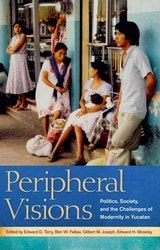
Peripheral Visions
Politics, Society, and the Challenges of Modernity in YucatanEdward D. Terry
University of Alabama Press, 2010
The essays in this collection illuminate both the processes of change and the negative reactions that they frequently elicited
Yucatan has been called “a world apart”—cut off from the rest of Mexico by geography and culture. Yet, despite its peripheral location, the region experienced substantial change in the decades after independence. As elsewhere in Mexico, apostles of modernization introduced policies intended to remold Yucatan in the image of the advanced nations of the day. Indeed, modernizing change began in the late colonial era and continued throughout the 19th century as traditional patterns of land tenure were altered and efforts were made to divest the Catholic Church of its wealth and political and intellectual influence. Some changes, however, produced fierce resistance from both elites and humbler Yucatecans and modernizers were frequently forced to retreat or at least reach accommodation with their foes.
Covering topics from the early 19th century to the late 20th century, the essays in this collection illuminate both the processes of change and the negative reactions that they frequently elicited. The diversity of disciplines covered by this volume—history, anthropology, sociology, economics—illuminates at least three overriding challenges for study of the peninsula today. One is politics after the decline of the Institutional Revolutionary Party: What are the important institutions, practices, and discourses of politics in a post-postrevolutionary era? A second trend is the scholarly demystification of the Maya: Anthropologists have shown the difficulties of applying monolithic terms like Maya in a society where ethnic relations are often situational and ethnic boundaries are fluid. And a third consideration: researchers are only now beginning to grapple with the region’s transition to a post-henequen economy based on tourism, migration, and the assembly plants known as maquiladoras. Challenges from agribusiness and industry will no doubt continue to affect the peninsula’s fragile Karst topography and unique environments.
Contributors: Eric N. Baklanoff, Helen Delpar, Paul K. Eiss, Ben W. Fallaw, Gilbert M. Joseph, Marie Lapointe, Othón Baños Ramírez, Hernán Menéndez Rodríguez, Lynda S. Morrison, Terry Rugeley, Stephanie J. Smith
Places of Their Own
African American Suburbanization in the Twentieth CenturyAndrew Wiese
University of Chicago Press, 2005
For most people, this cozy image of suburbia does not immediately evoke images of African Americans. But as this pioneering work demonstrates, the suburbs have provided a home to black residents in increasing numbers for the past hundred years—in the last two decades alone, the numbers have nearly doubled to just under twelve million. Places of Their Own begins a hundred years ago, painting an austere portrait of the conditions that early black residents found in isolated, poor suburbs. Andrew Wiese insists, however, that they moved there by choice, withstanding racism and poverty through efforts to shape the landscape to their own needs. Turning then to the 1950s, Wiese illuminates key differences between black suburbanization in the North and South. He considers how African Americans in the South bargained for separate areas where they could develop their own neighborhoods, while many of their northern counterparts transgressed racial boundaries, settling in historically white communities. Ultimately, Wiese explores how the civil rights movement emboldened black families to purchase homes in the suburbs with increased vigor, and how the passage of civil rights legislation helped pave the way for today's black middle class.
Tracing the precise contours of black migration to the suburbs over the course of the whole last century and across the entire United States, Places of Their Own will be a foundational book for anyone interested in the African American experience or the role of race and class in the making of America's suburbs.
Winner of the 2005 John G. Cawelti Book Award from the American Culture
Association.
Winner of the 2005 Award for Best Book in North American Urban
History from the Urban History Association.
Politics and the Class Divide
Working People and the Middle Class LeftDavid Croteau
Temple University Press, 1994