158 books match the query 'Social justice' and 6 start with p

cover of Pedagogies of Crossing: Meditations on Feminism, Sexual Politics, Memory, and the Sacred

Pedagogies of Crossing

Meditations on Feminism, Sexual Politics, Memory, and the Sacred

M. Jacqui Alexander

Duke University Press, 2005

M. Jacqui Alexander is one of the most important theorists of transnational feminism working today. Pedagogies of Crossing brings together essays she has written over the past decade, uniting her incisive critiques, which have had such a profound impact on feminist, queer, and critical race theories, with some of her more recent work. In this landmark interdisciplinary volume, Alexander points to a number of critical imperatives made all the more urgent by contemporary manifestations of neoimperialism and neocolonialism. Among these are the need for North American feminism and queer studies to take up transnational frameworks that foreground questions of colonialism, political economy, and racial formation; for a thorough re-conceptualization of modernity to account for the heteronormative regulatory practices of modern state formations; and for feminists to wrestle with the spiritual dimensions of experience and the meaning of sacred subjectivity.

In these meditations, Alexander deftly unites large, often contradictory, historical processes across time and space. She focuses on the criminalization of queer communities in both the United States and the Caribbean in ways that prompt us to rethink how modernity invents its own traditions; she juxtaposes the political organizing and consciousness of women workers in global factories in Mexico, the Caribbean, and Canada with the pressing need for those in the academic factory to teach for social justice; she reflects on the limits and failures of liberal pluralism; and she presents original and compelling arguments that show how and why transgenerational memory is an indispensable spiritual practice within differently constituted women-of-color communities as it operates as a powerful antidote to oppression. In this multifaceted, visionary book, Alexander maps the terrain of alternative histories and offers new forms of knowledge with which to mold alternative futures.
[more]
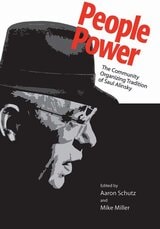
cover of People Power: The Community Organizing Tradition of Saul Alinsky

People Power

The Community Organizing Tradition of Saul Alinsky

Aaron Schutz

Vanderbilt University Press, 2015

Saul Alinsky, according to Time Magazine in 1970, was a "prophet of power to the people," someone who "has possibly antagonized more people . . . than any other living American." People Power introduces the major organizers who adopted and modified Alinsky's vision across the United States:


--Fred Ross, Cesar Chavez, Dolores Huerta, and the Community Service Organization and National Farm Workers Association
--Nicholas von Hoffman and the Woodlawn Organization
--Tom Gaudette and the Northwest Community Organization
--Ed Chambers, Richard Harmon, and the Industrial Areas Foundation
--Shel Trapp, Gale Cincotta, and National People's Action
--Heather Booth, Midwest Academy, and Citizen Action
--Wade Rathke and ACORN


Weaving classic texts with interviews and their own context-setting commentaries, the editors of People Power provide the first comprehensive history of Alinsky-based organizing in the tumultuous period from 1955 to 1980, when the key organizing groups in the United States took form. Many of these selections--previously available only on untranscribed audiotapes or in difficult-to-read mimeograph or Xerox formats--appear in print here for the first time.

[more]
cover of Pirkei Avot: A Social Justice Commentary

Pirkei Avot

A Social Justice Commentary

Rabbi Dr. Shmuly Yanklowitz

Central Conference of American Rabbis, 2018

Pirkei Avot is the urtext of Jewish practical wisdom. In many ways, Pirkei Avot was the first recorded manifesto of social justice in Western civilization. This commentary explores the text through a lens of contemporary social justice and moral philosophy, engaging both classical commentators and modern thinkers.
[more]
cover of Political Life in the Wake of the Plantation: Sovereignty, Witnessing, Repair

Political Life in the Wake of the Plantation

Sovereignty, Witnessing, Repair

Deborah A. Thomas

Duke University Press, 2019
In 2010, Jamaican police and military forces entered the West Kingston community of Tivoli Gardens to apprehend Christopher “Dudus” Coke, who had been ordered for extradition to the United States on gun and drug-running charges. By the time Coke was detained, somewhere between seventy-five and two hundred civilians had been killed. In Political Life in the Wake of the Plantation, Deborah A. Thomas uses the incursion as a point of departure for theorizing the roots of contemporary state violence in Jamaica and in post-plantation societies in general. Drawing on visual, oral historical, and colonial archives, Thomas traces the long-term legacies of the plantation system and how its governing logics continue to shape and replicate forms of violence. She places affect at the center of sovereignty to destabilize disembodied narratives of liberalism and progress and to raise questions about recognition, repair, and accountability. In tying theories of politics, colonialism, race, and affect together with Jamaica's history, Thomas presents a robust framework for understanding what it means to be human in the plantation's wake.
[more]
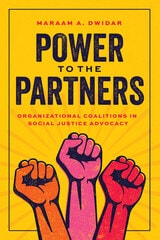
cover of Power to the Partners: Organizational Coalitions in Social Justice Advocacy

Power to the Partners

Organizational Coalitions in Social Justice Advocacy

Maraam A. Dwidar

University of Chicago Press, 2025

A vital examination of how social and economic justice organizations overcome resource disadvantages and build political power.

Why do some coalitions triumph while others fall short? In Power to the Partners, Maraam A. Dwidar documents the vital role of social and economic justice organizations in American politics and explores the process by which they strategically build partnerships to advance more effective and equitable advocacy. Using original data tracking the collaboration patterns of more than twenty thousand nationally active advocacy organizations, Dwidar evaluates the micro- and macro-level conditions surrounding these groups’ successful efforts to collectively shape public policy.

Power to the Partners reveals that while organizational advocates for social and economic justice are at a disadvantage in the American lobbying landscape—financially, tactically, and politically—coalition work can help ameliorate these disparities. By building and sustaining coalitions with structures and memberships that facilitate clarity, learning, and diverse perspectives, these advocates can successfully—and uniquely—make their mark on American public policy. Dwidar’s work offers critical insights for scholars and practitioners alike, from groundbreaking academic findings to evidence-based lessons for political organizers.
[more]
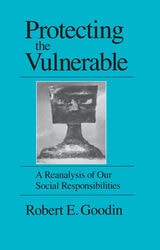
cover of Protecting the Vulnerable: A Re-Analysis of our Social Responsibilities

Protecting the Vulnerable

A Re-Analysis of our Social Responsibilities

Robert E. Goodin

University of Chicago Press, 1985

Our narrower obligations often blind us to larger social responsibilities. The moral claims arising out of special relationships—family, friends, colleagues, and so on—always seem to take priority. Strangers ordinarily get, and ordinarily are thought to deserve, only what is left over. Robert E. Goodin argues that this is morally mistaken. In Protecting the Vulnerable, he presents a comprehensive theory of responsibility based on the concept of vulnerability. Since the range of people vulnerable to our actions or choices extends beyond those to whom we have made specific commitments (promises, vows, contracts), we must recognize a much more extensive network of obligations and moral claims. State welfare services, for example, are morally on a par with the services we render to family and friends. The same principle widens our international, intergenerational, and interpersonal responsibilities as well as our duties toward animals and natural environments. This book, written with keen intelligence and unfailing common sense, opens up new perspectives on issues central to public policy and of critical concern to philosophers and social scientists as well as to politicians, lawyers and social workers.
[more]