Results by title
201 books match the query 'Social movements' and 12 start with p
Passionate Politics
Emotions and Social MovementsEdited by Jeff Goodwin, James M. Jasper, and Francesca Polletta
University of Chicago Press, 2001
With this new collection of essays, Jeff Goodwin, James M. Jasper, and Francesca Polletta reverse this trend, reincorporating emotions such as anger, indignation, fear, disgust, joy, and love into research on politics and social protest. The tools of cultural analysis are especially useful for probing the role of emotions in politics, the editors and contributors to Passionate Politics argue. Moral outrage, the shame of spoiled collective identities, or the joy of imagining a new and better society, are not automatic responses to events. Rather, they are related to moral institutions, felt obligations and rights, and information about expected effects, all of which are culturally and historically variable.
With its look at the history of emotions in social thought, examination of the internal dynamics of protest groups, and exploration of the emotional dynamics that arise from interactions and conflicts among political factions and individuals, Passionate Politics will lead the way toward an overdue reconsideration of the role of emotions in social movements and politics generally.
Contributors:
Rebecca Anne Allahyari
Edwin Amenta
Collin Barker
Mabel Berezin
Craig Calhoun
Randall Collins
Frank Dobbin
Jeff Goodwin
Deborah B. Gould
Julian McAllister Groves
James M. Jasper
Anne Kane
Theodore D. Kemper
Sharon Erickson Nepstad
Steven Pfaff
Francesca Polletta
Christian Smith
Arlene Stein
Nancy Whittier
Elisabeth Jean Wood
Michael P. Young
Pathways to Prohibition
Radicals, Moderates, and Social Movement OutcomesAnn-Marie E. Szymanski
Duke University Press, 2003
Combining historical research with the insights of social movement theory, Pathways to Prohibition shows how a locally based, moderate strategy allowed the early-twentieth-century prohibition crusade both to develop a potent grassroots component and to transcend the limited scope of local politics. Szymanski describes how the prohibition movement’s strategic shift toward moderate goals after 1900 reflected the devolution of state legislatures’ liquor licensing power to localities, the judiciary’s growing acceptance of these local licensing regimes, and a collective belief that local electorates, rather than state legislatures, were best situated to resolve controversial issues like the liquor question. "Local gradualism" is well suited to the porous, federal structure of the American state, Szymanski contends, and it has been effectively used by a number of social movements, including the civil rights movement and the Christian right.
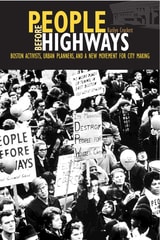
People before Highways
Boston Activists, Urban Planners, and a New Movement for City MakingKarilyn Crockett
University of Massachusetts Press, 2018
In 1948, inspired by changes to federal law, Massachusetts government officials started hatching a plan to build multiple highways circling and cutting through the heart of Boston, making steady progress through the 1950s. But when officials began to hold public hearings in 1960, as it became clear what this plan would entail—including a disproportionate impact on poor communities of color—the people pushed back. Activists, many with experience in the civil rights and antiwar protests, began to organize.
Linking archival research, ethnographic fieldwork, and oral history, Karilyn Crockett in People before Highways offers ground-level analysis of the social, political, and environmental significance of a local anti-highway protest and its lasting national implications. The story of how an unlikely multiracial coalition of urban and suburban residents, planners, and activists emerged to stop an interstate highway is one full of suspenseful twists and surprises, including for the actors themselves. And yet, the victory and its aftermath are undeniable: federally funded mass transit expansion, a linear central city park, and a highway-less urban corridor that serves as a daily reminder of the power and efficacy of citizen-led city making.

Polarizing Development
Alternatives to Neoliberalism and the CrisisEdited by Lucia Pradella and Thomas Marois
Pluto Press, 2015
The global economic crisis has exposed the limits of neoliberalism and dramatically deepened social polarization. Yet, despite increasing social resistance and opposition, neoliberalism prevails globally.
Radical alternatives, moreover, are only rarely debated. And if they are, such alternatives are reduced to new Keynesian and new developmental agendas, which fail to address existing class divisions and imperialist relations of domination.
This collection of essays polarizes the debate between radical and reformist alternatives by exploring head-on the antagonistic structure of capitalist development. The contributors ground their proposals in an international, non-Eurocentric and Marxian inspired analysis of capitalism and its crises. From Latin America to Asia, Africa to the Middle East and Europe to the US, social and labour movements have emerged as the protagonists behind creating alternatives.
This book’s new generation of scholars has written accessible yet theoretically informed and empirically rich chapters elaborating radical worldwide strategies for moving beyond neoliberalism, and beyond capitalism. The intent is to provoke critical reflection and positive action towards substantive change.
Politics and the Class Divide
Working People and the Middle Class LeftDavid Croteau
Temple University Press, 1994
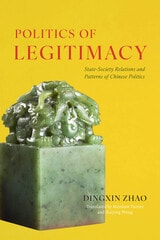
Politics of Legitimacy
State-Society Relations and Patterns of Chinese PoliticsDingxin Zhao
University of Chicago Press, 2026
The Chinese communist state has survived massive social changes, including the introduction of capitalist markets, an ongoing explosion of technological innovation, and an unprecedented jump in wealth and education, accompanied by a major cultural transformation. How has China managed to maintain its power even as the ground has so profoundly shifted? In Politics of Legitimacy, Dingxin Zhao argues that state power can be legitimized in three ideal-typical ways: a set of values upheld by the state (ideological legitimacy), recognized political processes such as regular competitive elections (procedural legitimacy), and the state’s capacity to provide public goods (performance legitimacy).
Building on this theoretical framework, Zhao analyzes different aspects of Chinese politics, including the tragic ending of the 1989 pro-democracy movement, the weak development of mass-based nationalism in post-Mao China, the reasons behind China’s economic success, the anti-establishment tendency of the Chinese mass media and social media, and the sources of political tension in China, despite a superb economy. Moreover, Zhao’s innovative framework is widely applicable beyond China, shifting our attention from regime-type categories to the tools and relationships that determine their survival or collapse, and illuminating the current global emergence of conservatism and religious nationalism.
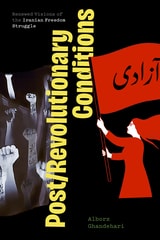
Post/Revolutionary Conditions
Renewed Visions of the Iranian Freedom StruggleAlborz Ghandehari
Northwestern University Press, 2025
An exploration of how the Iranian people have renewed their longtime struggle for freedom
The Woman, Life, Freedom uprising is only the latest manifestation of a century-long struggle for liberation in Iran. This ongoing movement for justice has encompassed two revolutions against domestic dictatorship and foreign imperialism, as well as a series of uprisings since the 1979 Iranian Revolution, which was followed by a new era of repression. Post/Revolutionary Conditions: Renewed Visions of the Iranian Freedom Struggle offers an intersectional analysis of how progressive and radical movement builders have reenvisioned liberation in the post-’79 era, despite new forms of oppression under the Islamic Republic and from US and other foreign imperial powers. Bringing together a diverse array of sources, including oral histories with Iranian labor, student, and gender justice organizers, as well as resistance literature and art, Alborz Ghandehari challenges narratives that treat working-class, feminist, queer, and oppressed ethnic minorities’ movements as separate from one another. Post/Revolutionary Conditions demonstrates how such potent reimaginings of collective liberation and a radically democratic future have been shaped by multiple generations of protest and kindred struggles globally.
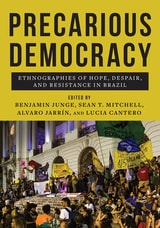
Precarious Democracy
Ethnographies of Hope, Despair, and Resistance in BrazilBenjamin Junge
Rutgers University Press, 2021
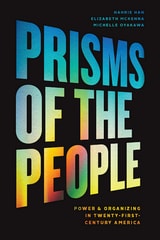
Prisms of the People
Power & Organizing in Twenty-First-Century AmericaHahrie Han, Elizabeth McKenna, and Michelle Oyakawa
University of Chicago Press, 2021
Prisms of the People addresses those questions and more. Using data from six movement organizations—including a coalition that organized a 104-day protest in Phoenix in 2010 and another that helped restore voting rights to the formerly incarcerated in Virginia—Hahrie Han, Elizabeth McKenna, and Michelle Oyakawa show that the power of successful movements most often is rooted in their ability to act as “prisms of the people,” turning participation into political power just as prisms transform white light into rainbows. Understanding the organizational design choices that shape the people, their leaders, and their strategies can help us understand how grassroots groups achieve their goals.
Linking strong scholarship to a deep understanding of the needs and outlook of activists, Prisms of the People is the perfect book for our moment—for understanding what’s happening and propelling it forward.
Promises of 1968
Crisis, Illusion and UtopiaVladimir Tismaneanu
Central European University Press, 2011
Protestors and Their Targets
James Jasper
Temple University Press, 2020
The strategic interactions between protestors and their targets shape the world around us in profound ways. The editors and contributors to Protesters and Their Targets—all leading scholars in the study of social movements—look at why movements do what they do and why their interactions with other societal actors turn out as they do. They recognize that targets are not stationary but react to the movement and require the movement to react back.
This edited collection analyzes how social movements select their targets, movement-target interactions, and the outcomes of those interactions. Case studies examine school closures in Sweden, the U.S. labor movement, Bolivian water and Mexican corn, and other global issues to show the strategic thinking, shifting objectives, and various degrees of success in the actions and nature of these protest movements.
Protesters and Their Targets seeks to develop a set of tools for the further development of the field’s future work on this underexplored set of interactions.

Public Interests
Media Advocacy and Struggles over U.S. TelevisionPerlman, Allison
Rutgers University Press, 2016
Nearly as soon as television began to enter American homes in the late 1940s, social activists recognized that it was a powerful tool for shaping the nation’s views. By targeting broadcast regulations and laws, both liberal and conservative activist groups have sought to influence what America sees on the small screen. Public Interests describes the impressive battles that these media activists fought and charts how they tried to change the face of American television.