86 books match the query 'Soul' and 9 start with p
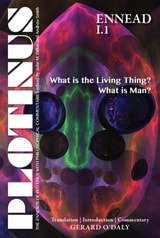
cover of PLOTINUS Ennead I.1: What is the Living Thing? What is Man?: Translation with an Introduction and Commentary

PLOTINUS Ennead I.1

What is the Living Thing? What is Man?: Translation with an Introduction and Commentary

Gerard O'Daly

Parmenides Publishing, 2017


Ennead I.1 is a succinct and concentrated analysis of key themes in Plotinus' psychology and ethics. It focuses on the soul-body relation, discussing various Platonic, Aristotelian, and Stoic views before arguing that there is only a soul-trace in the body (forming with the body a “compound”), while the reasoning soul itself is impassive and flawless. The soul-trace hypothesis is used to account for human emotions, beliefs, and perceptions, and human fallibility in general. Its problematic relation to our rational powers, as well as the question of moral responsibility, are explored. Plotinus develops his original and characteristic concept of the self or “we,” which is so called because it is investigated as something common to all humans (rather than a private individual self), and because it is multiple, referring to the reasoning soul or to the “living thing” composed of soul-trace and body. Plotinus explores the relation between the “we” and consciousness, and also its relation to the higher metaphysical entities, the Good, and Intellect.
 
[more]
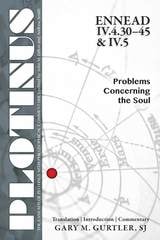
cover of PLOTINUS Ennead IV.4.30-45 & IV.5: Problems Concerning the Soul: Translation, with an Introduction and Commentary

PLOTINUS Ennead IV.4.30-45 & IV.5

Problems Concerning the Soul: Translation, with an Introduction and Commentary

Gary M. Gurtler, SJ

Parmenides Publishing, 2015
Ennead IV.4.30–45 and IV.5 retrieves the unity in this last section of Plotinus’ treatise on Problems concerning the Soul. Combining translation with commentary, Gurtler enhances both the accuracy of the translation and the recovery of Plotinus’ often unsuspected originality. This is especially true for IV.5, where previous translations fail to convey the concise nature of his argument against both the Aristotelian and Platonic theories of vision. Plato and Aristotle each claim that vision depends on the light between the eye and the object, but Plotinus presents evidence that this is not the case and develops a novel theory of light as a second activity that moves from source to object directly, even arguing that color is in the light itself rather than merely a quality of the object. This theory of vision, in turn, depends on the nature of sympathy developed especially in IV.4.30–45, where Plotinus shows how action at a distance is both possible and necessary for the proper unity in diversity of the sensible cosmos.
[more]
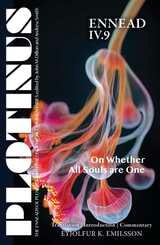
cover of PLOTINUS Ennead IV.9: On Whether All Souls are One: Translation | Introduction | Commentary

PLOTINUS Ennead IV.9

On Whether All Souls are One: Translation | Introduction | Commentary

Eyjólfur K. Emilsson

Parmenides Publishing, 2026

This short, early treatise undertakes to explain the controversial thesis that all souls—this includes individual human souls and the world-soul—are in some sense just one soul. Plotinus considers a number of objections that can be raised against the thesis. For instance, if the thesis is true, it may seem to follow that that everything that holds for one soul also holds for every other soul. Plotinus seeks to explain that such objections are off the mark, which also shows that the thesis about the unity of soul is not a claim about strict identity of all souls. He then (chapter 5) considers and rejects two materialistic hypotheses about the relationship between individual souls and the world-soul. In the final chapter he presents his own solution: the individual souls and the world-soul are all the soul hypostasis. He likens the relationship between the hypostatic soul and the individual souls with that between a science and the theorems of the science: each theorem potentially contains the whole science and can in a sense be said to be it.
[more]
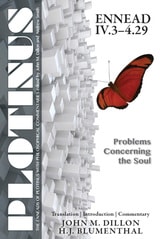
cover of PLOTINUS Ennead IVI.3-4.29: Problems Concerning the Soul: Translation, with an Introduction and Commentary

PLOTINUS Ennead IVI.3-4.29

Problems Concerning the Soul: Translation, with an Introduction and Commentary

John M. Dillon

Parmenides Publishing, 2015

For Plotinus, the nature and status of the human soul is one of the central problems of philosophy. Ennead IV.3­–4.29 constitutes his most penetrating enquiry into this topic, addressing the issues of the relation of the individual soul to the World Soul, the descent of the soul into body, its relations with that body, problems of personal identity and the nature of memory, sense perception, and the true seat of the emotions —many of which still have a resonance today. 

The treatise is an excellent example of Plotinus’ distinctive method of enquiry: not dogmatic (though he is no sceptic), but worrying away at questions until he has uncovered their complexities to the best of his ability. Such a work requires detailed commentary, such as is provided here, to tease out fully the fascinating convolutions of his thought.
 
[more]
cover of PLOTINUS Ennead V.1: On the Three Primary Levels of Reality: Translation, with an Introduction and Commentary

PLOTINUS Ennead V.1

On the Three Primary Levels of Reality: Translation, with an Introduction and Commentary

Eric D. Perl

Parmenides Publishing, 2015
Plotinus' Treatise V.1 comes closer than any other to providing an outline of his entire spiritual and metaphysical system, and as such it may serve to some degree as an introduction to his philosophy. It addresses in condensed form a great many topics to which Plotinus elsewhere devotes extended discussion, including the problem of the multiple self; eternity and time; the unity-in-duality of intellect and the intelligible; and the derivation of intelligible being from the One. Above all, it shows that the so-called “three hypostases”—soul, intellect, and the One—are best understood not as a sequence of three things additional to one another, but as three levels of possession of the same content, so that each lower level—soul in relation to intellect and intellect in relation to the One—is an “image” and “expression” of its superior. Plotinus exhorts the human soul to overcome its alienation from its own true nature and its divine origin by first recognizing itself as superior to the body and the same in kind as the animating principle of the entire cosmos, and then discovering within itself the still higher levels of reality from which it derives: intellect and, ultimately, the One or Good, the supreme first principle of all things. To do so the soul must redirect its attention inward and upward to become aware of the divinity which is always within it but from which it is distracted by the clamor of the senses.
[more]
cover of PLOTINUS Ennead VI.4 and VI.5: On the Presence of Being, One and the Same, Everywhere as a Whole: Translation with an Introduction and Commentary

PLOTINUS Ennead VI.4 and VI.5

On the Presence of Being, One and the Same, Everywhere as a Whole: Translation with an Introduction and Commentary

Eyjólfur K. Emilsson

Parmenides Publishing, 2015
Ennead VI.4-5, originally written as a single treatise, contains Plotinus’ most general and sustained exposition of the relationship between the intelligible and the sensible realms, addressing and coalescing two central issues in Platonism: the nature of the soul-body relationship and the nature of participation. Its main question is, How can soul animate bodies without sharing their extension? The treatise seems to have had considerable impact: it is much reflected in Porphyry’s important work, Sententiae, and the doctrine of reception according to the capacity of the recipient, for which this treatise is the main source, resonated in medieval thinkers.   
[more]
cover of Plotinus ENNEAD IV.8: On the Descent of the Soul into Bodies: Translation, with an Introduction, and Commentary

Plotinus ENNEAD IV.8

On the Descent of the Soul into Bodies: Translation, with an Introduction, and Commentary

Barrie Fleet

Parmenides Publishing, 2012
[more]
cover of Plotinus Ennead VI.9: On the Good or the One: Translation with an Introduction and Commentary

Plotinus Ennead VI.9

On the Good or the One: Translation with an Introduction and Commentary

Stephen R. L. Clark

Parmenides Publishing, 2020
This early treatise is placed by Plotinus’ editor at the very end of the Enneads, as the culmination of his thought, matching Plotinus’ own last recorded instruction, “to bring the god in you back to the god in the all.” It is a cosmological sketch, arguing that the being of anything depends on its being unified by its orientation to its own good, and so also the being of Everything, the All. The One, or the Good, is at once the goal of all things both individually and collectively, and also the transcendent source of all that we experience, mediated through an intelligible order. But it is also, and perhaps more importantly, intended as a guide to the proper education and discipline of our own motives and experience. We are encouraged to put aside immediate sensory data, egoistic prejudice and sensual impulse, first to grasp at least a little of the intelligible order within which we all live, and at last to purge even those last intellectual attachments and experience what cannot be adequately described: the unity of being.
[more]
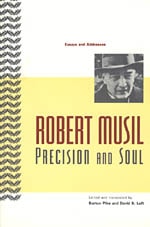
cover of Precision and Soul: Essays and Addresses

Precision and Soul

Essays and Addresses

Robert Musil

University of Chicago Press, 1990

"We do not have too much intellect and too little soul, but too little precision in matters of the soul."—Robert Musil

Best known as author of the novel The Man without Qualities, Robert Musil wrote these essays in Vienna and Berlin between 1911 and 1937. Offering a perspective on modern society and intellectual life, they are concerned with the crisis of modern culture as it manifests itself in science and mathematics, capitalism and nationalism, the changing roles of women and writers, and more. Writing to find his way in a world where moral systems everywhere were seemingly in decay, Musil strives to reconcile the ongoing conflict between functional relativism and the passionate search for ethical values.

Robert Musil was born in 1880 and died in 1942. His first novel, Young Törless, is available in English. A new two-volume translation by Burton Pike and Sophie Wilkins of The Man without Qualities is forthcoming from Alfred A. Knopf.

"Now we have these thirty-one invaluable and entertaining pieces, from an article on 'The Obscene and Pathological in Art' to the equally provocative talk 'On Stupidity,' which, with a new translation of The Man without Qualities forthcoming . . . amount to a literary event for the reader of English comparable to Constance Garnett's massive translation of Chekhov's stories."—Joseph Coates, Chicago Tribune

"Musil is one of the few great moderns, one of the handful who ventured to confront the issues that shape and define our time. . . . He has a range and a striking capacity every bit as great as that of Mann, Joyce, or Beckett."—Boston Review

"These essays are crucial in understanding a writer and critic whose lifelong task was an attempt to resolve the dichotomy between the precision of scientific form and the soul—the matter of life and art."—Choice
[more]