Results by title
254 books match the query 'Sports' and 8 start with p
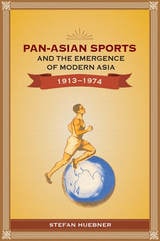
Pan-Asian Sports and the Emergence of Modern Asia, 1913-1974
Stefan Huebner
National University of Singapore Press, 2016
Based on a vast range of archival materials and spanning sixty years and three continents, Sports and the Emergence of Modern Asia shows how pan-Asian sporting events helped shape anti-colonial sentiments, Asian nationalisms, and pan-Asian aspirations in places as diverse as Japan and Iran, and across the span of countries lying between them.

People of Prowess
Sport, Leisure, and Labor in Early Anglo-AmericaNancy L. Struna
University of Illinois Press, 1996
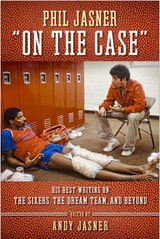
Phil Jasner "On the Case"
His Best Writing on the Sixers, the Dream Team, and BeyondAndy Jasner
Temple University Press, 2017
Allen Iverson loved Philadelphia Daily News basketball beat reporter Phil Jasner, calling him “the best” in the world of sports journalism. From 1981 until his death in 2010, Jasner was always “on the case,” going to great lengths to track athletes down for a quote or a story. He was most known for covering the team’s famous players, including World B. Free and Bobby Jones, Julius Erving and Moses Malone, Charles Barkley, and, of course, Iverson. His tremendous output was beloved by players and fans alike, earning him many honors, including inductions into six Halls of Fame.
Phil Jasner “On the Case” collects the best of Jasner’s writing throughout his illustrious career. Jasner wrote about baseball, the Eagles, and the Philadelphia Atoms’ soccer with the same insight and aplomb he showed in his coverage of The Big 5, the 76ers’ championship season in 1983, and the Dream Team. Lovingly assembled—each chapter is introduced by some of the most prominent figures Jasner covered, from Vince Papale, Doug Collins, and Billy Cunningham to Iverson and Barkley—this collection recounts a distinguished sportswriter’s remarkable career.
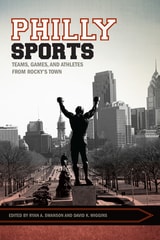
Philly Sports
Teams, Games, and Athletes from Rocky's TownRyan Swanson
University of Arkansas Press, 2016
Philadelphia sports—anchored by the Eagles, Flyers, Phillies, and 76ers—have a long, and sometimes tortured, history. Philly fans have booed more than their share and have earned a reputation as some of the most hostile in the country. They’ve been known, so the tales go, to jeer Santa Claus and cheer at the injury of an opposing player.
Strangely though, much of America’s perception of Philadelphia sports has been shaped by a fictional figure: Rocky. The series of Hollywood films named after their title character has told and retold the Cinderella story of an underdog boxer rising up against long odds. One could plausibly make the argument that Rocky is Philadelphia’s most famous athlete.
Beyond the major sports franchises and Rocky, lesser-known athletic competition in Philadelphia offers much to the interested observer. The city’s boxing culture, influence on Negro Leagues baseball, role in establishing interscholastic sport, and leadership in the rise of cricket all deserve and receive close investigation in this new collection. Philly Sports combines primary research and personal experiences—playing in the Palestra, scouting out the tombstones of the city’s best athletes, enjoying the fervor of a Philadelphia night with a local team in pursuit of a championship title. The essence of Philadelphia sport, and to a certain extent the city itself, is distilled here.
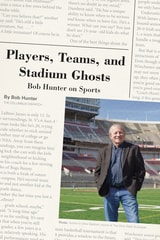
Players, Teams, and Stadium Ghosts
Bob Hunter on SportsBob Hunter
Ohio University Press, 2019
In Players, Teams, and Stadium Ghosts, sportswriter Bob Hunter has assembled a Hall of Fame collection of his best writing from the Columbus Dispatch. Fans will encounter some of the biggest names in sports and relive great moments from games played by amateurs and pros. They’ll encounter forgotten players and teams that struggled.
Hunter shows us LeBron James when he was a 15-year-old high school freshman, already capturing the world’s attention; 20-year-old Derek Jeter’s meteoric rise through the minors, including the Columbus Clippers; a strange encounter with Pete Rose hustling frozen pizzas; and the excitement of watching future WNBA star Katie Smith dominate a Columbus Quest championship game. The common thread is the personal touch that Hunter consistently uses to take readers beyond the final scores and the dazzle of lights. These are the people behind the athletes. They’re remembered for how they played, but Hunter reminds us who they were.
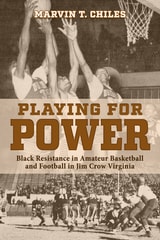
Playing for Power
Black Resistance in Amateur Basketball and Football in Jim Crow VirginiaMarvin T. Chiles
University of Alabama Press, 2025
Reveals the role of amateur Black football and basketball in Virginia before integration as a form of resistance to white supremacy
In Playing for Power, Marvin T. Chiles offers a fascinating account of amateur sports in Jim Crow Virginia, revealing how, in addition to churches, workspaces, and civil rights organizations, sports were also a key arena for Black resistance to white supremacy. Drawing from a rich trove of primary sources, Chiles recounts the development of Black football and basketball culture at the high school and college levels in Virginia from the 1890s to the early 1970s. Looking beyond their role as leisure pastimes, Chiles demonstrates how amateur sports strengthened education, neutralized class divisions, shaped Black masculinity, mentored Black male leadership, cultivated race pride, and reflected Black desires for urban modernity.
Illuminating the ways Black athletes created a world that pushed for racial progress through objective, meritocratic achievement anchored by masculine leadership and institutional success, Playing for Power traces how amateur sports coalesced into a key cultural institution that fostered Black Virginians’ collective sense of community, achievement, and purpose during segregation, cornerstones of later advances in the Civil Rights Movement. Playing for Power also contributes to a larger understanding of sports history and how amateur sports became favorite American spectacles and markers of Southern identity. Chiles’s groundbreaking work will interest historians, scholars, and individuals interested in the intersection of sports and civil rights and the history of Black sports during the Jim Crow era.
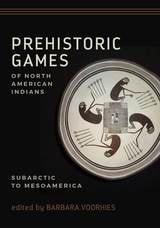
Prehistoric Games of North American Indians
Subarctic to MesoamericaBarbara Voorhies
University of Utah Press, 2017
Prehistoric Games of North American Indians is a collection of studies on the ancient games of indigenous peoples of North America. The authors, all archaeologists, muster evidence from artifacts, archaeological features, ethnography, ethnohistory, and to a lesser extent linguistics and folklore. Chapters sometimes center on a particular game (chunkey rolling disc game or patolli dice game, for example) or sometimes on a specific prehistoric society and its games (Aztec acrobatic games, games of the ancient Fremont people), and in one instance on the relationship between slavery and gaming in ancient indigenous North American societies.
In addition to the intrinsic value of pursuing the time depth of these games, some of which remain popular and culturally important today among Native Americans or within the broader society, the book is important for demonstrating a wide variety of research methods and for problematizing a heretofore overlooked research topic. Issues that emerge include the apparently ubiquitous but difficult to detect presence of gambling, the entanglement of indigenous games and the social logic of the societies in which they are embedded, the characteristics of women’s versus men’s games or those of in-group and out-group gaming, and the close correspondence between gaming and religion. The book’s coverage is broad and balanced in terms of geography, level of socio-cultural organization and gender.
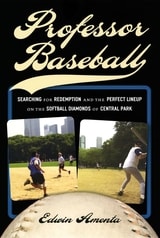
Professor Baseball
Searching for Redemption and the Perfect Lineup on the Softball Diamonds of Central ParkEdwin Amenta
University of Chicago Press, 2007
It happens every summer: packs of beer-bellied men with gloves and aluminum bats, putting their middle-aged bodies to the test on the softball diamond. For some, this yearly ritual is driven by a simple desire to enjoy a good ballgame; for others, it’s a way to forge friendships—and rivalries. But for one short, wild-haired, bespectacled professor, playing softball in New York’s Central Park means a whole lot more. It's one last chance to heal the nagging wounds of Little League trauma before the rust of decline and the relentless responsibilities of fatherhood set in.
Professor Baseball is the coming-of-middle-age story of New York University professor and Little League benchwarmer Edwin Amenta. As rookie manager of the Performing Arts Softball League’s doormat Sharkeys, he reverses softball’s usual brawn-over-brains formula. He coaxes his skeptical teammates to follow his sabermetric and sociological approach, based equally on Bill James and Max Weber, which in the heady days of early success he dubs “Eddy Ball.” But Amenta soon learns that his teammates’ attachments to favorite positions and time-honored (if ineffective) strategies are hard to break—especially when the team begins losing. And though he rejects the baseball-as-life metaphor, life keeps intruding on his softball season. Amenta here comes to grips with the humiliation of assisted reproduction, suffers mysterious ailments, and finds himself lingering at the sponsor’s bar, while his partner, a beautiful but baseball-challenged professor, second-guesses his book in the making. Can he turn his team—and his life—around?
Packed with colorful personalities, dramatic games, and the bustle of New York life, Professor Baseball will charm anyone who has ever root, root, rooted for the underdog.