Results by title
57 books match the query 'State, The' and 2 start with p
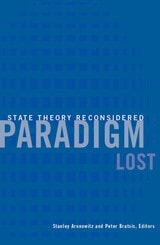
Paradigm Lost
State Theory ReconsideredStanley Aronowitz
University of Minnesota Press, 2002
Analyzes the ongoing relevance of a revitalized state theory to today’s political debates.
With increasing globalization, the meaning and role of the nation-state are in flux. At the same time, state theory, which might help to explain such a trend, has fallen victim to the general decline of radical movements, particularly the crisis in Marxism. This volume seeks to enrich and complicate current political debates by bringing state theory back to the fore and assessing its relevance to the social phenomena and thought of our day. Throughout, it becomes clear that, whether confronting the challenges of postmodern and neo-institutionalist theory or the crisis of the welfare state and globalization, state theory still has great analytical and strategic value.
Contributors: Clyde W. Barrow, U of Massachusetts, Dartmouth; Richard A. Cloward; Adriano Nervo Codato, Federal U of Paraná, Brazil; Bob Jessop, Lancaster U, UK; Andreas Kalyvas, U of Michigan; Rhonda F. Levine, Colgate U; Leo Panitch, York U; Renato Monseff Perissinotto, Federal U of Paraná, Brazil; Frances Fox Piven, CUNY; Paul Thomas, U of California, Berkeley; Constantine Tsoukalas, U of Athens.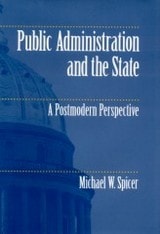
Public Administration and the State
A Postmodern PerspectiveMichael W. Spicer
University of Alabama Press, 2005
A critical examination of public administration's pervasive vision of a powerful state
Woodrow Wilson argued for a state led by a powerful government, guided by science and enlightened experts, for the accomplishment of a set of collective purposes—in other words, a purposive state. Michael Spicer contends that though Wilson and those who followed him have not typically explored questions of political and constitutional theory in their writing, a clear and strong vision of the state has emerged in their work nonetheless.
Building upon the work of Dwight Waldo and others who have sought to explore and reveal the political theory behind the seemingly neutral language of administration, Spicer explores the roots—both historical and philosophical—of the purposive state. He considers the administrative experience of 18th-century Prussia and its relationship to the vision of the purposive state, and examines the ways this idea has been expressed in the 20th century. He then looks at the practical problems such a vision creates for public policy in a fragmented postmodern political culture. Finally, Spicer explores an alternative view of public administration—one based on a civil association model appropriate to our constitutional traditions and contemporary culture.