Results by title
52 books match the query 'Structure' and 5 start with p
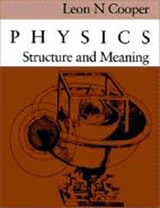
Physics
Structure and MeaningLeon N. Cooper
Brandeis University Press, 1992
Physics explores the scientific view of the world as it has developed from the earliest theories of Aristotle, Euclid, and Newton to modern theories, such as Einstein’s relativity and quantum mechanics. The classic text’s chief distinction is its time-proven ability to overcome anxieties about science by arousing interest in imaginative ideas. Those curious about physics but lacking science and mathematics backgrounds will find well-told history and countless stimulating examples. The historical approach enables students to examine philosophical questions from many viewpoints and ot see how current theory evolved. Physics has been thoroughly tested and refined by several decades of classroom teaching. A new prologue covers the years since the original 1968 edition. Chapter source notes, review problems, questions and answers, and mathematical appendices are included for those wishing to pursue topics further. The material is supplemented with clear line drawings, illustrations, graphs, charts, and tables.
[more]

Plough, Sword, and Book
The Structure of Human HistoryErnest Gellner
University of Chicago Press, 1990
"Philosophical anthropology on the grandest scale. . . .Gellner has produced a sharp challenge to his colleagues and a thrilling book for the non-specialist. Deductive history on this scale cannot be proved right or wrong, but this is Gellner writing, incisive, iconoclastic, witty and expert. His scenario compels our attention."—Adam Kuper, New Statesman
"A thoughtful and lively meditation upon probably the greatest transformation in human history, upon the difficult problems it poses and the scant resources it has left us to solve them."—Charles Larmore, New Republic
"A thoughtful and lively meditation upon probably the greatest transformation in human history, upon the difficult problems it poses and the scant resources it has left us to solve them."—Charles Larmore, New Republic
[more]
Political Judgment
Structure and ProcessMilton Lodge and Kathleen M. McGraw, Editors
University of Michigan Press, 1995
An information processing approach to how citizens make important political decisions
[more]

Positive Political Theory II
Strategy and StructureDavid Austen-Smith and Jeffrey S. Banks
University of Michigan Press, 2005
“A major piece of work . . . a classic. There is no
other book like it.”
—Norman Schofield, Washington University
“The authors succeed brilliantly in tackling a large
number of important questions concerning the
interaction among voters and elected representatives
in the political arena, using a common, rigorous
language.”
—Antonio Merlo, University of Pennsylvania
Positive Political Theory II: Strategy and Structure
is the second volume in Jeffrey Banks and David
Austen-Smith’s monumental study of the links
between individual preferences and collective choice.
The book focuses on representative systems, including
both elections and legislative decision-making
processes, clearly connecting individual preferences to
collective outcomes. This book is not a survey. Rather,
it is the coherent, cumulative result of the authors’
brilliant efforts to indirectly connect preferences to
collective choice through strategic behaviors such as
agenda-selection and voting.
The book will be an invaluable reference and teaching
tool for economists and political scientists, and an
essential companion to any scholar interested in the
latest theoretical advances in positive political theory.
[more]

Private Sectors in Higher Education
Structure, Function, and Change in Eight CountriesRoger L. Geiger
University of Michigan Press, 1986
Private Sectors in Higher Education examines how the tasks of higher education have been divided between public and private institutions, and with what consequences. In doing so, the author analyzes both the comparative structures of educational systems and their social relations. Besides correcting the widespread misperception that private higher education is predominately an American phenomenon, this study should enlarge the range of experience that can be brought to bear on issues currently facing public policy and private higher education. It constitutes the first scholarly treatment of private higher education outside the United States. Case studies of private sectors in seven countries—Belgium, France, Great Britain, Japan, the Netherlands, the Philippines, and Sweden—form the core of this work. This material provides a perspective for probing several underlying rationales for private higher education in the United States. And finally, the author analyzes the issue of government financial support for private higher education. This book should significantly contribute to enlarging the framework of discussion of this question by broadening the understanding of the social and political underpinnings of public/private division in higher education.
[more]