Results by title
206 books match the query 'Study & Teaching' and 10 start with p
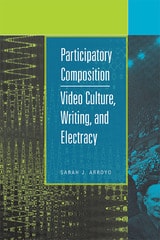
Participatory Composition
Video Culture, Writing, and ElectracySarah J. Arroyo
Southern Illinois University Press, 2013
Like. Share. Comment. Subscribe. Embed. Upload. Check in. The commands of the modern online world relentlessly prompt participation and encourage collaboration, connecting people in ways not possible even five years ago. This connectedness no doubt influences college writing courses in both form and content, creating possibilities for investigating new forms of writing and student participation. In this innovative volume, Sarah J. Arroyo argues for a “participatory composition,” inspired by the culture of online video sharing and framed by theorist Gregory Ulmer’s concept of electracy.
Electracy, according to Ulmer, “is to digital media what literacy is to alphabetic writing.” Although electracy can be compared to digital literacy, it is not something shut on and off with the power buttons on computers or mobile devices. Rather, electracy encompasses the cultural, institutional, pedagogical, and ideological implications inherent in the transition from a culture of print literacy to a culture saturated with electronic media, regardless of the presence of actual machines.
Arroyo explores the apparatus of electracy in many of its manifestations while focusing on the participatory practices found in online video culture, particularly on YouTube. Chapters are devoted to questions of subjectivity, definition, authorship, and pedagogy. Utilizing theory and incorporating practical examples from YouTube, classrooms, and other social sites, Arroyo presents accessible and practical approaches for writing instruction. Additionally, she outlines the concept of participatory composition by highlighting how it manifests in online video culture, offers student examples of engagement with the concept, and advocates participatory approaches throughout the book.
Arroyo presents accessible and practical possibilities for teaching and learning that will benefit scholars of rhetoric and composition, media studies, and anyone interested in the cultural and instructional implications of the digital age.
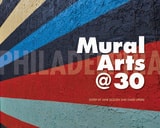
Philadelphia Mural Arts @ 30
Jane Golden
Temple University Press, 2014
The Mural Arts Program of Philadelphia began in 1984 as a summer youth program with modest support from city government. Under the guidance of Jane Golden, however, it gradually grew into one of the largest and most successful public art organizations in the country, garnering support from local corporations, foundations, and individuals to extend the reach and effectiveness of its innovative programs.
Now three decades later, the Mural Arts Program has created more than 3,800 murals and public art projects that have made lasting imprints in every Philadelphia neighborhood. In the process, Mural Arts has engaged thousands of people of all ages from across the city, helped hundreds of ex-offenders train for new jobs, transformed the face of struggling commercial corridors, and developed funding partners in both public and private sectors.
While the Mural Arts Program has significantly changed the appearance of the city, it has also demonstrated how participatory public art can empower individuals and promote communal healing around difficult issues. Philadelphia Mural Arts @ 30 is a celebration of and guide to the program's success. Unlike Philadelphia Murals and the Stories They Tell and its sequel, More Philadelphia Murals and the Stories They Tell, Philadelphia Murals @ 30 showcases the results of 21 projects completed since 2009 and features essays by policy makers, curators, scholars, and educators that offer valuable lessons for artists, activists, and communities to emulate.
Philadelphia Mural Arts @ 30 traces the program's history and evolution, acknowledging the challenges and rewards of growth and change while maintaining a core commitment to social, personal, and community transformation.
Contributors include: Dr. Arthur C. Evans, Jr., Arlene Goldbard, Thora Jacobson, Rick Lowe, Dr. Samantha L. Matlin, Paulette Moore, Jeremy Nowak, Maureen H. O'Connell, Elisabeth Perez Luna, Robin Rice, Dr. Jacob Kraemer Tebes, Elizabeth Thomas, Cynthia Weiss, Howard Zehr, and the editors.

Pikes Peak Partnership
The Penroses and the TuttsThomas J. Noel
University Press of Colorado, 2002
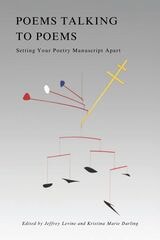
Poems Talking to Poems
Setting Your Poetry Manuscript ApartEdited by Jeffrey Levine and Kristina Marie Darling
Tupelo Press, 2025
Poems Talking to Poems presents practical guidance for sequencing, structure and architecture, revision, and choosing titles for sections as well as the poetry manuscript as a whole. This guide also includes insider tips about how contests work, the literary marketplace, and how you can set your work apart.
With essays by such literary luminaries as Ilya Kaminsky, Katie Farris, Kristina Marie Darling, Jeffrey Levine, and many other distinguished contributors, this anthology is a concise and comprehensive field guide to perfecting your book and getting it into print.
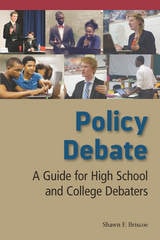
Policy Debate
A Guide for High School and College DebatersShawn F. Briscoe
Southern Illinois University Press, 2017
Briscoe addresses all aspects of policy debate, including stock issues, judging paradigms and effective engagement with judges, the responsibilities of both affirmative and negative teams, and the evaluation of policy proposals through the use of disadvantages, counterplans, and critical argumentation. In addition, Briscoe helps debaters better establish their credibility, improve their cross-examination skills, and understand the specialized notetaking method called flowing. The book models for readers how to effectively cross-examine an opposing team, features a transcript of a mock debate designed to help clarify the lessons taught in previous chapters, and includes a glossary of key terms. Briscoe also considers contemporary trends in the debate community, exploring the evolution of policy debate and the rise of performance-based approaches, while providing insight into how best to engage with performance teams.
Offering a unique approach presented by a seasoned debate coach, Policy Debate: A Guide for High School and College Debaters goes beyond the basics to explore how policy is an ever-evolving form of debate. This attention to the progression of policy styles will make readers better at adapting to opponents during a debate and will make them more adept at arguing against a wider range of cases.
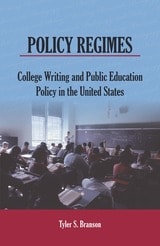
Policy Regimes
College Writing and Public Education Policy in the United StatesTyler S. Branson
Southern Illinois University Press, 2021
Author Tyler S. Branson argues that education reform initiatives in the twentieth century can be understood in terms of historical shifts in the ideas, interests, and governing arrangements that inform the teaching of writing. Today, policy regimes of “accountability” shape education reform programs such as Common Core in K-12 and Dual Enrollment in postsecondary institutions. This book reopens the conversation between policy makers and writing teachers, empirically describing the field’s institutional/historical relationship to policy and the ways teachers work on a daily basis to carry out policy. Federal and state accountability policy significantly shapes classrooms before teachers even enter them, but Branson argues the classroom is where teachers leverage disciplinary knowledge about writing to bridge, partner with, support, and sometimes resist education policies.
Branson deftly blends policy critique, archival analysis, and participant observation to offer the first scholarly treatment of the National Council of Teachers of English (NCTE) Washington Task Force as well as a rare empirical study of a dual enrollment course offered in a high school. This book’s macro-and-micro-level analysis of education policy reveals how writing teachers, researchers, and administrators can strengthen their commitments to successfully teaching their students across all levels of education, while deepening their understanding of the ways education policy helps—and hinders—those commitments.
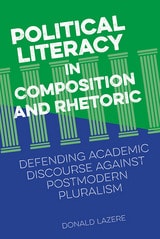
Political Literacy in Composition and Rhetoric
Defending Academic Discourse against Postmodern PluralismDonald Lazere
Southern Illinois University Press, 2015
Postcomposition
Sidney I. Dobrin
Southern Illinois University Press, 2011
Dobrin evaluates the current state of composition studies, underscoring the difference between composition and writing and arguing that the field's focus on the administration of writing students and its historically imposed prohibition on theory greatly limit what can be understood about writing. Instead he envisions a more significant approach to writing, one that questions the field's conservative allegiance to subject and administration and reconsiders writing as spatial and ecological. Using concepts from ecocomposition, spatial theory, network theory, complexity theory, and systems theory, Postcomposition lays the groundwork for a networked theory of writing, and advocates the abandonment of administration as a useful part of the field. He also challenges the usefulness of rhetoric in writing studies, showing how writing exceeds rhetoric.
Postcomposition is a detailed consideration of how posthumanism affects the field's understanding of subjectivity. It also tears at the seams of the "contingent labor problem." As he articulates his own frustrations with the conservatism of composition studies and builds on previous critiques of the discipline, Dobrin stages a courageous-and inevitably polemical-intellectual challenge to the entrenched ideas and assumptions that have defined composition studies.
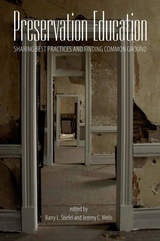
Preservation Education
Sharing Best Practices and Finding Common GroundEdited by Barry L. Stiefel and Jeremy C. Wells
University Press of New England, 2014
Problem with Education Technology (Hint
It's Not the Technology)Ben Fink
Utah State University Press, 2016
Education is in crisis—at least, so we hear. And at the center of this crisis is technology. New technologies like computer-based classroom instruction, online K–12 schools, MOOCs (massive open online courses), and automated essay scoring may be our last great hope—or the greatest threat we have ever faced.
In The Problem with Education Technology, Ben Fink and Robin Brown look behind the hype to explain the problems—and potential—of these technologies. Focusing on the case of automated essay scoring, they explain the technology, how it works, and what it does and doesn’t do. They explain its origins, its evolution (both in the classroom and in our culture), and the controversy that surrounds it. Most significantly, they expose the real problem—the complicity of teachers and curriculum-builders in creating an education system so mechanical that machines can in fact often replace humans—and how teachers, students, and other citizens can work together to solve it.
Offering a new perspective on the change that educators can hope, organize, and lobby for, The Problem with Education Technology challenges teachers and activists on “our side,” even as it provides new evidence to counter the profit-making, labor-saving logics that drive the current push for technology in the classroom.