Results by title
81 books match the query 'Systematic' and 4 start with p
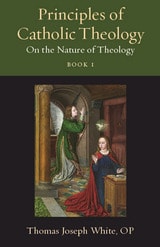
Principles of Catholic Theology, Book 1
On the Nature of TheologyThomas Joseph White, OP
Catholic University of America Press, 2023
Catholic theology has to face a certain number of fundamental questions: what is the nature and content of Christian revelation, what are the sources of revelation, how are the mysteries of the faith to be understood in relation of one to another, and how do the truths of the Catholic faith relate to the acquisitions of natural reason. In the contemporary context, Catholic theology is marked by a diversity of approaches, many of which are seemingly incompatible or estranged from one another. How might we think about the unity of Catholic theology over and above the diversity of forms? What role, if any, can Aquinas play as a common doctor in facilitating exchanges between theological traditions in the Church?
Principles of Catholic Theology seeks to address directly the nature of Catholic theology and the challenge of its contemporary articulation with an eye towards its articulation in its Thomistic key. This book is also the first of a series of collections of essays by Thomas Joseph White, OP, extending over a range of fundamental topics in Catholic dogmatic theology.
[more]
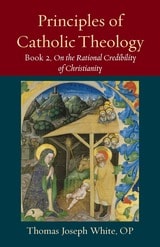
Principles of Catholic Theology, Book 2
On the Rational Credibility of ChristianityThomas Joseph White, OP
Catholic University of America Press, 2023
Can a philosopher defend the rational warrant for belief in Christianity? Is it reasonable to be religious? Is it philosophically responsible to be a Christian who believes in the mystery of the Trinity? Principles of Catholic Theology explores these questions in a systematic way by considering questions of ultimate explanation. Why not hold that modern atheistic naturalism provides the best explanation of reality? Or, if there is a transcendent first principle that explains all of reality, is it impersonal rather than personal? Contrastingly, if monotheism constitutes the best explanation for created being, how can we reasonably believe in any particular revelation concerning God? What are the criteria for rational belief in revelation?
Thomas Joseph White, OP, considers these questions by exploring a series of topics: the transcendentals (existence, oneness, truth, goodness, beauty); rational argument for the existence of God; the immateriality and subsistence after death of the personal soul of the human being; the historical and conceptual coherence of Trinitarian doctrine; and the reasonableness of the natural desire to see God. The aim of Principles of Catholic Theology, Book 2 is to place contemporary natural reason in profound dialogue with the Catholic faith and to think about ways that we can consent to the profound mystery of the Holy Trinity that are in robust concord with the knowledge obtained from philosophical, scientific, and historical sources.
[more]
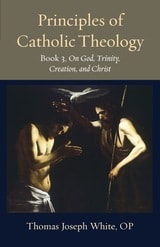
Principles of Catholic Theology, Book 3
On God, Trinity, Creation, and ChristThomas Joseph White
Catholic University of America Press, 2024
What if anything can human beings know about God, either by way of philosophical reasoning or by divine revelation? How does the mystery of the Incarnation illuminate our understanding of the nature and mystery of God and the nature and destiny of the human person? The essays in this book explore topics pertaining to the nature of God, apophatic theology, divine simplicity and the holy Trinity, divine beauty, and the beauty of creation. The book also contains a series of speculative considerations of Christology: Why did God become human? How ought we understand the two natures of Christ and the topic of the communication of idioms (attribution of both divine and human properties to one person)? There is also a sustained treatment of Jesus' human knowledge and voluntary freedom. Did Jesus understand his own lordship and his unity with the Father and the Holy Spirit, and if so, how? Did Christ's human will always accord with the divine will, and what significance does this idea have for our understanding of the redemption affected by Christ for the whole human race? Through these explorations, principles drawn from Thomas Aquinas and from Thomistic tradition are taken into account as key resources for the adjudication of contemporary theological challenges.
Principles of Catholic Theology, Book 3 is a continuation of Fr. Thomas Joseph White's collection of essays, extending over a range of fundamental topics in Catholic dogmatic theology.
[more]
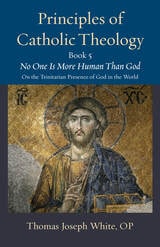
Principles of Catholic Theology, Book 5
No One is More Human Than God: On the Trinitarian Presence of God in the WorldThomas Joseph White
Catholic University of America Press, 2026
This work explores a Christian understanding of God’s presence in the world. As the Creator of all that exists, the Creator-Trinity is mysteriously present to all things, and truly but imperfectly knowable as such. In addition to this creative presence, however, there is also the manifestation of God’s presence as a gift of grace. By supernatural faith, the trinitarian life of God is made known to us as an object of the Christian mystical life. This life is centered especially upon God’s unique presence by way of Incarnation, human life, death, and resurrection, in the person of Jesus of Nazareth. This work explores these notions in comparison with other religious traditions, in a Catholic as well as ecumenical perspective. Original considerations are offered regarding the nature of scriptural inspiration, the Church as the mystical body of Christ, and the sacraments as instrumental expressions of the Incarnation, all with a view to the notion of mystical experience, and union with God.
Principles of Catholic Theology, Book 5 is a continuation of Fr. Thomas Joseph White’s collection of essays, extending over a range of fundamental topics in Catholic dogmatic theology.
[more]