Results by title
151 books match the query 'Tales' and 3 start with p

Penny Loafers & Bobby Pins
Tales and Tips from Growing Up in the ’50s and ’60sSusan Sanvidge
Wisconsin Historical Society Press, 2010
“In the fifties, sleek Mixmasters were replacing rusty eggbeaters, and new pressure-cookers blew their tops in kitchens all over town. There were kids everywhere, and new ‘ranch-style’ houses filled vacant lots. . . . Turquoise Studebakers and dusty-rose Chevy BelAirs with flamboyant fins and lots of chrome replaced dark pre-war cars. Cameras took color snapshots instead of black-and-white. We wore red canvas tennis shoes and lemon yellow shorts, and bright blue popsicles melted down our chins.” —from the Introduction
In Penny Loafers & Bobby Pins, the four Sanvidge sisters, whose birthdates span the Baby Boomer period, present a lively chronicle of growing up in the 1950s and 1960s in a small midwestern town. Each sister writes about the facets of her childhood she remembers best, and their lighthearted stories are illustrated with period photos. Sprinkled with mentions of pedal pushers, home permanents, and “two-tone” cars; early TV shows and the first rock and roll; hula hoops, Tiny Tears, and Mr. Potato Head (played with a real potato); and memories of their grandparents who lived nearby, Penny Loafers & Bobby Pins also features “how-tos” for re-creating the fads, foods, crafts, and games the Sanvidge sisters recall in their stories.
[more]
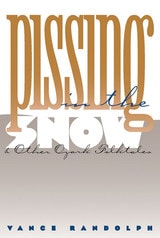
Pissing in the Snow and Other Ozark Folktales
Vance Randolph
University of Illinois Press, 1976
Vance Randolph has long been an undeniable presence on the American folklore scholarship scene. His Ozark corpus is "the best known single body of regional folklore in the United States," according to Richard Dorson, director of the Folklore Institute at Indiana University. And Gershon Legman, the world's leading scholar of sexual and scatological humor, has called Randolph "the greatest and most successful field collector and regional folklorist that America ever had." In Legman's estimation, "We have no one else like him. He is a national treasure, like Mark Twain.
Randolph's reputation rests on the massive accumulation of folksong, folktale, and ballad materials he collected during forty years of living and working in the Ozarks. Unfortunately, in the 1950s when Randolph published several collection of Ozark tales, the material in this volume was considered unprintable.
Pissing in the Snow departs from the academic prudery that until recently has restricted the amount of bawdy folklore available for study. It presents a body of material that for twenty years has circulated only in manuscript or microfilm under its present title.
When placed in their rightful context alongside Randolph's other collections of folk material, the bawdy tales help provide evidence of what Ozark hill people think about their own lives and language. As Rayna Green writes in her introduction, "The entire body of material . . . offers a picture of expressive behavior unparalleled by any other American region's or group's study." Hoffmann's annotations draw parallels between the erotic narrative tradition of the Ozarks and that in other parts of the country and the world, especially Europe.
[more]
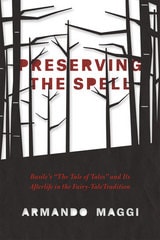
Preserving the Spell
Basile's "The Tale of Tales" and Its Afterlife in the Fairy-Tale TraditionArmando Maggi
University of Chicago Press, 2015
Fairy tales are supposed to be magical, surprising, and exhilarating, an enchanting counterpoint to everyday life that nonetheless helps us understand and deal with the anxieties of that life. Today, however, fairy tales are far from marvelous—in the hands of Hollywood, they have been stripped of their power, offering little but formulaic narratives and tame surprises.
If we want to rediscover the power of fairy tales—as Armando Maggi thinks we should—we need to discover a new mythic lens, a new way of approaching and understanding, and thus re-creating, the transformative potential of these stories. In Preserving the Spell, Maggi argues that the first step is to understand the history of the various traditions of oral and written narrative that together created the fairy tales we know today. He begins his exploration with the ur-text of European fairy tales, Giambattista Basile’s The Tale of Tales, then traces its path through later Italian, French, English, and German traditions, with particular emphasis on the Grimm Brothers’ adaptations of the tales, which are included in the first-ever English translation in an appendix. Carrying his story into the twentieth century, Maggi mounts a powerful argument for freeing fairy tales from their bland contemporary forms, and reinvigorating our belief that we still can find new, powerfully transformative ways of telling these stories.
If we want to rediscover the power of fairy tales—as Armando Maggi thinks we should—we need to discover a new mythic lens, a new way of approaching and understanding, and thus re-creating, the transformative potential of these stories. In Preserving the Spell, Maggi argues that the first step is to understand the history of the various traditions of oral and written narrative that together created the fairy tales we know today. He begins his exploration with the ur-text of European fairy tales, Giambattista Basile’s The Tale of Tales, then traces its path through later Italian, French, English, and German traditions, with particular emphasis on the Grimm Brothers’ adaptations of the tales, which are included in the first-ever English translation in an appendix. Carrying his story into the twentieth century, Maggi mounts a powerful argument for freeing fairy tales from their bland contemporary forms, and reinvigorating our belief that we still can find new, powerfully transformative ways of telling these stories.
[more]