Results by title
461 books match the query 'Teaching' and 19 start with p
Past and Future Presence
Approaches for Implementing XR Technology in Humanities and Art EducationLissa Crofton-Sleigh and Brian Beams, editors
Amherst College Press, 2024
Pastplay
Teaching and Learning History with TechnologyKevin Kee, editor
University of Michigan Press, 2014
In the field of history, the Web and other technologies have become important tools in research and teaching of the past. Yet the use of these tools is limited—many historians and history educators have resisted adopting them because they fail to see how digital tools supplement and even improve upon conventional tools (such as books). In Pastplay, a collection of essays by leading history and humanities researchers and teachers, editor Kevin Kee works to address these concerns head-on. How should we use technology? Playfully, Kee contends. Why? Because doing so helps us think about the past in new ways; through the act of creating technologies, our understanding of the past is re-imagined and developed. From the insights of numerous scholars and teachers, Pastplay argues that we should play with technology in history because doing so enables us to see the past in new ways by helping us understand how history is created; honoring the roots of research, teaching, and technology development; requiring us to model our thoughts; and then allowing us to build our own understanding.
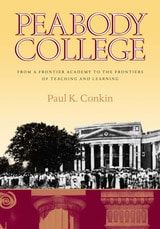
Peabody College
From a Frontier Academy to the Frontiers of Teaching and LearningPaul K. Conkin
Vanderbilt University Press, 2002
It all began as a small frontier academy in 1785. The institution that would become Peabody experienced its first reinvention two decades later as it became Cumberland College, and then, in 1826, the University of Nashville. The University maintained an elite undergraduate college until 1850, and, despite the success of its medical school and a military institute, it failed in three subsequent efforts to restart its undergraduate program.
In 1875 the University offered its campus and degree-granting authority to the first normal school in the state of Tennessee, a school funded by the Peabody Education Fund. The Peabody Normal College was the best in the South, and, as such, exerted an enormous influence on education in the region.
A new era began in 1909. The trustees of the Peabody Fund, at its liquidation, provided an eventual $1.5 million to establish a graduate-level George Peabody College for Teachers. It opened for classes in 1914, on its present campus, where it quickly became the premier teachers' college in the South. As was the case with many private, independent institutions, Peabody faced intermittent financial struggles, which finally ended with its union with Vanderbilt. Today Peabody is, by almost any criteria, one of the five or six strongest colleges of education in the United States.
Performing Math
A History of Communication and Anxiety in the American Mathematics ClassroomAndrew Fiss
Rutgers University Press, 2021
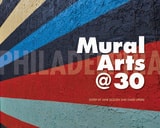
Philadelphia Mural Arts @ 30
Jane Golden
Temple University Press, 2014
The Mural Arts Program of Philadelphia began in 1984 as a summer youth program with modest support from city government. Under the guidance of Jane Golden, however, it gradually grew into one of the largest and most successful public art organizations in the country, garnering support from local corporations, foundations, and individuals to extend the reach and effectiveness of its innovative programs.
Now three decades later, the Mural Arts Program has created more than 3,800 murals and public art projects that have made lasting imprints in every Philadelphia neighborhood. In the process, Mural Arts has engaged thousands of people of all ages from across the city, helped hundreds of ex-offenders train for new jobs, transformed the face of struggling commercial corridors, and developed funding partners in both public and private sectors.
While the Mural Arts Program has significantly changed the appearance of the city, it has also demonstrated how participatory public art can empower individuals and promote communal healing around difficult issues. Philadelphia Mural Arts @ 30 is a celebration of and guide to the program's success. Unlike Philadelphia Murals and the Stories They Tell and its sequel, More Philadelphia Murals and the Stories They Tell, Philadelphia Murals @ 30 showcases the results of 21 projects completed since 2009 and features essays by policy makers, curators, scholars, and educators that offer valuable lessons for artists, activists, and communities to emulate.
Philadelphia Mural Arts @ 30 traces the program's history and evolution, acknowledging the challenges and rewards of growth and change while maintaining a core commitment to social, personal, and community transformation.
Contributors include: Dr. Arthur C. Evans, Jr., Arlene Goldbard, Thora Jacobson, Rick Lowe, Dr. Samantha L. Matlin, Paulette Moore, Jeremy Nowak, Maureen H. O'Connell, Elisabeth Perez Luna, Robin Rice, Dr. Jacob Kraemer Tebes, Elizabeth Thomas, Cynthia Weiss, Howard Zehr, and the editors.
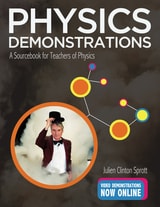
Physics Demonstrations
A Sourcebook for Teachers of PhysicsJulien Clinton Sprott
University of Wisconsin Press, 2015
Dr. Sprott shares demonstrations tested over many years in his popular public lectures on “The Wonders of Physics,” which appeal to general audiences and to students from grade school to graduate school. Science teachers at all levels will find a wealth of detail showing how to present these demonstrations to students with flair. Science professionals will find indispensable information for creating educational and entertaining public programs. Organized to teach the six major areas of classical physics—motion, heat, sound, electricity, magnetism, and light—Physics Demonstrations includes:
• a brief description of each demonstration
• materials lists, with sources for common materials
• preparation procedures
• discussions of the physics principles demonstrated
• potential safety hazards
• references for further information.
Picture a Professor
Interrupting Biases about Faculty and Increasing Student LearningJessamyn Neuhaus
West Virginia University Press, 2022
“Does a service to all who would prefer a different path, offering realistic strategies to engage students in undermining scholarly stereotypes.”—Science
Picture a Professor is a collection of evidence-based insights and intersectional teaching strategies crafted by and for college instructors. It aims to inspire transformative student learning while challenging stereotypes about what a professor looks like.
Representing a variety of scholarly disciplines, the volume’s contributing authors offer practical advice for effectively navigating student preconceptions about embodied identity and academic expertise. Each contributor recognizes the pervasiveness of racialized, gendered, and other biases about professors and recommends specific ways to respond to and interrupt such preconceptions—helping students, teachers, and others reenvision what we think of when we picture a professor.
Educators at every stage of their career will find affirming acknowledgment of the ways systemic inequities affect college teaching conditions, as well as actionable advice about facilitating student learning with innovative course design, classroom activities, assessment techniques, and more.
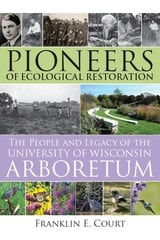
Pioneers of Ecological Restoration
The People and Legacy of the University of Wisconsin ArboretumFranklin E. Court
University of Wisconsin Press, 2012
Internationally renowned for its pioneering role in the ecological restoration of tallgrass prairies, savannas, forests, and wetlands, the University of Wisconsin Arboretum contains the world’s oldest and most diverse restored ecological communities. A site for land restoration research, public environmental education, and enjoyment by nature lovers, the arboretum remains a vibrant treasure in the heart of Madison’s urban environment.
Pioneers of Ecological Restoration chronicles the history of the arboretum and the people who created, shaped, and sustained it up to the present. Although the arboretum was established by the University of Wisconsin in 1932, author Franklin E. Court begins his history in 1910 with John Nolen, the famous landscape architect who was invited to create plans for the city of Madison, the university campus, and Wisconsin state parks. Drawing extensive details from archives and interviews, Court follows decades of collaborative work related to the arboretum’s lands, including the early efforts of Madison philanthropists and businessmen Michael Olbrich, Paul E. Stark, and Joseph W. “Bud” Jackson.
With labor from the Civilian Conservation Corps during the 1930s Depression, University of Wisconsin scientists began establishing both a traditional horticultural collection of trees and plants and a completely new, visionary approach to recreate native ecosystems. Hundreds of dedicated scientists and staff have carried forward the arboretum’s mission in the decades since, among them G. William Longenecker, Aldo Leopold, John T. Curtis, Rosemary Fleming, Virginia Kline, and William R. Jordan III.
This archival record of the arboretum’s history provides rare insights into how the mission of healing and restoring the land gradually shaped the arboretum’s future and its global reputation; how philosophical conflicts, campus politics, changing priorities, and the encroaching city have affected the arboretum over the decades; and how early aspirations (some still unrealized) have continued to motivate the work of this extraordinary institution.
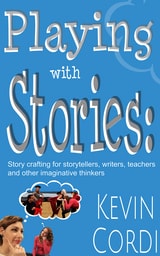
Playing With Stories
Story crafting for storytellers, writers, teachers and other imaginative thinkersKevin D. Cordi, Ph.D.
Parkhurst Brothers, Inc., 2014
Despite that the world around me does not value play, in my creative life, play is necessary. In fact, I have discovered it is the real work I do as an artist and teacher. As a storyteller, writer, teacher, and imaginative thinker, it is play that has produced the most desired results in my life, in my work, and especially, in my creativity. It is in play that we experience who we are and we begin to extend our choices. Play is not consciously prepared; discovery that happens in the moment. It invites reflection. In fact, Plato once shared, “You can discover more about a person in an hour of play than in a year of conversation.”
In this book, you will discover new ways to work with your story craft and find new story direction using play. Indeed, play is a meaningful way to create and learn.
In both childhood and adult play, the imagination plays a central role in the meaning making process. Although there are many types of play: school-based, recess, sports, this work is rooted in play inviting the writer, storyteller, or imaginative thinker to make choices as they work to create meaning in their work.
I will share how collaborative play can increase your choices when making a story. You will find not only exercises to build your story making and telling skills, but pedagogy of practice to use when called to create story.
Poets on Teaching
A SourcebookJoshua Marie Wilkinson
University of Iowa Press, 2010
In response to a lack of source works for wide-ranging approaches to teaching poetry, award-winning poet Joshua Marie Wilkinson has gathered ninety-nine micro-essays for poets, critics, and scholars who teach and for students who wish to learn about the many ways poets think about how a poem comes alive from within—and beyond—a classroom. Not narrowly concerned with how to read poetry or how to write poetry, by virtue of their central concern with teaching poetry, the essays in this fresh and innovative volume address both reading and writing and give teachers and students useful tools for the classroom and beyond.
Divided into four sections—“Reflections / Poetics,” “Exercises / Praxis,” “New Approaches to Poetry Courses and Methodology,” and “Talks / Directives”—Poets on Teaching provides practical, intelligent advice. “Reflections / Poetics” encompasses the most expansive approaches to teaching poetry, where poets reflect variously on what teachers can cultivate in their classrooms. “Exercises / Praxis” consists of hands-on approaches to reading and, especially, writing poems. “New Approaches to Poetry Courses and Methodology” features essays on rethinking specific courses, offering new ideas for course design and pedagogy. “Talks / Directives” contains a series of more informal and conversational discussions geared toward becoming a stronger reader, writer, teacher, and student of poetry. Poets on Teaching will be required reading for new and experienced teachers alike.
Kazim Ali, Rae Armantrout, Hadara Bar-Nadav, Dan Beachy-Quick, Bruce Beasley, Claire Becker, Jaswinder Bolina, Jenny Boully, Joel Brouwer, Lily Brown, Laynie Browne, Stephen Burt, Julie Carr, Joshua Clover, Matthew Cooperman, Oliver de la Paz, Linh Dinh, Ben Doller, Sandra Doller, Julie Doxsee, Lisa Fishman, Graham Foust, John Gallaher, Forrest Gander, C. S. Giscombe, Peter Gizzi, Lara Glenum, Kenneth Goldsmith, Johannes Göransson, Noah Eli Gordon, Arielle Greenberg, Richard Greenfield, Sarah Gridley, Anthony Hawley, Terrance Hayes, Eric Hayot, Brian Henry, Brenda Hillman, Jen Hofer, Paul Hoover, Christine Hume, Brenda Iijima, Lisa Jarnot, Kent Johnson, Bhanu Kapil, Karla Kelsey, Aaron Kunin, Quraysh Ali Lansana, Dorothea Lasky, Sueyeun Juliette Lee, Ada Limón, Timothy Liu, Sabrina Orah Mark, Dawn Lundy Martin, Kristi Maxwell, Joyelle McSweeney, Christina Mengert, Albert Mobilio, K. Silem Mohammad, Fred Moten, Jennifer Moxley, Laura Mullen, Sawako Nakayasu, Aimee Nezhukumatathil, Hoa Nguyen, Jena Osman, D. A. Powell, Kristin Prevallet, Bin Ramke, Jed Rasula, Srikanth Reddy, Barbara Jane Reyes, Boyer Rickel, Elizabeth Robinson, Martha Ronk, Emily Rosko, Prageeta Sharma, Evie Shockley, Eleni Sikelianos, Richard Siken, Ron Silliman, Tracy K. Smith, Juliana Spahr, Sasha Steensen, Peter Streckfus, Cole Swensen, Michael Theune, Tony Trigilio, Spring Ulmer, Karen Volkman, Catherine Wagner, G. C. Waldrep, Mark Wallace, Tyrone Williams, Mark Yakich, Jake Adam York, Stephanie Young, Timothy Yu, Matthew Zapruder, Andrew Zawacki, and Rachel Zucker
Point of View and the Emotional Arc of Stories
A handbook for writers and storytellersLoren Niemi & Nancy Donoval
Parkhurst Brothers, Inc., 2020
Populism, Education, and Teaching the Manners of Democracy
Robert V Bullough Jr.
Rutgers University Press, 2027
In an era of intense polarization, misinformation, and challenges to democratic norms, American citizens have become disenchanted with democracy and instead embraced populism and grievance. In Populism, Education, and Teaching the Manners of Democracy Robert V. Bullough Jr. offers readers a range of concepts useful for re-imagining the practice of democratic citizenship, both in the classroom as well as for themselves as citizens. Structured around five democratic manners that Bullough argues teachers, students, and citizens should cultivate, hospitality, attuned listening, voice, reflectivity, and evidential discernment, he argues that democracy is a peculiar and demanding way of life that shares with education the goal of human flourishing. By embracing these five manners, we can counter the current grievance culture and instead promote personal and social growth, reorienting education toward democratic living.
Practice Dialogues
Listening to the Wisdom of Care WorkEdited by Alice Lesnick
Lever Press, 2026
Prepare to Scare
How to tell scary storiesElizabeth Ellis
Parkhurst Brothers, Inc., 2021
Preparing Adult English Learners to Read for College and the Workplace
Edited by Kirsten Schaetzel, Joy Kreeft Peyton, and Rebeca Fernández
University of Michigan Press, 2024
After reading this book, adult ESL practitioners will be able to
- Prepare adults learning English to apply appropriate reading strategies to a variety of academic and professional contexts and purposes
- Use instructional strategies, including digital technology, to help struggling and developing readers close gaps in skills and conceptual knowledge
- Improve reading comprehension through robust vocabulary instruction
- Enhance reading skills and comprehension through writing instruction that balances sentence-level, discourse, and interactive processes and practices
- Inspire students to become lifelong readers who engage in extensive reading outside of school and professional contexts
Preservation Education
Sharing Best Practices and Finding Common GroundEdited by Barry L. Stiefel and Jeremy C. Wells
University Press of New England, 2014
Producing Excellence
The Making of VirtuososWagner, Izabela
Rutgers University Press, 2015
A musician and a parent of a young violinist, sociologist Izabela Wagner offers an inside look at how her young subjects set out on the long road to becoming a soloist. The remarkable research she conducted—at rehearsals, lessons, and in other educational settings—enabled her to gain deep insight into what distinguishes these talented prodigies and their training. She notes, for instance, the importance of a family culture steeped in the values of the musical world. Indeed, more than half of these students come from a family of professional musicians and were raised in an atmosphere marked by the importance of instrumental practice, the vitality of music as a vocation, and especially the veneration of famous artists. Wagner also highlights the highly structured, rigorous training system of identifying, nurturing, and rewarding talent, even as she underscores the social, economic, and cultural factors that make success in this system possible.
Offering an intimate portrait of the students, their parents, and their instructors, Producing Excellence sheds new light on the development of exceptional musical talent, as well as draw much larger conclusions as to “producing prodigy” in other competition-prone areas, such as sports, sciences, the professions, and other arts. Wagner’s insights make this book valuable for academics interested in the study of occupations, and her clear, lively writing is perfect for general readers curious about the ins and outs of training to be a violin soloist.
Pronunciation Myths
Applying Second Language Research to Classroom TeachingLinda Grant with Donna M. Brinton, Tracey Derwing and Murray J. Munro, John Field, Judy Gilbert, John Murphy, Ron Thomson, Beth Zielinski and Lynda Yates
University of Michigan Press, 2014
This volume was conceived as a "best practices" resource for pronunciation and speaking teachers in the way that Vocabulary Myths by Keith S. Folse is one for reading and vocabulary teachers. Like others in the Myths series, this book combines research with good pedagogical practices.
The book opens with a Prologue by Linda Grant (author of the Well Said textbook series), which reviews the last four decades of pronunciation teaching, the differences between accent and intelligibility, the rudiments of the English sound system, and other factors related to the ways that pronunciation is learned and taught.
The myths challenged in this book are:
§ Once you’ve been speaking a second language for years, it’s too late to change your pronunciation. (Derwing and Munro)
§ Pronunciation instruction is not appropriate for beginning-level learners. (Zielinski and Yates)
§ Pronunciation teaching has to establish in the minds of language learners a set of distinct consonant and vowel sounds. (Field)
§ Intonation is hard to teach. (Gilbert)
§ Students would make better progress if they just practiced more. (Grant)
§ Accent reduction and pronunciation instruction are the same thing. (Thomson)
§ Teacher training programs provide adequate preparation in how to teach pronunciation (Murphy).
The book concludes with an Epilogue by Donna M. Brinton, who synthesizes some of the best practices explored in the volume.
Public Humanities
Engaging Community, Empowering Civic Discourse, and Reshaping AcademiaMolly Todd
Michigan State University Press, 2025