Results by title
270 books match the query 'Technology' and 13 start with p

Pairing STEAM with Stories
46 Hands-On Activities for ChildrenElizabeth M. McChesney
American Library Association, 2020
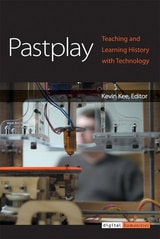
Pastplay
Teaching and Learning History with TechnologyKevin Kee, editor
University of Michigan Press, 2014
In the field of history, the Web and other technologies have become important tools in research and teaching of the past. Yet the use of these tools is limited—many historians and history educators have resisted adopting them because they fail to see how digital tools supplement and even improve upon conventional tools (such as books). In Pastplay, a collection of essays by leading history and humanities researchers and teachers, editor Kevin Kee works to address these concerns head-on. How should we use technology? Playfully, Kee contends. Why? Because doing so helps us think about the past in new ways; through the act of creating technologies, our understanding of the past is re-imagined and developed. From the insights of numerous scholars and teachers, Pastplay argues that we should play with technology in history because doing so enables us to see the past in new ways by helping us understand how history is created; honoring the roots of research, teaching, and technology development; requiring us to model our thoughts; and then allowing us to build our own understanding.
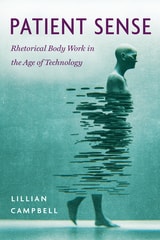
Patient Sense
Rhetorical Body Work in the Age of TechnologyLillian Campbell
The Ohio State University Press, 2025
In Patient Sense, Lillian Campbell introduces a theory of rhetorical body work and applies it to three distinct healthcare contexts: clinical nursing simulations, physical therapy labs, and tele-observation in a virtual intensive care unit. Drawing on sociological frameworks, she defines rhetorical body work as paid physical, emotional, or discursive labor performed at the material or technological interface of worker–client bodies. Such work is devalued within social and institutional systems and often gendered and racialized. Campbell captures the value of providers’ intuitive patient sense in the face of increasingly technology-mediated healthcare and intervenes in conversations about the future of healthcare training. Ultimately, she demonstrates that we will always need responsive healthcare providers whose rhetorical body work and patient sense cannot be replaced by technicians or algorithms.
Perceptions of Technological Risks and Benefits
Leroy C. Gould
Russell Sage Foundation, 1988

Physics and Technology of Heterojunction Devices
D. Vernon Morgan
The Institution of Engineering and Technology, 1991
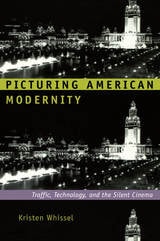
Picturing American Modernity
Traffic, Technology, and the Silent CinemaKristen Whissel
Duke University Press, 2008
Whissel shows that by portraying key events, achievements, and anxieties, the cinema invited American audiences to participate in the rapidly changing world around them. Moving pictures provided astonishing visual dispatches from military camps prior to the outbreak of fighting in the Spanish-American War. They allowed audiences to delight in images of the Pan-American Exposition, and also to mourn the assassination of President McKinley there. One early film genre, the reenactment, presented spectators with renditions of bloody battles fought overseas during the Philippine-American War. Early features offered sensational dramatizations of the scandalous “white slave trade,” which was often linked to immigration and new forms of urban work and leisure. By bringing these frequently distant events and anxieties “near” to audiences in cities and towns across the country, the cinema helped construct an American national identity for the machine age.
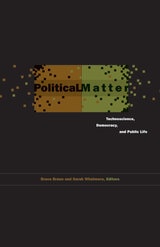
Political Matter
Technoscience, Democracy, and Public LifeBruce Braun
University of Minnesota Press, 2010
Exploring the frictions that come from linking the work of scholars in science and technology studies and political theory, these essays spark new ways of understanding the matter of politics.
Contributors: Andrew Barry, U of Oxford; Jane Bennett, Johns Hopkins U; Stephen J. Collier, New School; William E. Connolly, Johns Hopkins U; Rosalyn Diprose, U of New South Wales; Lisa Disch, U of Michigan; Gay Hawkins, U of New South Wales; Andrew Lakoff, UC San Diego; Noortje Marres, U of London; Isabelle Stengers, U Libre de Bruxelles; Nigel Thrift, U of Warwick.
Postphenomenology
Essays in the Postmodern ContextDon Ihde
Northwestern University Press, 1995
Practicing Materiality
Edited by Ruth M. Van Dyke
University of Arizona Press, 2015
Practicing Materiality focuses on the practical job of applying materiality to anthropological investigations, but with the firm retention of anthropocentrism. The philosophical discussions that run through the nine chapters develop practical applications for material studies, including Heideggerian phenomenology, Gellian secondary agency, object life histories, and bundling. Seven case studies are flanked by an introduction and a discussion chapter. The case studies represent a wide range of archaeological and anthropological contexts, from contemporary New York City and Turkey to fifteenth-century Portugal, the ancient southwest United States, and the ancient Andes. Authors in every chapter argue for the rejection of subject/object dualism, regarding material things as actively involved in the negotiation of power within human social relationships. Practicing Materiality demonstrates that it is possible to focus on the entangled lives of things without losing sight of their political and social implications.
Presidential Management of Science and Technology
The Johnson PresidencyBy W. Henry Lambright
University of Texas Press, 1985
How do science and technology issues become important to a particular presidency? Which issues gain priority? How? Why? What is the role of the presidency in the adoption of national policies affecting science and technology? In their implementation? How does the presidency try to curtail certain programs? Eliminate others? Or rescue programs Congress might seek to terminate? How does implementation vary between a president's own program and one that is inherited?
Such are the questions raised in this book, one of the first to address the relationship between scientists, few of whom have political backgrounds, and presidents, few of whom are knowledgeable in matters of science and technology. Drawing on extensive research performed at the Lyndon B. Johnson Library in Austin, Texas, and the National Archives in Washington, as well as on secondary sources and interviews, W. Henry Lambright describes, discusses, and analyzes this relationship and shows how one presidency set its agenda, adopted, implemented, and curtailed or eliminated science and technology programs.
Twenty-four case studies of specific decision processes occurring in the era of Lyndon Johnson anchor the book in the world of real events. Some programs adopted under Johnson are now all but forgotten, such as the Manned Orbiting Laboratory, nuclear desalting, and electronic barrier. The effects of many more, initiated, maintained, or enlarged under LBJ, lasted far beyond his administration. These include environmental pollution control, Project Apollo, and the application of Agent Orange in Vietnam. Finally, there are those that were redirected, placed on hold, or terminated under Johnson, such as the supersonic transport, antiballistic missile, and Project Mohole.
In this important book, Lambright has provided a framework for analyzing how the presidency as an institution deals with such issues, and he has established a strong foundation on which all future students of presidential policy management can build.

Product Design, Technology, and Social Change
A Short Cultural HistoryLaura Scherling
Intellect Books, 2024
This cultural history critically examines the development of product design, considering major milestones in the mass production of goods and services and aiming to incorporate a more inclusive worldview than traditional surveys of the topic.
The breadth and versatility of product design throughout history have been profound. Products have long supported the integration and interpretation of emerging technologies into our lives. These objects include everything from tools, accessories, furniture, and clothing to types of transportation, websites, and mobile applications. Products provide singular or multiple functions, are tangible and intangible, and in many instances have affected the quality of our lives by saving time or money or by increasing feelings of personal satisfaction. At the same time, many products have negatively affected people and the environment. For nearly every product that makes it into the hands of a consumer, there is also a designer who created it and someone who labored to make it.
An eye-opening survey of product design from preindustrial times to the present day, Product Design, Technology, and Social Change provides a thorough examination of the relationship between products, consumption, sustainability, politics, and social movements.
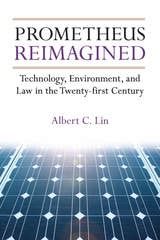
Prometheus Reimagined
Technology, Environment, and Law in the Twenty-first CenturyAlbert C. Lin
University of Michigan Press, 2013
Technologies such as synthetic biology, nanotechnology, artificial intelligence, and geoengineering promise to address many of our most serious problems, yet they also bring environmental and health-related risks and uncertainties. Moreover, they can come to dominate global production systems and markets with very little public input or awareness. Existing governance institutions and processes do not adequately address the risks of new technologies, nor do they give much consideration to the concerns of persons affected by them.
Instead of treating technology, health, and the environment as discrete issues, Albert C. Lin argues that laws must acknowledge their fundamental relationship, anticipating both future technological developments and their potential adverse effects. Laws should encourage international cooperation and the development of common global standards, while allowing for flexibility and reassessment.
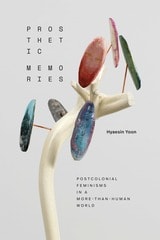
Prosthetic Memories
Postcolonial Feminisms in a More-Than-Human WorldHyaesin Yoon
Duke University Press, 2025