Results by title
67 books match the query 'Technology Studies' and 4 start with p
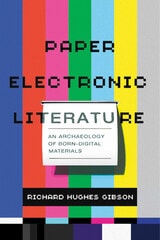
Paper Electronic Literature
An Archaeology of Born-Digital MaterialsRichard Hughes Gibson
University of Massachusetts Press, 2021
Paper Electronic Literature attests that digital literature's old media elements have much to teach us about the cultural and physical conditions in which we compute; the creativity that new media artists have shown in their dealings with old media; and the distinctively electronic issues that confront digital artists. Moving between avant-garde works and popular ones, fiction writing and poetry generation, Richard Hughes Gibson reveals the diverse ways in which paper has served as a component within electronic literature, particularly in facilitating interactive experiences for users. This important study develops a new critical paradigm for appreciating the multifaceted material innovation that has long marked digital literature.
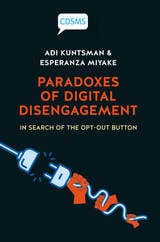
Paradoxes of Digital Disengagement
In Search of the Opt-Out ButtonAdi Kuntsman and Esperanza Miyake
University of Westminster Press, 2022
Listen to authors Adi Kuntsman and Esperanza Miyake discuss collective data justice, the rights, refusals and ethics of digital (dis)engagement in this latest podcast from Lateral, the Journal of the Cultural Studies Association.
“The digital now thoroughly saturates our everyday lives to the point where it seems we are drowning. But is it possible to swim on our terms? This book thoughtfully examines this question, critically teasing apart the structures of power that permeate digital relations and charting pathways to a more just digital world. Essential reading for those who want to move beyond personal digital detoxes to challenge and transform our digital society and economy.” - Professor Rob Kitchin, author of The Data Revolution and Data Lives
“The seductions of tech have ushered in the encroachment of technological solutions into policing, law enforcement and ever-widening systems of social regulation across the UK and Europe. This book marks a critical intervention – by conceptualising our understanding of the ways in which data and digital harms are systemically expended against the powerless. It is a must read for those of us who are concerned to resist the (digital) exclusion of the marginalised, and the (digital) banishment of the vulnerable.” - Dr Patrick Williams, author of Data-Driven Policing: The Hardwiring of Discriminatory Policing Practices Across Europe
“While imaginaries of techno futures constructed by the Digital Lords of contemporary societies become self-fulfilling prophecies, we struggle to imagine a present and future free from digital coercion and exclusion. In their powerful interdisciplinary analysis, Adi Kuntsman and Esperanza Miyake delve into the personal, social, political and environmental costs of compulsory digitality. Rejecting a self-defeating naturalisation of digitality and digital inevitability Paradoxes of Digital Disengagement compellingly shows how collective digital justice is imperative in this future/present where the machine rules and people can become marginalized and excluded. A much-needed scholarly intervention that can inspire our collective thinking, research and praxis.” - Dr Benedetta Brevini, author of Is AI Good for the Planet?
“Kuntsman and Miyake have written an engaging book. It offers a readable critique of enforced digitality and broadens the scope of disconnection studies. The detailed analyses of complicated documents are elegantly structured and thought-provoking.” - https://blogs.lse.ac.uk/lsereviewofbooks/2022/11/16/book-review-paradoxes-of-digital-disengagement-in-search-of-the-opt-out-button-by-adi-kuntsman-and-esperanza-miyake/
Life is increasingly governed and mediated through digital and smart technologies, platforms, big data and algorithms. However, the reasons, practices and impact of how the digital is used by different institutions are often deeply linked to social oppression and injustice. Similarly, the ability to resist these digital impositions is based on inequality and privilege. Challenging the ways in which we are increasingly dependent on the digital, this book raises a set of provocative and urgent questions: in a world of compulsory digitality is there an opt out button? Where, when, how, why and to whom is it available? Answering these questions has become even more relevant since the COVID-19 pandemic. In response, the book puts forward the concept of ‘digital disengagement’ which is explored across six key areas of digitisation: health; citizenship; education; consumer culture; labour; and the environment.
Part I examines the difficulty of opting out of compulsory digitality in a world where most things are digital by default. From health apps, algorithmic decision-making to learning analytics, opting out comes with a set of troubling consequences. Part II turns to several examples of disconnection and disengagement. The chapters reveal how phenomena like digital detoxes, time-management apps and online ‘green’ spaces are co-opted by the very digital systems one is trying to resist.
The book critiques issues relating to digital surveillance, algorithmic discrimination and biased tech, corporatisation and monetisation of data, exploitative digital labour, digitalised self-discipline and destruction of the environment. As an interdisciplinary piece of work, the book will be useful to any scholar and activist in Digital, Internet and Social Media Studies; Digital Sociology and Social Policy; Digital Health; Media, Popular and Communication Studies; Consumer culture; and Environment Studies.

Perspectives on the Human Genome Project and Genomics
Christopher R. Donohue
University of Minnesota Press, 2026
Interdisciplinary voices reflect on some of the most complex and consequential scientific undertakings of our time
Perspectives on the Human Genome Project and Genomics is a groundbreaking volume that examines the pivotal roles of the National Institutes of Health (NIH) and the National Human Genome Research Institute (NHGRI) in the Human Genome Project (HGP) and the development of other major genomics projects. Drawing on newly uncovered archival materials and oral histories from NHGRI, this volume offers a multifaceted narrative of transformative scientific achievements of the twentieth and twenty-first centuries.
Coeditors Christopher R. Donohue and Alan C. Love bring together a range of perspectives on the HGP’s progress and legacy, as well as other major genomics projects, to explore not only their scientific achievements but also their social and political dimensions. Presenting reflections from historians, philosophers, and sociologists alongside those of key NHGRI scientists like Eric Green, Mark Guyer, and Elise Feingold; experts like Nature editor-in-chief Magdalena Skipper and geneticist Eric Vilain; and scholars of the ethical, legal, and social implications of genomics like Jean McEwan and Joy Boyer, Perspectives on the Human Genome Project and Genomics highlights the international, interdisciplinary collaborations and collective long view that underpinned these genomics initiatives aimed at a better understanding of our basic biology and genetic diseases.
From genomic variation and sequencing technologies to the integration of big data and the influence of ancestry and gender, this book is an essential resource for deepening the discussion of the scientific, historical, and ethical impacts of genomics and a fascinating collection of insights into coordinated science in the making.
Contributors: Rina Bliss, Joy Boyer, Lisa D. Brooks, Michel Dubois, Elise A. Feingold, Adam Felsenfeld, Miguel García-Sancho, Eric D. Green, Catherine Guaspare, Chris Gunter, Stephan Guttinger, Mark Guyer, Elke Jordan, Jonathan E. LoTempio Jr., Jean McEwen, Jane Peterson, Anya Plutynski, Ramya M. Rajagopalan, Emanuele Ratti, Sahotra Sarkar, Jeffery A. Schloss, Magdalena Skipper, Alexandra Soulier, Thomas Stoeger, Eric Vilain, Kris A. Wetterstrand.
Retail e-book files for this title are screen-reader friendly with images accompanied by short alt text and/or extended descriptions.
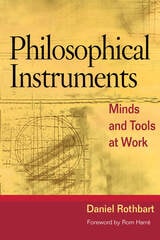
Philosophical Instruments
Minds and Tools at WorkDaniel Rothbart. Foreword by Rom Harré
University of Illinois Press, 2006
The surprising roles of instruments and experimentation in acquiring knowledge
In Philosophical Instruments Daniel Rothbart argues that our tools are not just neutral intermediaries between humans and the natural world, but are devices that demand new ideas about reality. Just as a hunter's new spear can change their knowledge of the environment, so can the development of modern scientific equipment alter our view of the world.
Working at the intersections of science, technology, and philosophy, Rothbart examines the revolution in knowledge brought on by recent advances in scientific instruments. Full of examples from historical and contemporary science, including electron scanning microscopes, sixteenth-century philosophical instruments, and diffraction devices used by biochemical researchers, Rothbart explores the ways in which instrumentation advances a philosophical stance about an instrument's power, an experimenter's skills, and a specimen's properties. Through a close reading of engineering of instruments, he introduces a philosophy from (rather than of) design, contending that philosophical ideas are channeled from design plans to models and from model into the use of the devices.