Results by title
333 books match the query 'Television' and 14 start with p

Paolo Sorrentino's Cinema and Television
Edited by Annachiara Mariani
Intellect Books, 2021
This is the first English-language collection dedicated to the prolific director, who has emerged as one of the most compelling figures in twenty-first-century European cinema. International contributors—from the UK, Italy, France, the Netherlands, Australia, Israel, Canada, and the US—offer original interpretations of Sorrentino’s work in film and television. In an invaluable contribution to the existing literature, they examine Sorrentino’s recurrent grand themes, offer new perspectives and cues for discussion, and challenge established notions about the filmmaker and his career.
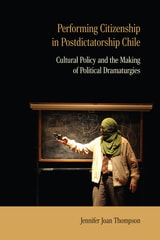
Performing Citizenship in Postdictatorship Chile
Cultural Policy and the Making of Political DramaturgiesJennifer Joan Thompson
Northwestern University Press, 2025
Offering a nuanced understanding of the performing arts’ relationship to politics
Through careful readings of key political performances in Chile's transition from military dictatorship to neoliberal democracy, Jennifer Joan Thompson examines how the production and aesthetics of theater are intertwined in processes of democratization, enactments of citizenship, and the development of cultural policy. Performing Citizenship in Postdictatorship Chile: Cultural Policy and the Making of Political Dramaturgies reveals how artists performed changing models of democratic citizenship. Thompson traces the ways artists confronted and resisted the military dictatorship of Augusto Pinochet, how they then reimagined the body politic during the early transitional period and challenged official constructions of history and memory as the transition to democracy progressed, how they critiqued Chile’s neoliberal economic model and its violence, and, finally, how they have made claims for feminist and Indigenous citizen subjectivities throughout Chile’s current social crisis. Incorporating archival and ethnographic research alongside readings of theatrical and political performances, this study offers a nuanced understanding of the performing arts’ relationship to politics, one that accounts for the ways artists and the state collaborate in the production of the political imagination.
Performing the News
Identity, Authority, and the Myth of NeutralityElia Powers
Rutgers University Press, 2024
Performing the News: Identity, Authority, and the Myth of Neutrality explores how journalists from historically marginalized groups have long felt pressure to conform when performing for audiences. Many speak with a flat, “neutral” accent, modify their delivery to hide distinctive vocal attributes, dress conventionally to appeal to the “average” viewer, and maintain a consistent appearance to avoid unwanted attention. Their aim is what author Elia Powers refers to as performance neutrality—presentation that is deemed unobjectionable, reveals little about journalists’ social identity, and supposedly does not detract from their message. Increasingly, journalists are challenging restrictive, purportedly neutral forms of self-presentation. This book argues that performance neutrality is a myth that reinforces the status quo, limits on-air diversity, and hinders efforts to make newsrooms more inclusive. Through in-depth interviews with journalists in broadcasting and podcasting, and those who shape their performance, the author suggests ways to make journalism more inclusive and representative of diverse audiences.
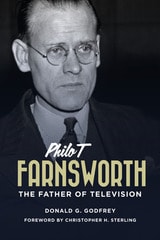
Philo T Farnsworth
Donald Godfrey
University of Utah Press, 2001
Philo T. Farnsworth (1906–1971) has been called the "forgotten father of television." He grew up in Utah and southern Idaho, and was described as a genius by those who knew and worked with him. With only a high school education, Farnsworth drew his first television schematic for his high school teacher in Rigby, Idaho. Subsequent claims and litigation notwithstanding, he was the first to transmit a television image.
Farnsworth filed ten patents between 1927 and 1929 for camera tubes (transmitting), circuitry, and the cathode ray tube (viewing). After his early years as an inventor in San Francisco, he worked as an engineer, doing battle with RCA in the 1930s over patent rights, formed the Farnsworth Television Company in the 1940s, and worked for IT&T after their purchase of the Farnsworth enterprises. Every television set sold utilized at least six of his basic patents.
Because of endless legal wrangling with RCA over patent rights, he received very little financial reward for his television patents. Donald Godfrey examines the genius and the failures in the life of Philo Farnsworth as he struggled to be both inventor and entrepreneur.

Playing Doctor
Television, Storytelling, and Medical PowerJoseph Turow
University of Michigan Press, 2010

Popular Stories and Promised Lands
Fan Cultures and Symbolic PilgrimagesRoger C. Aden
University of Alabama Press, 2007
A conversation about who we are, where we’ve been, and where we might be going.
Popular Stories and Promised Lands enters a conversation about who we are, where we’ve been, and where we might be going by suggesting that possible answers to those questions can be found in the popular stories we encounter at the movies, on television, in popular magazines, and even on the funny pages.
As countless scholars and popular writers have noted, those of us living in the United States find ourselves at a cultural crossroads. We are increasingly aware that the stories that once permeated life in these United States, stories that tell us that social and economic progress comes from working hard, that everyone has an equal opportunity to experience such progress, do not resonate to the degree they once did. Because many Americans have traditionally defined themselves, others, and their unique sense of place through these stories, we find ourselves displaced socially, economically, politically, and/or culturally.
So, Roger Aden says, we go to places of our own making. Fans of the television series The X-Files return to the Funhouse each week for a dose of frightening fun. Fans of the weekly magazine Sports Illustrated play in the American Elysian Fields where democratic efforts at balancing work and play are valued. Fans of the movie Field of Dreams work as altruistic producers in an alternative garden spot.
Grounded in the author’s own experiences and reinforced by the voices of approximately two hundred additional fans of the four popular stories, this book offers a compelling case for understanding the alleged wasteland of popular culture as a fertile site of individually and communally created sacred places.
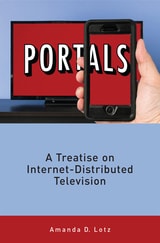
Portals
A Treatise on Internet-Distributed TelevisionAmanda D. Lotz
Michigan Publishing Services, 2017
Portals: A Treatise on Internet-Distributed Television pushes understandings of the business of television to keep pace with the considerable technological change of the last decade. It explains why shows such as Orange is the New Black or Transparent are indeed television despite coming to screens over internet connection and in exchange for a monthly fee. It explores how internet-distributed television is able to do new things – particularly, allow different people to watch different shows chosen from a library of possibilities. This technological ability allows new audience behaviors and new norms in making television.
Portals are the “channels” of internet-distributed television, and Portals identifies how the task of curating a library of shows differs from channels’ task of building a schedule. It explores the business model—subscriber funding—that supports many portals, and identifies the key differences from advertiser or direct purchase. Portals considers what we know about the future of television, even though we remain early in a process of transformative change.

Prescription TV
Therapeutic Discourse in the Hospital and at HomeJoy V. Fuqua
Duke University Press, 2012
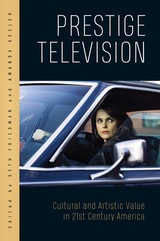
Prestige Television
Cultural and Artistic Value in Twenty-First-Century AmericaSeth Friedman
Rutgers University Press, 2023
Principles of Adaptation for Film and Television
By Ben Brady
University of Texas Press, 1994
From All Quiet on the Western Front, the Academy Award-winning "Best Picture" of 1929-1930, to Dances with Wolves, the 1991 winner, many of Hollywood's most popular and enduring movies have been screen adaptations of written work, including novels, stories, and plays. In this practical, hands-on guide, veteran TV and screenwriter Ben Brady unlocks the secrets of the adaptation process, showing aspiring writers and writing teachers how to turn any kind of narrative material into workable, salable screenplays for film and television.
Step by step, Brady guides novice screenwriters to the completion of a professional screenplay. He begins with an incisive discussion of how to evaluate a written work's potential as a screenplay. Then he discusses each step of the writing process, showing how to identify the plot and premise of the play, develop character, treatment, and dialogue, and handle camera language and format. Brady illustrates each of these points by developing and writing a complete screenplay of the novel Claire Serrat within the text.
With these tools, beginning screenwriters can draw on the rich resources of words in print to create exciting screenplays for film and television. Written in vivid, entertaining prose, the book will be equally useful in the classroom or at the kitchen table, wherever enterprising writers ply their craft.
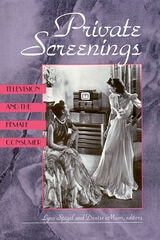
Private Screenings
Television and the Female ConsumerLynn Spigel
University of Minnesota Press, 1992
Processing Politics
Learning from Television in the Internet AgeDoris A. Graber
University of Chicago Press, 2001
More and more people rely on information from television and the Internet to make important decisions. Processing Politics offers a sound, well-researched defense of these remarkably versatile media, and challenges us to make them work for us in our democracy.
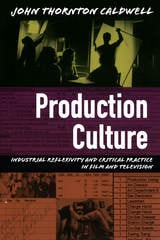
Production Culture
Industrial Reflexivity and Critical Practice in Film and TelevisionJohn Thornton Caldwell
Duke University Press, 2008
Drawing on interviews, observations of sets and workplaces, and analyses of TV shows, industry documents, economic data, and promotional materials, Caldwell shows how film and video workers function in a transformed, post-network industry. He chronicles how workers have responded to changes including media convergence, labor outsourcing, increasingly unstable labor and business relations, new production technologies, corporate conglomeration, and the proliferation of user-generated content. He explores new struggles over “authorship” within collective creative endeavors, the way that branding and syndication have become central business strategies for networks, and the “viral” use of industrial self-reflexivity to motivate consumers through DVD bonus tracks, behind-the-scenes documentaries, and “making-ofs.” A significant, on-the-ground analysis of an industry in flux, Production Culture offers new ways of thinking about media production as a cultural activity.
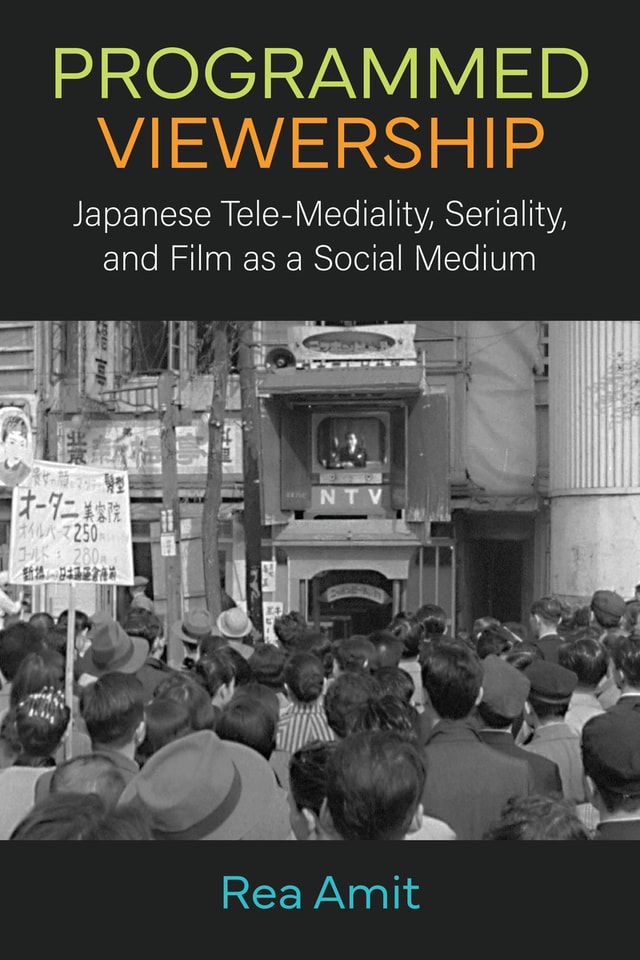
Programmed Viewership
Japanese Tele-Mediality, Seriality, and Film as a Social MediumRea Amit
University of Michigan Press, 2027
Programmed Viewership examines the concept of “program” in Japanese cinema as an organizing framework that links marketing and promotion, exhibition and distribution, and viewing practices in public and domestic spaces. Rea Amit defines “program” as the ideological infrastructure or platform that perpetuates habitual and ritualistic patterns in film production and reception. Amit takes a holistic approach to understanding more than a century of Japanese cinema through the analysis of material film ephemera, cinema theatre, film content, and viewership. This framework positions programming, rather than provenance, as the decisive factor that confers a film’s cultural and institutional identity. While earlier scholarship has gestured toward loosening the tie between cinematic identity and its nation of origin, Programmed Viewership extends this insight by emphasizing that production constitutes only one dimension of a broader programmatic system.