Results by title
85 books match the query 'Television broadcasting' and 3 start with p

Performing Television
Contemporary Drama and the Media CultureElizabeth Klaver
University of Wisconsin Press, 2000
Is it possible today to understand current genres such as drama and theater without considering the influence of television? Elizabeth Klaver argues that television’s dominance of the entertainment industry demands a continual negotiation of subject position from all other cultural forms and institutions. By examining plays that incorporate televisual discourse—from cameras and monitors to televisual style and structure—Performing Television probes the turbulent relation contemporary drama has had to television and its negotiations for identity in a postmodern media culture.
Klaver applies post-structuralist theories of subjectivity to drama while ranging through Beckett’s plays, National Hockey League games, “The Tonight Show,” gay and lesbian drama, minority drama, avant-garde performance, and the topics of theatrical paranoia, the mediatized Imaginary, and the spectatorial gaze.
Klaver applies post-structuralist theories of subjectivity to drama while ranging through Beckett’s plays, National Hockey League games, “The Tonight Show,” gay and lesbian drama, minority drama, avant-garde performance, and the topics of theatrical paranoia, the mediatized Imaginary, and the spectatorial gaze.
[more]

Prescription TV
Therapeutic Discourse in the Hospital and at HomeJoy V. Fuqua
Duke University Press, 2012
Tracing the history of television as a therapeutic device, Joy V. Fuqua describes how TVs came to make hospitals seem more like home and, later, "medicalized" the modern home. She examines the introduction of television into the private hospital room in the late 1940s and 1950s and then moves forward several decades to consider the direct-to-consumer prescription drug commercials legalized in 1997. Fuqua explains how, as hospital administrators and designers sought ways of making the hospital a more inviting, personalized space, TV sets came to figure in the architecture and layout of health care facilities. Television manufacturers seized on the idea of therapeutic TV, specifying in their promotional materials how TVs should be used in the hospital and positioned in relation to the viewer. With the debut of direct-to-consumer prescription drug advertising in the late 1990s, television assumed a much larger role in the medical marketplace. Taking a case-study approach, Fuqua uses her analysis of an ad campaign promoting Pfizer's Viagra to illustrate how television, and later the Internet, turned the modern home into a clearinghouse for medical information, redefined and redistributed medical expertise and authority, and, in the process, created the contemporary consumer-patient.
[more]
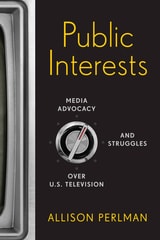
Public Interests
Media Advocacy and Struggles over U.S. TelevisionPerlman, Allison
Rutgers University Press, 2016
Winner of the 2017 Outstanding Book Award from the Popular Communication Division of the International Communication Association
Nearly as soon as television began to enter American homes in the late 1940s, social activists recognized that it was a powerful tool for shaping the nation’s views. By targeting broadcast regulations and laws, both liberal and conservative activist groups have sought to influence what America sees on the small screen. Public Interests describes the impressive battles that these media activists fought and charts how they tried to change the face of American television.
Nearly as soon as television began to enter American homes in the late 1940s, social activists recognized that it was a powerful tool for shaping the nation’s views. By targeting broadcast regulations and laws, both liberal and conservative activist groups have sought to influence what America sees on the small screen. Public Interests describes the impressive battles that these media activists fought and charts how they tried to change the face of American television.
Allison Perlman looks behind the scenes to track the strategies employed by several key groups of media reformers, from civil rights organizations like the NAACP to conservative groups like the Parents Television Council. While some of these campaigns were designed to improve the representation of certain marginalized groups in television programming, as Perlman reveals, they all strove for more systemic reforms, from early efforts to create educational channels to more recent attempts to preserve a space for Spanish-language broadcasting.
Public Interests fills in a key piece of the history of American social reform movements, revealing pressure groups’ deep investments in influencing both television programming and broadcasting policy. Vividly illustrating the resilience, flexibility, and diversity of media activist campaigns from the 1950s onward, the book offers valuable lessons that can be applied to current battles over the airwaves.
[more]