Results by title
146 books match the query 'Terrorism' and 6 start with p
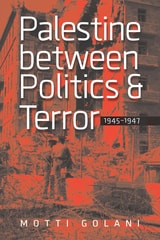
Palestine between Politics and Terror, 1945–1947
Motti Golani
Brandeis University Press, 2013

Philosophy in a Time of Terror
Dialogues with Jurgen Habermas and Jacques DerridaGiovanna Borradori
University of Chicago Press, 2003
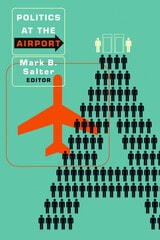
Politics at the Airport
Mark B. Salter
University of Minnesota Press, 2008
Establishes the airport as a crucial site in the rise of the surveillance state
Few sites are more symbolic of both the opportunities and vulnerabilities of contemporary globalization than the international airport.
Politics at the Airport brings together leading scholars to examine how airports both shape and are shaped by current political, social, and economic conditions. Focusing on the ways that airports have become securitized, the essays address a wide range of practices and technologies—from architecture, biometric identification, and CCTV systems to “no-fly lists” and the privatization of border control—now being deployed to frame the social sorting of safe and potentially dangerous travelers. This provocative volume broadens our understanding of the connections among power, space, bureaucracy, and migration while establishing the airport as critical to the study of politics and global life.Contributors: Peter Adey, Colin J. Bennett, Gillian Fuller, Francisco R. Klauser, Gallya Lahav, David Lyon, Benjamin J. Muller, Valérie November, Jean Ruegg.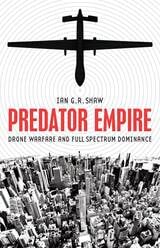
Predator Empire
Drone Warfare and Full Spectrum DominanceIan G. R. Shaw
University of Minnesota Press, 2016
What does it mean for human beings to exist in an era of dronified state violence? How can we understand the rise of robotic systems of power and domination? Focusing on U.S. drone warfare and its broader implications as no other book has to date, Predator Empire argues that we are witnessing a transition from a labor-intensive “American empire” to a machine-intensive “Predator Empire.”
Moving from the Vietnam War to the War on Terror and beyond, Ian G. R. Shaw reveals how changes in military strategy, domestic policing, and state surveillance have come together to enclose our planet in a robotic system of control. The rise of drones presents a series of “existential crises,” he suggests, that are reengineering not only spaces of violence but also the character of the modern state. Positioning drone warfare as part of a much longer project to watch and enclose the human species, he shows that for decades—centuries even—human existence has slowly but surely been brought within the artificial worlds of “technological civilization.” Instead of incarcerating us in prisons or colonizing territory directly, the Predator Empire locks us inside a worldwide system of electromagnetic enclosure—in which democratic ideals give way to a system of totalitarian control, a machinic “rule by Nobody.”
As accessibly written as it is theoretically ambitious, Predator Empire provides up-to-date information about U.S. drone warfare, as well as an in-depth history of the rise of drones.
Presidential Accountability in Wartime
President Bush, the Treatment of Detainees, and the Laws of WarStuart Streichler
University of Michigan Press, 2023
The American presidency has long tested the capacity of the system of checks and balances to constrain executive power, especially in times of war. While scholars have examined presidents starting military conflicts without congressional authorization or infringing on civil liberties in the name of national security, Stuart Streichler focuses on the conduct of hostilities. Using the treatment of war-on-terror detainees under President George W. Bush as a case study, he integrates international humanitarian law into a constitutional analysis of the repercussions of presidential war powers for human rights around the world.
Putting President Bush’s actions in a wider context, Presidential Accountability in Wartime begins with a historical survey of the laws of war, with particular emphasis on the 1949 Geneva Conventions and the Nuremberg Tribunal. Streichler then reconstructs the decision-making process that led to the president’s approval of interrogation methods that violated Geneva’s mandate to treat wartime captives humanely. While taking note of various accountability options—from within the executive branch to the International Criminal Court—the book illustrates the challenge in holding presidents personally responsible for violating the laws of war through an in-depth analysis of the actions taken by Congress, the Supreme Court, and the public in response. In doing so, this book not only raises questions about whether international humanitarian law can moderate wartime presidential behavior but also about the character of the presidency and the American constitutional system of government.

Prison Writings
The Roots of CivilisationAbdullah Ocalan
Pluto Press, 2007
Since his imprisonment, Öcalan has written extensively in Kurdish history. This book brings together his writings for the first time. Breathtaking in scope, it provides a broad Marxist perspective on ancient Middle Eastern history, incorporating the rise of the major religions (Islam, Christianity, and Judaism), and defining the Kurdish position within this, from the ancient Sumerian civilization through the feudal age, the birth of capitalism, and beyond.
"Very readable. It is a tour-de-force."
---Ghada Talhami, D. K. Pearsons Professor of Political, Lake Forest College
"We would expect Abudullah Öcalan to write a political treatise. Instead, he has penned a monumental history of the ancient Near East that offers a grand vision. . . . This is the first truly postcolonial history of Mesopotamia."
---Randall H. McGuire, Professor of Anthropology, Binghamton University