64 books match the query 'Text' and 3 start with p

cover of PYNCHON'S POETICS: Interfacing Theory and Text

PYNCHON'S POETICS

Interfacing Theory and Text

Hanjo Berressem

University of Illinois Press, 1993

Pynchon's Poetics
  is a provocative, intelligent analysis of V., The Crying of Lot 49, Gravity's
  Rainbow, and Vineland. Hanjo Berrssem examines these works in the
  light of post-structuralist thought and literary theory, investigating the notion
  of subjectivity and the relations between the subject, culture, and language.
 
[more]
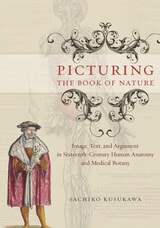
cover of Picturing the Book of Nature: Image, Text, and Argument in Sixteenth-Century Human Anatomy and Medical Botany

Picturing the Book of Nature

Image, Text, and Argument in Sixteenth-Century Human Anatomy and Medical Botany

Sachiko Kusukawa

University of Chicago Press, 2012

Because of their spectacular, naturalistic pictures of plants and the human body, Leonhart Fuchs’s De historia stirpium and Andreas Vesalius’s De humani corporis fabrica are landmark publications in the history of the printed book. But as Picturing the Book of Nature makes clear, they do more than bear witness to the development of book publishing during the Renaissance and to the prominence attained by the fields of medical botany and anatomy in European medicine. Sachiko Kusukawa examines these texts, as well as Conrad Gessner’s unpublished Historia plantarum, and demonstrates how their illustrations were integral to the emergence of a new type of argument during this period—a visual argument for the scientific study of nature.
 
To set the stage, Kusukawa begins with a survey of the technical, financial, artistic, and political conditions that governed the production of printed books during the Renaissance. It was during the first half of the sixteenth century that learned authors began using images in their research and writing, but because the technology was so new, there was a great deal of variety of thought—and often disagreement—about exactly what images could do: how they should be used, what degree of authority should be attributed to them, which graphic elements were bearers of that authority, and what sorts of truths images could and did encode. Kusukawa investigates the works of Fuchs, Gessner, and Vesalius in light of these debates, scrutinizing the scientists’ treatment of illustrations and tracing their motivation for including them in their works. What results is a fascinating and original study of the visual dimension of scientific knowledge in the sixteenth century.
[more]
cover of Poetic Voices: Discourse Linguistics and the Poetic Text

Poetic Voices

Discourse Linguistics and the Poetic Text

Timothy R. Austin

University of Alabama Press, 1994

 Poems written in the first person, poems that contain passages of conversation or dialogue, and narrative poems all rely on their readers’ capacity to process discourse. Discourse features in the texts of those poems—features such as temporal and spatial reference, narrative “framing”, and the strategic use of direct speech—inevitably affect the way readers receive the central themes. Recent developments in linguistic theory, including developments that address discourse structure, thus offer literary scholars new tools for approaching a richer understanding of those poems.

    In Poetic Voices, Austin demonstrates some of the potential applications of such a discourse-based stylistics by pursuing what amounts to a literary conundrum, an apparent anomaly at the heart of a well-respected text, William Wordsworth’s “Resolution and Independence.” By applying a series of insights borrowed from linguists’ theories of discourse structure, Austin accounts satisfactorily for the poem’s linguistic irregularity. At each stage, he reviews other poetic texts that also respond well to analysis from that particular stylistic perspective—works by Coleridge, Frost, Shelley, and Tennyson.
    As a discipline, stylistics aims first and foremost to influence our understanding of individual literary works. In this tradition, Poetic Voices presents unconventional and challenging interpretations of poems such as Shelley’s “Ozymandias” and Tennyson’s Ulysses. In addition to these literary claims, however, Poetic Voices also seeks to extend the domain of stylistics generally by establishing the contribution that linguists’ theories of discourse structure may make to the appreciation of literature.
    This book makes claims in both literary and linguistic/stylistic fields. Like the author’s previous book, Language Crafted: A Linguistic Theory of Poetic Syntax, this volume will be most enthusiastically received and most thoroughly appreciated by stylists. Nevertheless, Poetic Voices is fully accessible to non-specialists who will appreciate the discussions of Romantic and post-Romantic texts without having to become experts in discourse analysis.
[more]