Results by title
91 books match the query 'Theater and society' and 8 start with p
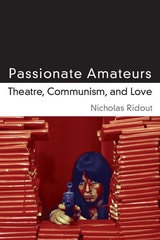
Passionate Amateurs
Theatre, Communism, and LoveNicholas Ridout
University of Michigan Press, 2015
Passionate Amateurs tells a new story about modern theater: the story of a romantic attachment to theater’s potential to produce surprising experiences of human community. It begins with one of the first great plays of modern European theater—Chekhov’s Uncle Vanya in Moscow—and then crosses the 20th and 21st centuries to look at how its story plays out in Weimar Republic Berlin, in the Paris of the 1960s, and in a spectrum of contemporary performance in Europe and the United States. This is a work of historical materialist theater scholarship, which combines a materialism grounded in a socialist tradition of cultural studies with some of the insights developed in recent years by theorists of affect, and addresses some fundamental questions about the social function and political potential of theater within modern capitalism. Passionate Amateurs argues that theater in modern capitalism can help us think afresh about notions of work, time, and freedom. Its title concept is a theoretical and historical figure, someone whose work in theater is undertaken within capitalism, but motivated by a love that desires something different. In addition to its theoretical originality, it offers a significant new reading of a major Chekhov play, the most sustained scholarly engagement to date with Benjamin’s “Program for a Proletarian Children’s Theatre,” the first major consideration of Godard’s La chinoise as a “theatrical” work, and the first chapter-length discussion of the work of The Nature Theatre of Oklahoma, an American company rapidly gaining a profile in the European theater scene.
Passionate Amateurs contributes to the development of theater and performance studies in a way that moves beyond debates over the differences between theater and performance in order to tell a powerful, historically grounded story about what theater and performance are for in the modern world.
Performance and the Afterlives of Injustice
Catherine M. Cole
University of Michigan Press, 2020
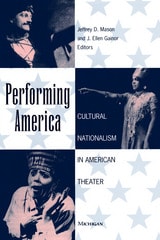
Performing America
Cultural Nationalism in American TheaterJeffrey D. Mason and J. Ellen Gainor, Editors
University of Michigan Press, 1999
Performing America provides fresh perspectives on the development of visions of both America and "America"--that is, the actual community and the constructed concept--on a variety of theatrical stages. It explores the role of theater in the construction of American identity, highlighting the tension between the desire to categorize American identity and the realization that such categorical uniformity may neither be desirable nor possible. The topics covered include the links between politics and the stage during the Federalist period, the appropriation of "Indian" artifacts, an exploration of early gender roles, and the metaphorical connections between the theater and western expansion. Other essays treat vaudeville's artistically colonized cultures; Chautauqua's attempt to homogenize culture and commercialize American ideals; W. E. B. Du Bois's pageant, The Star of Ethiopia, as a strategy for constructing "African-American" as "Other" in an attempt to promote a vision of black nationalism; and how theater was used to help immigrants form a new sense of community while joining the resident culture.The collection then turns to questions of how various ethnic minorities through their recent theatrical work have struggled to argue their identities, especially in relation to the dominant white culture. Two final essays offer critiques of contrasting aspects of the American male. Throughout, the collection addresses questions of marginality and community, exclusion and inclusion, colonialism and imperialism, heterogeneity and homogeneity, conflict and negotiation, repression and opportunity, failure and success, and, above all, the relationship of American stages at large. It will appeal to readers of a wide range of disciplines including history, American culture, gender studies, and theater studies.
Performing Democracy
International Perspectives on Urban Community-Based PerformanceSusan C. Haedicke and Tobin Nellhaus, Editors
University of Michigan Press, 2001
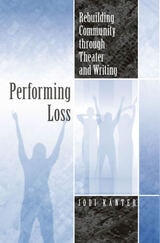
Performing Loss
Rebuilding Community through Theater and WritingJodi Kanter
Southern Illinois University Press, 2007
In Performing Loss: Rebuilding Community through Theater and Writing, author Jodi Kanter explores opportunities for creativity and growth within our collective responses to grief. Performing Loss provides teachers, students, and others interested in performance with strategies for reading, writing, and performing loss as communities—in the classroom, the theater, and the wider public sphere.
From an adaptation of Jose Saramago’s novel Blindness to a reading of Suzan-Lori Parks’s The America Play, from Kanter’s own experience creating theater with terminally ill patients and federal prisoners to a visual artist’s response to September 11th, Kanter shows in practical, replicable detail how performing loss with community members can transform experiences of isolation and paralysis into experiences of solidarity and action.
Drawing on academic work in performance, cultural studies, literature, sociology, and anthropology, Kanter considers a range of responses to grief in historical context and goes on to imagine newer, more collaborative, and more civically engaged responses. Performing Loss describes Kanter’s pedagogical and artistic processes in lively and vivid detail, enabling the reader to use her projects as models or to adapt the techniques to new communities, venues, and purposes. Kanter demonstrates through each example the ways in which writing and performing can create new possibilities for mourning and living together.
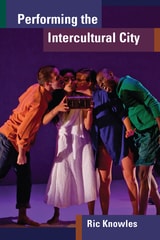
Performing the Intercultural City
Ric Knowles
University of Michigan Press, 2017
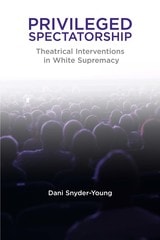
Privileged Spectatorship
Theatrical Interventions in White SupremacyDani Snyder-Young
Northwestern University Press, 2021
Many professional theater artists attempt to use live performances in formal theater spaces to disrupt racism and create a more equitable society. Privileged Spectatorship: Theatrical Interventions in White Supremacy examines the impact of such projects, looking at how and why they do and do not intervene in white supremacy. In this incisive study, Dani Snyder-Young examines audience responses to a range of theatrical events that focus on race‑related conflict or racial identity in the contemporary United States. The audiences for these performances, produced at mainstream not‑for‑profit professional theaters in major American cities in 2013–18, reflect dominant patterns of theater attendance: the majority of spectators are older, affluent, white, and describe themselves as politically progressive. Snyder-Young studies the ways these audience members consume the stories of racialized others and analyzes how different artistic, organizational, and programmatic strategies can (or cannot) mitigate white privilege.
This book is essential reading for scholars and students of theater, performance studies, and critical ethnic studies and for theater practitioners interested in equity and inclusion.
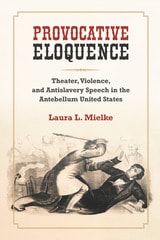
Provocative Eloquence
Theater, Violence, and Antislavery Speech in the Antebellum United StatesLaura L. Mielke
University of Michigan Press, 2019