248 books match the query 'Theology' and 9 start with p
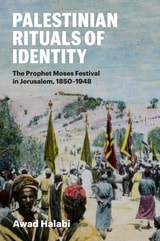
cover of Palestinian Rituals of Identity: The Prophet Moses Festival in Jerusalem, 1850-1948

Palestinian Rituals of Identity

The Prophet Moses Festival in Jerusalem, 1850-1948

Awad Halabi

University of Texas Press, 2023

Members of Palestine’s Muslim community have long honored al-Nabi Musa, or the Prophet Moses. Since the thirteenth century, they have celebrated at a shrine near Jericho believed to be the location of Moses’s tomb; in the mid-nineteenth century, they organized a civic festival in Jerusalem to honor this prophet. Considered one of the most important occasions for Muslim pilgrims in Palestine, the Prophet Moses festival yearly attracted thousands of people who assembled to pray, conduct mystical forms of worship, and hold folk celebrations.

Palestinian Rituals of Identity takes an innovative approach to the study of Palestine’s modern history by focusing on the Prophet Moses festival from the late Ottoman period through the era of British rule. Halabi explores how the festival served as an arena of competing discourses, with various social groups attempting to control its symbols. Tackling questions about modernity, colonialism, gender relations, and identity, Halabi recounts how peasants, Bedouins, rural women, and Sufis sought to influence the festival even as Ottoman authorities, British colonists, Muslim clerics, and Palestinian national leaders did the same. Drawing on extensive research in Arabic newspapers and Islamic and colonial archives, Halabi reveals how the festival has encapsulated Palestinians’ responses to modernity, colonialism, and the nation’s growing national identity.
[more]
cover of Peace in the Thought of Thomas Aquinas: Philosophy, Theology, and Ethics

Peace in the Thought of Thomas Aquinas

Philosophy, Theology, and Ethics

John M. Meinert

Catholic University of America Press, 2024
What does Aquinas have to teach us on the topic of peace? Looking over the scholarly literature, one would think very little. Most Thomists ignore Aquinas’s thought on peace. Most peace researchers summarily dismiss Aquinas. Peace in the Thought of Thomas Aquinas challenges both these trends and offers the first book length study of peace in Aquinas’s thought. John Meinert outlines Aquinas's historical predecessors, then provides an exposition and interpretation of the full scope of Aquinas's thought on peace: metaphysics, Trinitarian theology, Christology, Pneumatology, ecclesiology, natural theology, ethics, and sacramental theology. What emerges from this extended study is a new vision of Aquinas’s work. Peace in the Thought of Thomas Aquinas establishes Aquinas as an indispensable dialogue partner for anyone thinking rigorously about the theology, philosophy, and ethics of peace. As Aquinas himself says, “observe peace and you will come to salvation.”
[more]
cover of Plurality and Ambiguity: Hermeneutics, Religion, Hope

Plurality and Ambiguity

Hermeneutics, Religion, Hope

David Tracy

University of Chicago Press, 1994
In Plurality and Ambiguity, David Tracy lays the philosophical groundwork for a practical application of hermeneutics, while constructing an innovative model of theological interpretation developed out of the notions of conversation and argument. He concludes with an appraisal of the religious significance of hope in an age of radically different voices and constantly shifting meanings.
[more]
cover of Poetics of the Flesh

Poetics of the Flesh

Mayra Rivera

Duke University Press, 2015
In Poetics of the Flesh Mayra Rivera offers poetic reflections on how we understand our carnal relationship to the world, at once spiritual, organic, and social. She connects conversations about corporeality in theology, political theory, and continental philosophy to show the relationship between the ways ancient Christian thinkers and modern Western philosophers conceive of the "body" and "flesh.” Her readings of the biblical writings of John and Paul as well as the work of Tertullian illustrate how Christian ideas of flesh influenced the works of Maurice Merleau-Ponty and Michel Foucault, and inform her readings of Judith Butler, Frantz Fanon, and others. Rivera also furthers developments in new materialism by exploring the intersections among bodies, material elements, social arrangements, and discourses through body and flesh. By painting a complex picture of bodies, and by developing an account of how the social materializes in flesh, Rivera provides a new way to understand gender and race.
 
[more]
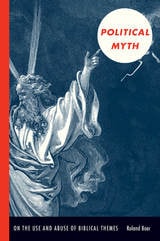
cover of Political Myth: On the Use and Abuse of Biblical Themes

Political Myth

On the Use and Abuse of Biblical Themes

Roland Boer

Duke University Press, 2009

In this provocative and necessary work, Roland Boer, a leading biblical scholar and cultural theorist, develops a political myth for the Left: a powerful narrative to be harnessed in support of progressive policy. Boer focuses on foundational stories in the Hexateuch, the first six books of the Bible, from Genesis through Joshua. He contends that the “primal story” that runs from Creation, through the Exodus, and to the Promised Land is a complex political myth, one that has been appropriated recently by the Right to advance reactionary political agendas. To reclaim it in support of progressive political ends, Boer maintains, it is necessary to understand the dynamics of political myth.

Boer elaborates a theory of political myth in dialogue with Ernst Bloch, Theodor Adorno, Alain Badiou, Jacques Lacan, and Slavoj Žižek. Through close readings of well-known biblical stories he then scrutinizes the nature of political myth in light of feminism, psychoanalysis, and Marxism. Turning to contemporary politics, he examines the statements of prominent American and Australian politicians to show how the stories of Creation, conquest, Paradise, and the Promised Land have been distorted into a fantasy of Israel as a perpetual state in the making and a land in need of protection. Boer explains how this fantasy of Israel shapes U.S. and Australian foreign and domestic policies, and he highlights the links between it and the fantasy of unfettered global capitalism. Contending that political myths have repressed dimensions which if exposed undermine the myths’ authority, Boer urges the Left to expose the weakness in the Right’s mythos. He suggests that the Left make clear what the world would look like were the dream of unconstrained capitalism to be realized.
[more]
cover of Possibilities for Over One Hundredfold More Spiritual Information: The Humble Approach in Theology and Science

Possibilities for Over One Hundredfold More Spiritual Information

The Humble Approach in Theology and Science

Sir John Templeton

Templeton Press, 2000
Sir John Templeton challenges the reader to apply the same energy that has been devoted to scientific inquiry to the pursuit of spiritual information. The world is at a state of unprecedented technical expertise, but why has our knowledge and faith in our own spirituality stalled and become obsolete in recent times?
Possibilities for Over One Hundredfold More Spiritual Information seeks to address this question. It points out that our spiritual knowledge would also have the capacity to increase dramatically if we were to open our minds to the endless possibilities that await us in terms of our spiritual lives. These include altruistic love for all people, new knowledge of the Divine, and a greater sense of our place in the universe. In order for us as human beings to take advantage of all of the spiritual gifts that we have been given, we need to be open and receptive to our individual spiritual natures, and to open ourselves to the limitless spiritual possibilities available to us.
The book acknowledges the ancient scriptures and thinkers who have guided us for centuries. Vastly expanded research and the use of scientific method would only enhance our understanding of the wisdom contained within these wise teachings. The benefits of extending our spiritual knowledge might, in fact, exceed the benefits we have realized thus far from scientific and medical advances.
Possibilities seeks to reawaken our desire for spiritual knowledge pushed aside so long ago in our quest for scientific knowledge. When these fields work together, the world will reap greater rewards that we can ever imagine.

[more]
cover of Postcolonial Perspectives in African Biblical Interpretations

Postcolonial Perspectives in African Biblical Interpretations

Musa W. Dube

SBL Press, 2012
This volume foregrounds biblical interpretation within the African history of colonial contact, from North Atlantic slavery to the current era of globalization. It reads of the prolonged struggle for justice and of hybrid identities from multifaceted contexts, where the Bible co-exists with African Indigenous Religions, Islam, and other religions. Showcasing the dynamic and creative approaches of an emerging and thriving community of biblical scholarship from the African continent and African diaspora, the volume critically examines the interaction of biblical texts with African people and their cultures within a postcolonial framework. While employing feminist/womanist, postcolonial, Afrocentric, social engagement, creative writing, reconstruction, and HIV/AIDS perspectives, the authors all engage with empire in their own ways: in specific times, forms, and geography. This volume is an important addition to postcolonial and empires studies in biblical scholarship. The contributors are David Tuesday Adamo, Lynn Darden, H. J. M. (Hans) van Deventer, Musa W. Dube, John D. K. Ekem, Ernest M. Ezeogu, Elelwani B. Farisani, Sylvester A. Johnson, Emmanuel Katongole, Malebogo Kgalemang, Temba L. J. Mafico, Madipoane Masenya (ngwan’a Mphahlele), Andrew M. Mbuvi, Sarojini Nadar, Elivered Nasambu-Mulongo, Jeremy Punt, Gerrie Snyman, Lovemore Togarasei, Sam Tshehla, Robert Wafawanaka, Robert Wafula, Gerald West, Alice Y. Yafeh-Deigh, and Gosnell L. Yorke.
[more]
cover of Primacies: Experience, Expression, and the Jewish Imagination

Primacies

Experience, Expression, and the Jewish Imagination

Michael Fishbane

University of Chicago Press, 2025

A powerful exploration of how literature expresses and transforms our earliest preverbal experiences.

Primacies begins with the assertion that our earliest preverbal experiences are accompanied by a primary language—a universal expression of tears, cries, and laughter offered long before we learn our distinctive, ordinary languages. For Michael Fishbane, these “primacies” release the raw feelings of our existential condition and catalyze our most powerful literary expressions of sorrow, joy, and fulfillment.

In this book, Fishbane explores how ancient, medieval, and modern literature and poetry express and transform these primal sensations. Building on his theological project begun in Sacred Attunement and Fragile Finitude, Fishbane offers here a radically new lived hermeneutics that seeks to do nothing less than redefine the relationship between experience and language.
[more]
cover of Protestant and Roman Catholic Ethics: Prospects for Rapprochement

Protestant and Roman Catholic Ethics

Prospects for Rapprochement

James M. Gustafson

University of Chicago Press, 1978

"If Catholic and Protestant ethicians were asked to name a single theologian who was qualified to write a comprehensive overview of the historical divergences of Catholic and Protestant positions on ethical questions, the bases for those divergences in fundamentally different philosophical and theological perspectives, and the possibilities for future convergences of the traditions, my guess is that James Gustafson would be the one. . . . This brilliant and tightly argued book . . . will be the most important book on moral theology to appear this year."—John Coleman, National Catholic Reporter
[more]