Results by title
56 books match the query 'Thought' and 5 start with p

Paul Klee
His Work and ThoughtMarcel Franciscono
University of Chicago Press, 1991
Marcel Franciscono offers an exhaustive historical and critical study of Klee's artistic personality and thought. Drawing extensively on documentation published since 1940, Franciscono highlights the extraordinary range of artistic, literary, and philosophical speculation Klee brought to his work. The portrait that emerges is one of a great comic artist, an ironist whose most characteristic pictures pit beauty of form and color against the dubious nature of things, yet one whose satiric depictions of everyday life extend to the most rarified evocations of nature.
[more]
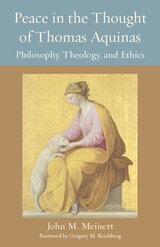
Peace in the Thought of Thomas Aquinas
Philosophy, Theology, and EthicsJohn M. Meinert
Catholic University of America Press, 2024
What does Aquinas have to teach us on the topic of peace? Looking over the scholarly literature, one would think very little. Most Thomists ignore Aquinas’s thought on peace. Most peace researchers summarily dismiss Aquinas. Peace in the Thought of Thomas Aquinas challenges both these trends and offers the first book length study of peace in Aquinas’s thought.
John Meinert outlines Aquinas's historical predecessors, then provides an exposition and interpretation of the full scope of Aquinas's thought on peace: metaphysics, Trinitarian theology, Christology, Pneumatology, ecclesiology, natural theology, ethics, and sacramental theology. What emerges from this extended study is a new vision of Aquinas’s work. Peace in the Thought of Thomas Aquinas establishes Aquinas as an indispensable dialogue partner for anyone thinking rigorously about the theology, philosophy, and ethics of peace. As Aquinas himself says, “observe peace and you will come to salvation.”
[more]
Philosophical Legacies
Essays on the Thought of Kant, Hegel, and Their Contemporaries (Studies in Philosophy and the History of Philosophy, Volume 50)Daniel O. Dahlstrom
Catholic University of America Press, 2008
The essays trace carefully the histories of the influences of earlier thinkers and their legacies upon later thinkers.
[more]
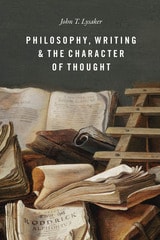
Philosophy, Writing, and the Character of Thought
John T. Lysaker
University of Chicago Press, 2018
Lysaker examines the relationship between philosophical thought and the act of writing to explore how this dynamic shapes the field of philosophy.
Philosophy’s relation to the act of writing is John T. Lysaker’s main concern in Philosophy, Writing, and the Character of Thought. Whether in Plato, Montaigne, Nietzsche, Wittgenstein, or Derrida, philosophy has come in many forms, and those forms—the concrete shape philosophizing takes in writing—matter. Much more than mere adornment, the style in which a given philosopher writes is often of crucial importance to the point he or she is making, part and parcel of the philosophy itself.
Considering how writing influences philosophy, Lysaker explores genres like aphorism, dialogue, and essay, as well as logical-rhetorical operations like the example, irony, and quotation. At the same time, he shows us the effects of these rhetorical devices through his own literary experimentation. In dialogue with such authors as Benjamin, Cavell, Emerson, and Lukács, he aims to revitalize philosophical writing, arguing that philosophy cannot fulfill its intellectual and cultural promise if it keeps to professional articles and academic prose. Instead, philosophy must embrace writing as an essential, creative activity, and deliberately reform how it approaches its subject matter, readership, and the evolving social practices of reading and reflection.
[more]
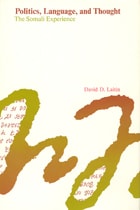
Politics, Language, and Thought
The Somali ExperienceDavid D. Laitin
University of Chicago Press, 1977
When the Somali Republic received independence, its parliamentary government decided to adopt three official languages: English, Italian, and Arabic—all languages of foreign contact. Since the vast majority of the nation's citizens spoke a single language, Somali, which then had no written form, this decision made governing exceedingly difficult. Selecting any one language was equally problematic, however, because those who spoke the official language would automatically become the privileged class.
Twelve years after independence, a military government was able to settle the acrimonious controversy by announcing that Somali would be the official language and Latin the basic script. It was hoped that this choice would foster political equality and strengthen the national culture. Politics, Language, and Thought is an exploration of how language and politics interrelate in the Somali Republic. Using both historical and experimental evidence, David D. Laitin demonstrates that the choice of an official language may significantly affect the course of a country's political development.
Part I of Laitin's study is an attempt to explain why the parliamentary government was incapable of reaching agreement on a national script and to assess the social and political consequences of the years of nondecision. Laitin shows how the imposition of nonindigenous languages produced inequalities which eroded the country's natural social basis of democracy.
Part 2 attempts to relate language to political thought and political culture. Analyzing interviews and role-playing sessions among Somali bilingual students, Laitin demonstrates that the impact of certain political concepts is quite different when expressed in different languages. He concludes that the implications of choosing a language are far more complex than previously thought, because to change the language of a people is to change the ways they think and act politically.
[more]