Results by title
124 books match the query 'Twenty - First Century' and 5 start with p
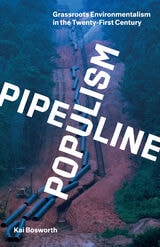
Pipeline Populism
Grassroots Environmentalism in the Twenty-First CenturyKai Bosworth
University of Minnesota Press, 2022
How contemporary environmental struggles and resistance to pipeline development became populist struggles
Stunning Indigenous resistance to the Keystone XL and the Dakota Access pipelines has made global headlines in recent years. Less remarked on are the crucial populist movements that have also played a vital role in pipeline resistance. Kai Bosworth explores the influence of populism on environmentalist politics, which sought to bring together Indigenous water protectors and environmental activists along with farmers and ranchers in opposition to pipeline construction.
Here Bosworth argues that populism is shaped by the “affective infrastructures” emerging from shifts in regional economies, democratic public-review processes, and scientific controversies. With this lens, he investigates how these movements wax and wane, moving toward or away from other forms of environmental and political ideologies in the Upper Midwest. This lens also lets Bosworth place populist social movements in the critical geographical contexts of racial inequality, nationalist sentiments, ongoing settler colonialism, and global empire—crucial topics when grappling with the tensions embedded in our era’s immense environmental struggles.
Pipeline Populism reveals the complex role populism has played in shifting interpretations of environmental movements, democratic ideals, scientific expertise, and international geopolitics. Its rich data about these grassroots resistance struggles include intimate portraits of the emotional spaces where opposition is first formed. Probing the very limits of populism, Pipeline Populism presents essential work for an era defined by a wave of people-powered movements around the world.
Postcolonial Disaster
Narrating Catastrophe in the Twenty-First CenturyPallavi Rastogi
Northwestern University Press, 2020
Rastogi creates a narratology for postcolonial disaster fiction and brings concepts from Disaster Studies into the realm of literary analysis.
Practice Under Pressure
Primary Care Physicians and Their Medicine in the Twenty-first CenturyHoff, Timothy
Rutgers University Press, 2009
Prometheus Reimagined
Technology, Environment, and Law in the Twenty-first CenturyAlbert C. Lin
University of Michigan Press, 2013
Technologies such as synthetic biology, nanotechnology, artificial intelligence, and geoengineering promise to address many of our most serious problems, yet they also bring environmental and health-related risks and uncertainties. Moreover, they can come to dominate global production systems and markets with very little public input or awareness. Existing governance institutions and processes do not adequately address the risks of new technologies, nor do they give much consideration to the concerns of persons affected by them.
Instead of treating technology, health, and the environment as discrete issues, Albert C. Lin argues that laws must acknowledge their fundamental relationship, anticipating both future technological developments and their potential adverse effects. Laws should encourage international cooperation and the development of common global standards, while allowing for flexibility and reassessment.
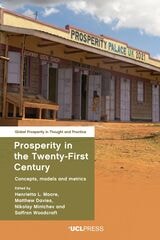
Prosperity in the Twenty-First Century
Concepts, Models and MetricsEdited by Henrietta L. Moore, Matthew Davies, Nikolay Mintchev, and Saffron Woodcraft
University College London, 2023
Prosperity in the Twenty-First Century sets out a new vision for prosperity in the twenty-first century and how it can be achieved for all. The volume challenges orthodox understandings of economic models but goes beyond contemporary debates to show how social innovation drives economic value. Drawing on substantive research in the UK, Lebanon, and Kenya, it develops new concepts, frameworks, models, and metrics for prosperity across a wide range of contexts, emphasizing commonalities and differences. Departing from general propositions about post-growth to delineate pathways to prosperity, the volume emphasizes that visions of the good life are diverse and require empirical work co-designed with local communities and stakeholders to drive change. It will be essential reading for policymakers who are stuck, local government officers who need new tools, activists who wonder what is next, academics in need of refreshment, and students and people of all ages who want a way forward.