Results by title
97 books match the query 'United States. Congress' and 7 start with p
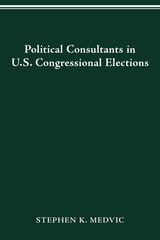
POLITICAL CONSULTANTS IN US CONGRESS ELECTIONS
STEPHEN K. MEDVIC
The Ohio State University Press, 2001
Political Consultants in U.S. Congressional Elections answers two simple questions: What do professional political consultants do? and How successful are they? Medvic analyzes the way consultants shape political dialogue and uses empirical data to show the benefits—and limits—of a consultant's involvement in a campaign. He focuses on issues as diverse as vote shares, outcomes, and fundraising. Finally, the author demonstrates how the adversarial nature of campaigns fosters the kind of electioneering advocated by most political consultants and argues that this process may not be as harmful for the country as is often suggested.

POWER OF THE PEOPLE
Congressional Competition, Public Attention, and Voter RetributionSean M. Theriault
The Ohio State University Press, 2005

Poindexter of Washington
A Study in Progressive PoliticsHoward W Allen
Southern Illinois University Press, 1981
In this study of Miles Poindexter, Insurgent Republican turned conservative, Howard W. Allen reaches beyond the traditional bounds of biography to present a history of the United States Congress during the Progressive era and the early years after World War I.
A congressman (1909–13)and a senator (1913–23), Miles Poindexter of Washington State was an outspoken, progressive reformer before World War I. He struggled to protect “the people” from “special interests,” particularly defending the interest of his section against eastern “colonialism.” A man with a penchant for absolute positions, Poindexter became caught up in the emotionalism of the Insurgent Republican revolt. At one time or another he championed Socialists, the IWW, the striking textile workers in Lawrence, Massachusetts—all unlikely causes for a middle-class lawyer from Spokane.
Regarding foreign policy, Poindexter was an uncompromising nationalist who, with Theodore Roosevelt, declared himself a member of the Progressive party in 1912.
After 1917 Poindexter actively tried to suppress opponents of the war. Following the war his targets were “Bolshevists” and other radicals. He also developed intense hostility toward Socialists, the IWW, and organized labor, fearing radicalism and labor. Reversing his former position, he allied himself with the eastern businessmen and regular Republicans in the Senate. Campaigning for the presidency in 1920, he appealed without success to the most conservative members of the party. He was defeated b a progressive Democrat in his 1922 bid for reelection to the Senate.
Allen examines the traditional sources—archival collections, newspaper files, and congressional reports. When he combines this material with a quantitative analysis of roll-call votes throughout Senator Poindexter’s years in Congress, he creates a remarkably useful method never before attempted in political biography.
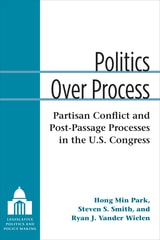
Politics Over Process
Partisan Conflict and Post-Passage Processes in the U.S. CongressHong Min Park, Steven S. Smith, and Ryan J. Vander Wielen
University of Michigan Press, 2018
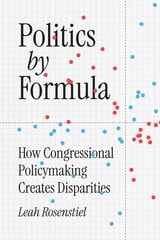
Politics by Formula
How Congressional Policymaking Creates DisparitiesLeah Rosenstiel
University of Chicago Press, 2026
A clear-eyed study that reveals how politics shapes and often distorts important federal programs, driving inequalities across states.
From Medicaid to Section 8 Housing Choice Vouchers, a large percentage of the annual US federal budget (approximately $1 trillion) is distributed through grants-in-aid, a policy tool that allocates aid to state and local governments rather than to individual Americans. When members of Congress use grants-in-aid to fund healthcare, housing, and other forms of support, they are not solely determining how much assistance one person receives. Instead, they can allot certain localities larger grants, which carry big implications for the quality of public services available to citizens living in different states.
Many reasonably assume that these assistance programs distribute funding to states impartially because they use statistical formulas based on population levels, poverty, and other characteristics that, ostensibly, measure need. However, in Politics by Formula, Leah Rosenstiel shows how this seemingly technocratic aspect of federal policymaking is deeply affected by both the structure of political institutions and the motivations of elected officials. Key congressional committees—and especially their leaders—design formulas to benefit their constituencies. Superficially neutral formulas can shield these political decisions from scrutiny, but formulas also constrain congressmembers. Drawing on formal modeling and quantitative and qualitative evidence, Rosenstiel elucidates how these dynamics shape whose and what needs are met and where.
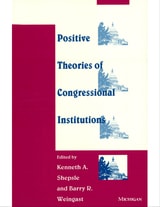
Positive Theories of Congressional Institutions
Kenneth A. Shepsle and Barry R. Weingast, Editors
University of Michigan Press, 1995
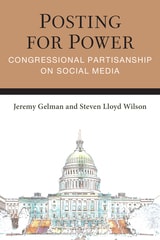
Posting for Power
Congressional Partisanship on Social MediaJeremy Gelman and Steven Lloyd Wilson
University of Michigan Press, 2026
In the US Congress, lawmakers regularly choose to bicker for political gain, whether or not they disagree on issues. By classifying millions of social media posts as partisan or not, Gelman and Wilson quantify a legislator’s partisan intensity through the time and effort they spend supporting their party and bickering with the opposition. The authors argue that the partisan personas politicians create are both a home style, to help them win reelection, and hill style, to help them become politically influential by showing off as good team players. Bringing together a wide range of data on leadership races, elections, voting records, cosponsorship patterns, and lawmaking outcomes, they demonstrate the nearly consequence-free way that legislators strategically deploy partisanship to impress their copartisans and voters. Gelman and Wilson closely examine what motivates members to differ so much in developing this part of their public personas and offer clear recommendations for how to turn down the partisan heat on Capitol Hill.