Results by title
75 books match the query 'United States. Supreme Court' and 6 start with p
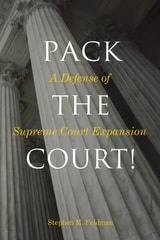
Pack the Court!
A Defense of Supreme Court ExpansionStephen M. Feldman
Temple University Press, 2021
The United States Supreme Court has numbered nine justices for the past 150 years. But that number is not fixed. With the Democrats controlling the House and Senate during the Biden presidency, they could add justices to the Supreme Court. But would court packing destroy the Court as an apolitical judicial institution? This is the crucial question Stephen Feldman addresses in his provocative book, Pack the Court! He uses a historical, analytical, and political argument to justify court-packing in general and Democratic court-packing more specifically.
Republicans and Democrats alike profess to worry that court-packing will destroy the legitimacy of the Supreme Court as a judicial institution by injecting politics into a purely legal adjudicative process. But as Feldman’s insightful book shows, law and politics are forever connected in judicial interpretation and decision making. Pack the Court! insists that court packing is not the threat to the Supreme Court’s institutional legitimacy that many fear. Given this, Feldman argues that Democrats should pack the Court while they have the opportunity. Doing so might even strengthen the American people’s faith in the Court.
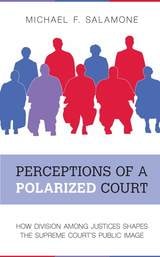
Perceptions of a Polarized Court
How Division among Justices Shapes the Supreme Court's Public ImageMichael F. Salamone
Temple University Press, 2018
Like our divided nation, the Supreme Court is polarized. But does a split among Supreme Court justices—particularly when it occurs along ideological lines—hurt public perception and the Court’s ability to muster popular support for its rulings? Michael Salamone’s Perceptions of a Polarized Court offers the first comprehensive, empirical analysis of how divisiveness affects the legitimacy of the Court’s decisions.
Salamone looks specifically at the Roberts Court years—which are characterized by unprecedented ideological and partisan polarization among the justices—to evaluate the public consequences of divided Supreme Court rulings. He also analyzes both the media’s treatment of Supreme Court decisions and public opinion toward the Court’s rulings to show how public acceptance is (or is not) affected.
Salmone contends that judicial polarization has had an impact on the manner in which journalists report on the Supreme Court. However, contrary to expectation, Court dissent may help secure public support by tapping into core democratic values.
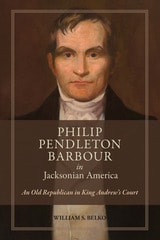
Philip Pendleton Barbour in Jacksonian America
An Old Republican in King Andrew’s CourtWilliam S. Belko
University of Alabama Press, 2016
Barbour, a Virginia lawyer, participated in America’s transition from a mostly republican government to a truer majority democracy, notably while serving as the twelfth Speaker of the United States House of Representatives and later as an associate justice of the United States Supreme Court. After being elected to the US Congress during the War of 1812, Barbour also emerged as one of the foremost champions of states’ rights, consistently and energetically fighting against expansions of federal powers. He, along with other Jeffersonian Old Republicans, opposed federal plans for a national tariff and internal improvements. Later, Barbour became one of the first Jeffersonian politicians to join the Jacksonian Democrats in Jackson’s war against a national bank.
Barbour continued to make crucial strides in support of states’ rights after taking his seat on the United States Supreme Court in 1836 under Chief Justice Roger Taney. He contributed to the Charles River Bridge v. Warren Bridge and Briscoe v. Bank of Kentucky decisions, which bolstered states’ rights. He also delivered the opinion of the court in New York v. Miln, which provided the basis for the State Police Powers Doctrine.
Expertly interweaving biography, history, political science, and jurisprudence, Philip Pendleton Barbour in Jacksonian America remembers the man whose personal life and career were emblematic of the decades in which the United States moved from the Age of Jefferson to the Age of Jackson, contributing to developments that continue to animate American politics today.

Politics and the Constitution in the History of the United States, Volume 3
The Political Background of the Federal ConventionWilliam W. Crosskey and William Jeffrey
University of Chicago Press, 1980
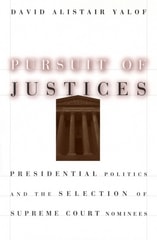
Pursuit of Justices
Presidential Politics and the Selection of Supreme Court NomineesDavid Alistair Yalof
University of Chicago Press, 1999
Yalof draws on the papers of seven modern presidents, from Truman to Reagan, and firsthand interviews with key figures, such as Ramsey Clark, Edwin Meese, and President Gerald Ford. He documents and analyzes the selection criteria these presidents used, the pool of candidates from which they chose, their strategies, and the political pressures affecting their decisions, both successes and failures. Yalof also disputes much conventional wisdom about the selection process, including the widely held view that presidents choose nominees primarily to influence future decisions of the high court. In a substantial epilogue, Yalof offers insightful observations about the selections of Presidents George Bush and Bill Clinton.
By focusing on a neglected area of presidential politics, Yalof offers a fascinating and unprecedented glimpse into the intricate world of executive branch decisionmaking and the Supreme Court appointment process as a whole.
Winner of the 2000 Richard E. Neustadt Award for Best Book on the American Presidency
Pushback
The Political Fallout of Unpopular Supreme Court DecisionsDave Bridge
University of Missouri Press, 2024
Certain to appeal to anyone interested in American political science and history, Pushback closes with a detailed examination of the unequivocally countermajoritarian Supreme Court ruling of our lifetimes, Dobbs v. Jackson Women’s Health Organization, which overturned Roe. For the first time in 50 years, conditions are ripe for a party to win votes by campaigning against the will of the Court. Upcoming elections will tell if the Republicans overplayed their hand, or if Democrats will play theirs as skillfully as did the GOP after Roe.