161 books match the query 'Universities and colleges' and 9 start with p

cover of Paying the Piper: Productivity, Incentives, and Financing in U.S. Higher Education

Paying the Piper

Productivity, Incentives, and Financing in U.S. Higher Education

Michael S. McPherson, Morton Owen Schapiro, and Gordon C. Winston, Editors

University of Michigan Press, 1994
Rising tuitions and shrinking government budgets have pushed questions about productivity and resource use in U.S. higher education to the fore. In Paying the Piper three distinguished researchers examine the many successes of U.S. higher education, identify real problems, and carefully analyze potential solutions. Among the questions addressed are: On what do colleges and universities spend their money and how have their spending patterns changed over time; what does "quality" really mean in higher education and how is it related to price and cost; what are appropriate measures of "productivity"; and does increasing the amount of federal financial aid encourage colleges to raise their tuitions? The essays comprising this volume demonstrate that the application of basic economic principles and a combination of both descriptive and econometric analyses can illuminate a number of issues. Using economic concepts and tools to provide insight into these pressing questions, Paying the Piper helps us to understand the recent past, anticipate the future, and develop policies that can influence the future.
[more]
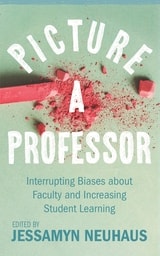
cover of Picture a Professor: Interrupting Biases about Faculty and Increasing Student Learning

Picture a Professor

Interrupting Biases about Faculty and Increasing Student Learning

Jessamyn Neuhaus

West Virginia University Press, 2022

“Does a service to all who would prefer a different path, offering realistic strategies to engage students in undermining scholarly stereotypes.”—Science

Picture a Professor is a collection of evidence-based insights and intersectional teaching strategies crafted by and for college instructors. It aims to inspire transformative student learning while challenging stereotypes about what a professor looks like.

Representing a variety of scholarly disciplines, the volume’s contributing authors offer practical advice for effectively navigating student preconceptions about embodied identity and academic expertise. Each contributor recognizes the pervasiveness of racialized, gendered, and other biases about professors and recommends specific ways to respond to and interrupt such preconceptions—helping students, teachers, and others reenvision what we think of when we picture a professor.

Educators at every stage of their career will find affirming acknowledgment of the ways systemic inequities affect college teaching conditions, as well as actionable advice about facilitating student learning with innovative course design, classroom activities, assessment techniques, and more.

[more]
cover of Poison in the Ivy: Race Relations and the Reproduction of Inequality on Elite College Campuses

Poison in the Ivy

Race Relations and the Reproduction of Inequality on Elite College Campuses

Byrd, W. Carson

Rutgers University Press, 2017

The world of elite campuses is one of rarified social circles, as well as prestigious educational opportunities. W. Carson Byrd studied twenty-eight of the most selective colleges and universities in the United States to see whether elite students’ social interactions with each other might influence their racial beliefs in a positive way, since many of these graduates will eventually hold leadership positions in society. He found that students at these universities believed in the success of the ‘best and the brightest,’ leading them to situate differences in race and status around issues of merit and individual effort.

Poison in the Ivy challenges popular beliefs about the importance of cross-racial interactions as an antidote to racism in the increasingly diverse United States. He shows that it is the context and framing of such interactions on college campuses that plays an important role in shaping students’ beliefs about race and inequality in everyday life for the future political and professional leaders of the nation. Poison in the Ivy is an eye-opening look at race on elite college campuses, and offers lessons for anyone involved in modern American higher education.  
 
[more]
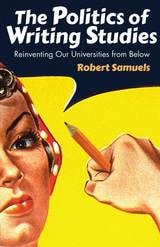
cover of Politics of Writing Studies: Reinventing Our Universities from Below

Politics of Writing Studies

Reinventing Our Universities from Below

Robert Samuels

Utah State University Press, 2017

A friendly critique of the field, The Politics of Writing Studies examines a set of recent pivotal texts in composition to show how writing scholarship, in an effort to improve disciplinary prestige and garner institutional resources, inadvertently reproduces structures of inequality within American higher education. Not only does this enable the exploitation of contingent faculty, but it also puts writing studies—a field that inherently challenges many institutional hierarchies—in a debased institutional position and at odds with itself.

Instead of aligning with the dominant paradigm of research universities, where research is privileged over teaching, theory over practice, the sciences over the humanities, and graduate education over undergraduate, writing studies should conceive itself in terms more often associated with labor. By identifying more profoundly as workers, as a collective in solidarity with contingent faculty, writing professionals can achieve solutions to the material problems that the field, in its best moments, wants to address. Ultimately, the change compositionists want to see in the university will not come from high theory or the social science research agenda; it must come from below.

Offering new insight into a complex issue, The Politics of Writing Studies will be of great interest to writing studies professionals, university administrators, and anyone interested in the political economy of education and the reform of institutions of higher education in America.
[more]
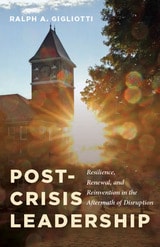
cover of Post-Crisis Leadership: Resilience, Renewal, and Reinvention in the Aftermath of Disruption

Post-Crisis Leadership

Resilience, Renewal, and Reinvention in the Aftermath of Disruption

Ralph A. Gigliotti

Rutgers University Press, 2025
Given the many pressures facing leaders across higher education, the work of crisis leadership remains an imperative for leaders at all levels. Attention tends to center on strategies for engaging in leadership both prior to and during crisis, often leaving the post-crisis period as an afterthought. This book introduces a research-informed framework for this critical, and often neglected, phase of crisis leadership. With an underlying commitment to values-based, principle-oriented, and people-centered practices, this framework consists of five leadership practices that are recognized as especially critical in the aftermath of crisis: (a) encourage learning, (b) inspire growth, (c) stimulate meaning-making, (d) pursue reinvention, and (e) advance renewal. Communication serves a critical role in each of the various dimensions of post-crisis leadership, and it is a communication orientation that can help to inform the paradoxes, processes, and patterns that arise during these periods of immense tension and, at times, transcendence.
 
[more]
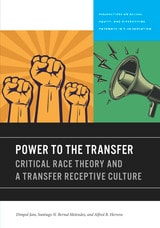
cover of Power to the Transfer: Critical Race Theory and a Transfer Receptive Culture

Power to the Transfer

Critical Race Theory and a Transfer Receptive Culture

Dimpal Jain

Michigan State University Press, 2020

Currently, U.S. community colleges serve nearly half of all students of color in higher education who, for a multitude of reasons, do not continue their education by transferring to a university. For those students who do transfer, often the responsibility for the application process, retention, graduation, and overall success is placed on them rather than their respective institutions. This book aims to provide direction toward the development and maintenance of a transfer receptive culture, which is defined as an institutional commitment by a university to support transfer students of color. A transfer receptive culture explicitly acknowledges the roles of race and racism in the vertical transfer process from a community college to a university and unapologetically centers transfer as a form of equity in the higher education pipeline. The framework is guided by critical race theory in education, which acknowledges the role of white supremacy and its contemporary and historical role in shaping institutions of higher learning.
[more]
cover of Preparing Students to Engage in Equitable Community Partnerships: A Handbook

Preparing Students to Engage in Equitable Community Partnerships

A Handbook

Elizabeth A. Tryon

Temple University Press, 2023

When done properly, community engagement in academia can have value for all stakeholders. Authentic experiences are more useful for students; faculty can add new knowledge to the field and their own toolbelts; and communities feel their investment has generated a useful deliverable or even a long-term partnership.

Preparing Students to Engage in Equitable Community Partnerships provides a wealth of valuable resources and activities to help impart ideas of identity, privilege, oppression, bias, and power dynamics to best support students and community in these relationships. Believing that authenticity only comes about in an atmosphere of mutual respect and self-awareness, the authors argue for cultural and intellectual humility.

Each chapter looks at topics and issues through different lenses, complete with underlying theories, and relates those discussions to concrete classroom activities, facilitation strategies, and scholarly frames. In addition, the authors include contributions from a diverse group of practitioners at community colleges, private colleges, historically Black colleges and universities, and minority-serving institutions.

Preparing Students to Engage in Equitable Community Partnerships is a much-needed, comprehensive resource for community-engaged professionals as they prepare students for building relationships when entering a community for learning or research purposes.
[more]
cover of Principled University Leadership: Critical Decision-Making in Academia

Principled University Leadership

Critical Decision-Making in Academia

Marc A. Johnson

University of Nevada Press, 2025

Principled University Leadership: Critical Decision-Making in Academia is a personal account by university president Marc A. Johnson that draws on his extensive experience in academic administration. The book delves into four major themes: traits that lead individuals into leadership roles; economic principles influencing university decision-making; practical leadership strategies for fostering institutional progress; and approaches to navigating today’s critical challenges, including DEI and free speech. 

Rooted in Johnson’s small-town origins and passion for civic engagement, this narrative offers unique insights into the path to university leadership and the key decisions leaders face. It is an invaluable resource for aspiring and current academic leaders seeking guidance in navigating the complexities of higher education.

 
[more]
cover of Professor Superstar: Fandom and Anti-Fandom of Academia

Professor Superstar

Fandom and Anti-Fandom of Academia

Mel Stanfill

University of Michigan Press, 2026

Examining celebrity and fan studies together, Professor Superstar argues that academia shares key traits with fandom, including collective emotional investment, shared interpretation of texts, and identity formation. Universities are often seen as isolated from everyday life, creating an atmosphere of both fascination and resentment. Some academics even go on to become field-specific microcelebrities. Some celebrate their influence while others resent their prominence, leading to both fandom and anti-fandom and reflecting broader social struggles as universities become battlegrounds for economic and political debates. The audiences engaging with academia extend beyond the students and faculty directly involved, creating multiple and conflicting interpretations of what academia represents. Public perceptions of academia are shaped less by its reality than by competing narratives about its role in society. By taking these dynamics seriously, we can better understand the cultural forces shaping both admiration and hostility toward higher education.
[more]