Results by title
66 books match the query 'Veterans' and 4 start with p
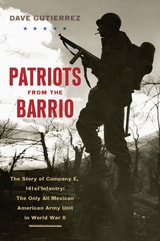
Patriots from the Barrio
The Story of Company E, 141st Infantry: The Only All Mexican American Army Unit in World War IIDave Gutierrez
Westholme Publishing, 2018
The Inspiring True Story of a Segregated Unit Whose Exploits Underscore the Forgotten Latino Contribution to the Allied Victory in World War II
As a child, Dave Gutierrez hung on every word his father recalled about his cousin Ramon, “El Sancudo” (the mosquito), and his service in World War II, where he earned a Silver Star, three Purple Hearts, and escaped from the Germans twice. Later, Dave decided to find out more about his father’s cousin, and in the course of his research he discovered that Ramon Gutierrez was a member of Company E, 141st Infantry, a part of the 36th “Texas” Division that was comprised entirely of Mexican Americans—the only such unit in the entire U.S. Army. The division landed at Salerno, Italy, in 1943, among first American soldiers to set foot in Europe. In the ensuing months, Company E and the rest of the 36th would battle their way up the mountainous Italian peninsula against some of Nazi Germany’s best troops. In addition to the merciless rain, mud, and jagged peaks, swift cold rivers crisscrossed the region, including the Rapido, where Company E would face its greatest challenge. In an infamous episode, the 36th Division was ordered to cross the Rapido despite reports that the opposite bank was heavily defended. In the ensuing debacle, the division was ripped apart, and Company E sustained appalling casualties. The company rebounded and made the storied landings at Anzio and ultimately invaded southern France for a final push into Germany. The men of Company E distinguished themselves as rugged fighters capable of warring amid the rubble of destroyed villages and in the devastated countryside.
Based on extensive archival research and veteran and family accounts, Patriots from the Barrio: The Story of Company E, 141st Infantry: The Only All Mexican American Army Unit in World War II brings to life the soldiers whose service should never have gone unrecognized for so long. With its memorable personalities, stories of hope and immigration, and riveting battle scenes, this beautifully written book is a testament to the shared beliefs of all who have fought for the ideals of the American flag.
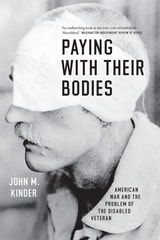
Paying with Their Bodies
American War and the Problem of the Disabled VeteranJohn M. Kinder
University of Chicago Press, 2015
America has grappled with the questions posed by injured veterans since its founding, and with particular force since the early twentieth century: What are the nation’s obligations to those who fight in its name? And when does war’s legacy of disability outweigh the nation’s interests at home and abroad? In Paying with Their Bodies, John M. Kinder traces the complicated, intertwined histories of war and disability in modern America. Focusing in particular on the decades surrounding World War I, he argues that disabled veterans have long been at the center of two competing visions of American war: one that highlights the relative safety of US military intervention overseas; the other indelibly associating American war with injury, mutilation, and suffering. Kinder brings disabled veterans to the center of the American war story and shows that when we do so, the history of American war over the last century begins to look very different. War can no longer be seen as a discrete experience, easily left behind; rather, its human legacies are felt for decades.
The first book to examine the history of American warfare through the lens of its troubled legacy of injury and disability, Paying with Their Bodies will force us to think anew about war and its painful costs.
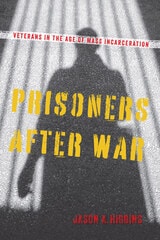
Prisoners after War
Veterans in the Age of Mass IncarcerationJason A. Higgins
University of Massachusetts Press, 2024
Winner of the 2025 Oral History Association Book Award • Winner of Virginia Tech's Albert Lee Sturm Award for Faculty Excellence • Finalist for the 2026 Veterans Studies Association Distinguished Book Award • Honorable Mention, National Council on Public History Book Award
The United States has both the largest, most expensive, and most powerful military and the largest, most expensive, and most punitive carceral system in the history of the world. Since the American War in Vietnam, hundreds of thousands of veterans have been incarcerated after their military service.
Identifying the previously unrecognized connections between American wars and mass incarceration, Prisoners after War reaches across lines of race, class, and gender to record the untold history of incarcerated veterans over the past six decades. Having conducted dozens of oral history interviews, Jason A. Higgins traces the lifelong effects of war, inequality, disability, and mental illness, and explores why hundreds of thousands of veterans, from Vietnam to Afghanistan, were caught up in the carceral system. This original study tells an intergenerational history of state-sanctioned violence, punishment, and inequality, but its pages also resonate with stories of survival and redemption, revealing future possibilities for reform and reparative justice.
Pulpits of the Lost Cause
The Faith and Politics of Former Confederate Chaplains during ReconstructionSteve Longenecker
University of Alabama Press, 2023
A comparison of the faith and politics of former Confederate chaplains with intriguing insights about the evolution of their postwar beliefs and the Lost Cause
Pulpits of the Lost Cause: The Faith and Politics of Former Confederate Chaplains during Reconstruction is the first in-depth study of former chaplains that juxtaposes their religion and politics, thereby revealing important insights about the Lost Cause movement. Steve Longenecker demonstrates that while some former chaplains vigorously defended the Lost Cause and were predictably conservative in the pulpit, embracing orthodoxy and resisting religious innovation, others were unexpectedly progressive and advocated on behalf of evolution, theological liberalism, and modern biblical criticism.
Former Confederate chaplains embodied both the distinctive white, Southern, regional identity and the variation within it. Most were theologically conservative and Lost Cause racists. But as with the larger South, variation abounded. The Lost Cause, which Longenecker interprets as a broad popular movement with numerous versions, meant different things to different chaplains. It ranged from diehard-ism to tempered sectional forgiveness to full reconciliation to a harmless once-a-year Decoration Day ritual.
This volume probes the careers of ten former chaplains, including their childhoods, wartime experiences, Lost Cause personas, and theologies, making use of manuscripts and published sermons as well as newspapers, diaries, memoirs, denominational periodicals, letters, and the books they themselves produced. In theology, many former chaplains were predictably conservative, while others were unexpectedly broad-minded and advocated evolution, theological liberalism, and modern Biblical criticism. One former chaplain became a social-climbing Harvard progressive. Another wrote innovative, liberal theology read by European scholars. Yet another espoused racial equality, at least in theory if not full practice. Additionally, former chaplains often exhibited the fundamental human trait of compartmentalization, most notably by extolling the past as they celebrated the Lost Cause while simultaneously looking to the future as religious progressives or New South boosters. The stereotypical preacher of the Lost Cause—a gray-clad Bible thumper—existed sufficiently to create the image but hardly enough to be universally accurate.